.png)

Blaming Yourself First is Empowerment, Not Masochism
We know risks exist but still overreact emotionally and outsource responsibility. When we can turn losses into tuition, instead of excuses. We just need to play the probabilistic game.

Kirti Tarang Pande is a psychologist, researcher, and brand strategist specialising in the intersection of mental health, societal resilience, and organisational behaviour.
March 28, 2026 at 5:59 AM IST
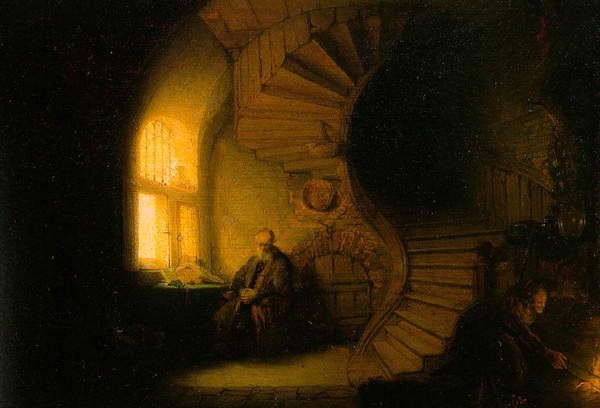
In the Louvre museum, Paris, hangs a small oil painting by Rembrandt. Not much bigger than your laptop screen. It´s called Philosopher in Meditation. The scene is claustrophobic with the heavy shadows, the massive staircase, the flickering fire and yet the philosopher remains utterly composed, bathed in golden clarifying light. He is not reacting to the “downs” or the unknown path ahead; he is just witnessing, discerning, and abiding in presence.
Most of us are NOT that man. Most of us never manage that stillness. Most of us intellectually accept volatility ("markets will go up and down," just like "there might be supply pressures from geopolitics"), but emotionally, we often can't handle the downsides without overreacting.
But why do we do this? Why do we emotionally overreact to anticipated downside in high-uncertainty environments despite prior knowledge of volatility or scarcity risks?
We enter the markets knowing that they go up and down. We quote the statistics, nod at the charts, even price in volatility with options and stops. Then the first real drawdown hits and we behave like the crowd in that viral video from petrol pumps last week.
When Prime Minister Narendra Modi stood in Parliament and said: “Prepare for a long battle like COVID.” Within hours, we were queuing for kilometres at petrol pumps. Motorcycles wedged between cars. Families filling every jerry can they owned. Social media filled with rumours of shortages. The same officials who had just spoken then begged, “Don’t panic, reserves are fine.” But it was too late. The words “long battle” had already flipped the switch from rational adult to survival mode. Every tank became a bucket. Every bucket became proof that a crisis is here.
And, you do the exact same thing with your portfolio.
You check prices ten times before lunch. You doom-scroll every macro headline. When oil prices wobble because of Middle East tensions, you latch onto any flicker of hope- “Trump just announced a five-day pause in hostilities”- and then, you tell yourself the crisis is solved.
This is because you are not looking for the truth. You are looking for relief. And that´s why that single tweet from Trump becomes your emotional life raft. And, when the pause ends and prices move again, the rage turns outward: regulators failed, the government is asleep, the system is rigged.
You call it market failure. Why can´t you take personal accountability and say, "It's my decision failure”?
You know volatility exists the way we know monsoons come every year. Yet the moment the downside appears, loss aversion takes the wheel. This ´Loss aversion´ is a "trick" our brains play on us. It makes the "ouch" of losing something feel much bigger than the "yay" of getting something new. Sometimes we might not want to play a new game because we're worried about losing, even if winning would be really fun. So, we continue treating markets like a casino hoping for constant wins, not a probabilistic game where losing periods test discipline.
That´s why, when the pain of a 5% drop feels twice as sharp as the pleasure of a 5% gain. So the mind does what it always does under threat, it hunts for someone else to blame. Like Ross asking in FRIENDS, “whom shall I say tricked me?” But the problem with externalizing is that when you blame "the market," "the algorithms," or "the experts" instead of your own strategy you fall into a trap. Because if it's someone else's fault, you don't feel the need to change your behavior, which leads to repeating the same mistakes.
Once you are in "threat mode," your brain stops being objective. You fixate on negative headlines that "prove" the world is against you. And, you ignore positive data because it doesn't fit your current feeling of being "tricked." In therapy talk we call it looking at the world through the filter of confirmation bias.
You stay obsessed with the price you paid, rather than what the asset is worth now. Because losing feels so bad, you refuse to sell a "loser" stock, hoping it will come back so you don't have to admit the loss. This is how a small 5% drop can turn into a much larger, "bleeding" disaster.
And that´s why we need to change our approach from blaming others to taking the blame. It's the only way to win. Because if the loss is your fault, you have the power to fix it. If the loss is "their" fault, you are just a helpless victim of the market.
By "blaming yourself first," you stop being a passenger to your biases and start making logical, disciplined decisions.
After all, we are from the land of Sāṃkhya Yog. We shouldn´t forget its teachings that suffering comes from mistaking the fluctuating mind for the steady Self. We get tangled in the drama of Prakṛti (the world of ups, downs, speeches, tweets, candles) and forget we are the witness, not the storm. The moment we identify only with the ego, every loss feels personal and every external event feels like an attack. The cure is ´viveka`—simple, ruthless discernment that this is just a mental event; the Self is untouched.
You do not need to become a monk to practice this. Modern psychological interventions offer three practical moves that actually work.
First, catch yourself in the act. When the urge to check your phone for the tenth time hits, pause and name it out loud: “I’m doom-scrolling for relief again.” That single second of noticing breaks the trance.
Second, defuse the story. Instead of “The market is killing me,” say “I’m having the thought that the market is killing me.” The distance is immediate. The emotion loses its grip.
Third, turn every loss into tuition. At the end of the trading day or week, ask this one question: “Did I follow my process or did I react?” Not “Why did the market do this?”—that is noise. Only the process belongs to you.
Size your positions before you need courage. Set the stop before greed whispers. Review the decision, not the outcome. Do this consistently and the next drawdown stops feeling like betrayal. It starts feeling like data.
After all, the market did not promise you steady gains. It promised volatility. The only surprise is how often we act shocked when it delivers that promise.
That´s why I like Rembrandt’s little painting. The room is cramped, the staircase dark, the future uncertain. Yet the philosopher sits in the light, composed. He has trained his mind to meet chaos without becoming it.
That is what we need. Not better forecasts. Not louder opinions. Just the quiet discipline of owning your reaction before you blame the world.
The next time a headline, a speech, or a red candle tries to push you into the petrol-queue panic, remember the old man in the Louvre. Sit with the feeling for one breath. Then ask: “What did I actually decide?”
More From BasisPoint