.png)

At the Next Table
Sometimes the most revealing part of a dinner outing is not on your own plate.
Kalyani Srinath, a food curator at www.sizzlingtastebuds.com, is a curious learner and a keen observer of life.
June 6, 2026 at 6:13 AM IST
Some twenty-young-somethings were seated next to us in one of those blink-and-you-miss cafés in Khan Market, Delhi. The kind of place that has become a badge of urban cool for the city’s upwardly mobile youth. Tiny. Moody. Expensive. Dimly lit enough for “ambience”, but bright enough for an iPhone camera to catch the steam curling upwards from a bowl of ramen.
It was an all-Asian vegetarian restaurant where the food arrived refined and deliberate, exactly as it does in these upscale establishments where the humble green tea, and its various leafy cousins, are celebrated in Instagram-worthy morsels that cost an arm and a leg. Sometimes more.
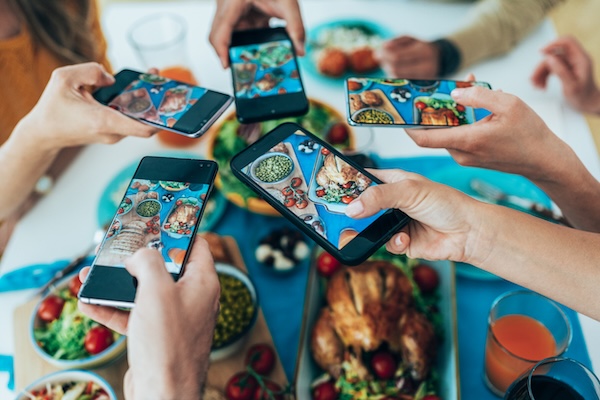
While we waited for our friend, and the food to arrive, we could not help but notice this trio of enthusiastic young foodies rearranging every single bowl, plate and glass that arrived at their tiny corner table.
Ramen was shifted twice for lighting. Dumplings were turned clockwise. Mocktails were pushed to the edge of the table for “depth”.One of them even held a phone torch over the food while another crouched low enough to photograph noodles from beneath eye level.
Then came the selfies.
Not one or two hurried clicks before the meal began, but a full-blown production over the next fifteen minutes that we were almost forced to observe from our arm’s-length distance. Each took turns becoming the “director”, instructing the others while shooting seven-second reels with all the seriousness of a cinema set.
“Wait, wait. Hold the chopsticks there.” “No, don’t touch it yet.” “Take the steam shot again.”
“Action.” And moments later, “Cut.”
What stood out to us as silent observers was not simply the obsession with documenting the food, but the fact that they barely ate any of it. In the dimly lit café, where Instagram clearly ruled supreme, the young diners clicked panoramic and ultra-microscopic photographs while the food went steadily cold and visibly limp.
The cold coffees and syrupy mocktails were perhaps the only things they actually consumed.
Everything else became theatre. Even after our own friend arrived and conversation resumed at our table, we could still see from the corner of our eyes that the food beside us remained almost untouched, except when required for “styled” shots to create the illusion that it had been eaten.
The flatbread was torn and dunked into curry for effect. The dumplings were carefully prised open as though someone had just taken a bite. Noodles were lifted mid-air repeatedly for dramatic slow-motion videos.
Meanwhile, the iced coffees sat sweating in the darkness of the room, the café lit less for diners and more for social media aesthetics.
At one point, one of the girls’ phones kept buzzing insistently. Her mother, we gathered, was calling her home for dinner because it was getting rather late. The young woman ignored the calls repeatedly before finally blurting out in irritation, in a foreign tongue, enough for us to understand that her mother was “bothering” her about food. The irony was impossible to miss.
Here sat a table overflowing with expensive dishes, while somewhere a mother waited for her child to come home and eat dinner.
In sharp contrast stood our hostess for the evening. Let us call her Kiran.
A bright young woman from Nepal, as she introduced herself, K moved through the cramped café with remarkable ease. She served not only us and the neighbouring table, but almost the entire tiny restaurant with a speed and efficiency that was difficult not to admire.
The café itself was packed. One of those wildly popular places with impossible weekend reservations, glowing online reviews and a loyal fanbase among Delhi’s current generation of diners who travel across the city for “experiences”.
Yet K navigated the chaos effortlessly.
Balancing trays of soup bowls and bamboo baskets, squeezing past handbags, chairs and selfie angles, she remained composed and warm throughout.
From time to time, she cleared away empty bowls and plates from our table and others nearby with swift practised movements. But when eventually the adjoining table signalled to have their meal cleared, the expression in her eyes changed ever so slightly.
The food was almost entirely untouched. Perfectly good ramen. Uneaten dumplings. Half-stirred curries. Barely disturbed food.
Food prepared with care, plated with precision and discarded without a second thought.
K said nothing. She remained entirely professional. But the disgust, or perhaps disappointment, in her eyes was palpable for a fleeting second before she quickly masked it with politeness.
Then she simply turned towards us and asked, in the gentlest tone possible, whether we might mention her in our star rating on Zomato.
We agreed instantly.
And yet long after the meal ended, it was not the food we remembered most vividly. It was that moment. Because somewhere between the carefully staged reels, the endless selfies and the untouched food lies a larger question about urban dining culture today.
With more money at their disposal, not to mention the freedom of living away from home, has food become more about the “Gram” than the palate itself? Is the fear of missing out now so overwhelming among Gen Z diners that experiences matter only when documented online?
More disturbingly, has food waste become so normalised that it no longer registers as waste at all?
This is surely not an isolated incident among the caffeinated and increasingly entitled sections of urban society. Across fashionable cafés and trendy restaurants, one sees tables full of diners spending more time photographing meals than eating them. Every dish must now perform. Every outing must become content.Every plate is expected to tell the internet that one has arrived somewhere exclusive enough, expensive enough or aesthetically pleasing enough to matter.
The meal itself becomes secondary.
Perhaps every generation has had its own vanities. Earlier generations flaunted jewellery, cars or imported clothes. Today’s generation curates experiences. Social media has transformed dining out into performance art, where restaurants double up as film sets and food becomes a prop in one’s carefully managed online identity.
But somewhere in this performance, something deeply human is being lost.
Food is not merely visual entertainment : It is labour, memory and sustenance .
Someone grows it. Someone transports it. Someone cooks it. Someone serves it.
And someone, somewhere, still goes hungry.
To waste food so casually, especially in a country where millions continue to struggle for a basic meal, feels more unsettling than fashionable.The saddest part is not even the waste itself. It is the growing disconnect from what food actually represents.
For many older (sic!) generations, food was sacred because it was scarce. Meals were family rituals. Plates were cleaned not out of discipline alone, but gratitude. Eating together meant conversation, comfort and connection.
Today, increasingly, food is consumed first through the camera lens and only later, if at all, through the senses.At whatever stage of life we find ourselves in, food remains the sustenance of life. It deserves to be respected as more than scenery for a thirty-second reel.
And perhaps the next time we sit before a beautifully plated meal, the more meaningful question is not whether it is worth posting online, but whether we are truly present enough to taste it while it is still warm.
More From BasisPoint