.png)

India Expands Gulf Trade Footprint with Oman CEPA
For India, the most visible gains lie in merchandise exports. Oman has offered immediate zero-duty access on about 98% of its tariff lines, covering roughly 99% of India’s exports by value.

Ajay Srivastava, founder of Global Trade Research Initiative, is an ex-Indian Trade Service officer with expertise in WTO and FTA negotiations.
December 18, 2025 at 4:25 PM IST
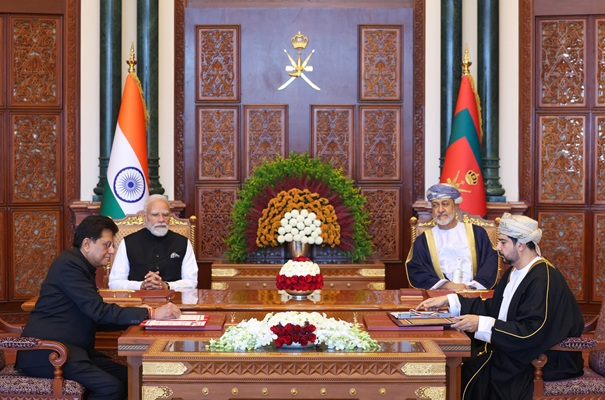
India and Oman on today signed a Comprehensive Economic Partnership Agreement, expanding India’s network of preferential trade deals in the Middle East.
The pact was signed by India’s Commerce and Industry Minister Piyush Goyal and Oman’s Minister of Commerce, Industry and Investment Promotion Qais bin Mohammed Al Yousef.
CEPA is India’s sixth free-trade agreement in the past five years, following deals with Mauritius, the United Arab Emirates, Australia, the EFTA bloc and the UK.
The CEPA is expected to come into force in the coming months. It substantially reduces or eliminates tariffs on goods, opens services markets and aims to facilitate investment between the two economies.
For India, the most visible gains lie in merchandise exports. Oman has offered immediate zero-duty access on about 98% of its tariff lines, covering roughly 99% of India’s exports by value. Indian shipments to Oman totaled about $4.1 billion in fiscal 2025, led by refined petroleum products such as naphtha and petrol, along with calcined alumina, machinery, aircraft, rice, iron and steel products, consumer goods and ceramics. While more than 80% of Indian goods already enter Oman at an average tariff of around 5%, duties on some items run as high as 100%. Their elimination under the CEPA is expected to improve price competitiveness for Indian exporters, though growth prospects are tempered by the size of Oman’s domestic market.
Oman’s gains are concentrated in energy and industrial inputs. India has offered tariff liberalization on about 78% of its tariff lines, largely through tariff-rate quotas to protect sensitive sectors. India imported roughly $6.6 billion of goods from Oman in fiscal 2025, dominated by crude oil, liquefied natural gas and fertilizers, alongside chemical inputs such as methanol and ammonia.
The agreement also includes services commitments, with Oman opening sectors such as IT, business and professional services, education, health care and research. It eases temporary entry for Indian professionals and streamlines regulatory approvals for pharmaceuticals, potentially lowering costs for Indian firms.
With over 6,000 India–Oman joint ventures and Indian investments of more than $7.5 billion—mainly in the Sohar and Salalah free zones—the CEPA is as much a strategic pact as a trade deal.
Given the small size of bilateral trade, its real value goes beyond tariffs: it strengthens India’s economic and geopolitical presence at the mouth of the Gulf, deepens Indian firms’ role in Omani logistics and supply chains, and supports India’s wider strategy on energy, services and regional connectivity. The agreement is therefore less a trade breakthrough than a strategic consolidation—locking in market access, mobility and influence in a critical maritime and energy corridor.
More From BasisPoint