.png)

Groupthink is the House View of BasisPoint’s in-house columnists.
September 1, 2026 at 3:20 AM IST
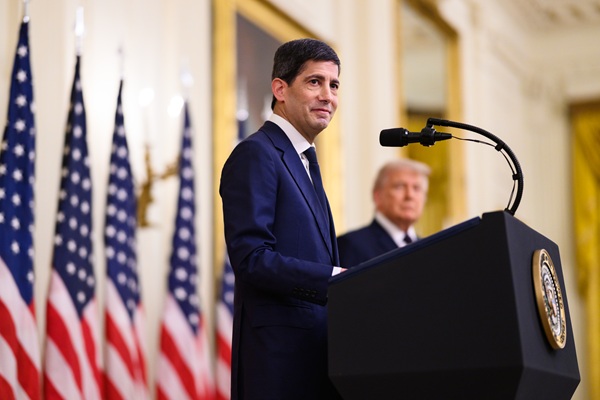
Kevin Warsh did more at Jackson Hole than reject forward guidance. He proposed a different compact between the Federal Reserve and financial markets. The Fed would make fewer promises, disclose less about its likely rate path and retain greater freedom to respond to events. Markets would have to infer more and bear more of the uncertainty.
Warsh reckoned Forward guidance was introduced as a crisis tool after 2008, when policy rates were near zero, and words had to do some of the work of conventional policy. It subsequently became a normal feature of central banking. Forecasts began to resemble commitments, changes of view looked like policy errors, and each meeting became another instalment in a rate path mapped months earlier.
Warsh’s objection is not merely that guidance can prove wrong. It can distort the information on which policy depends. If markets trade primarily on what they think the Fed will do, and the Fed then reads those market prices as evidence about the economy, both can become trapped in what he called a hall of mirrors. The experience of 2021 strengthened his case that prior commitments can delay a necessary response.
Warsh went further. He also declined to offer an explicit reaction function. No formula, he argued, can reliably capture an economy whose supply capacity cannot be observed directly and whose workings are being altered by technology, geopolitics and global supply chains. Monetary policy must remain an exercise in judgement.
That gives the Fed valuable option value. It also makes its policy rule less visible.
Jackson Hole demonstrated the trade-off immediately. Warsh rejected a rate path, then supplied markets with nearly all the ingredients needed to construct one. The 2% inflation target was “firm” and “fixed”. Short-term rates remained the predominant policy instrument. Labour markets were consistent with full employment. Broad financial conditions were not restrictive. Inflation was still running well above target, and progress over the past two years had been modest. Unless underlying inflation was moving towards 2% clearly and fast enough, the Fed had “work to do”.
Markets did the arithmetic and the implied probability of a September rate increase jumped from about 35% to nearly 60%, while the two-year Treasury yield rose almost 13 basis points. Warsh had not provided forward guidance. His diagnosis had done the guiding.
That does not make his project self-defeating. There is a meaningful distinction between promising a future decision and explaining the principles that will govern it. The former can imprison policymakers. The latter can help markets understand policy without inviting them simply to trade the Fed’s forecast.
The difficulty is that an implicit reaction function is harder to test. When the central bank withholds a common map, every phrase, omission and change of emphasis carries more weight. Greater discretion can preserve flexibility, but it can also make policy appear more personal, less predictable and harder to hold to account. Outcomes alone are an imperfect test because outcomes are also shaped by shocks the Fed does not control.
Warsh ended by committing himself to a discipline, not a decision. That is the right distinction, but it places a heavier burden on consistency. The Quiet Fed will have to show, decision by decision, how its stated principles translate into action. Otherwise, the uncertainty removed from the Fed’s own commitments will simply reappear in market prices.
Jackson Hole therefore marked more than a change in communication style. Warsh is asking markets to surrender the comfort of a pre-announced path so the Fed can recover room to manoeuvre. The exchange may improve monetary policy. But the Fed gains discretion only by shifting more of the uncertainty to everyone else.
More From BasisPoint