.png)

War Breaks the Policy Cycle
The April MPC ends the disinflation-led easing phase, pushing the RBI into a supply-shock regime where inflation risks rise even as growth weakens.

Groupthink is the House View of BasisPoint’s in-house columnists.
April 8, 2026 at 9:02 AM IST
The April monetary policy statement marks a clear break from the trajectory of recent meetings. The earlier disinflation-led, growth-supportive policy setting under a neutral stance has been overtaken by developments arising from the West Asia conflict, forcing the Reserve Bank of India into a different policy regime.
From August to February, the framework was internally consistent. Inflation declined faster than expected, core pressures remained contained, and growth held up.
Each MPC built on that foundation.
In August, RBI held rates while emphasising that the impact of earlier rate cuts was still being transmitted. The policy logic remained sequential, as easing had already been delivered and the system needed time to absorb it.
By October, inflation had moderated further, and the statement acknowledged that policy space had opened up. The committee still chose to pause, but the direction of travel was clear: lower inflation created room to support growth.
December converted that room into action. With inflation at unusually low levels and growth strong, the RBI cut rates and injected durable liquidity. Policy was no longer waiting for confirmation. It was actively supporting demand.
February marked a pause in that policy phase rather than a reversal, with inflation remaining benign, growth strong, and the central bank indicating that the current rate was appropriate, keeping the framework intact and preserving policy space.
April ends that phase.
Shock Regime
The April statement introduces a different problem. The conflict in West Asia has disrupted supply chains, pushed up energy prices, tightened financial conditions, and raised global uncertainty. It has also raised freight and insurance costs due to disruptions to key shipping routes such as the Strait of Hormuz, with spillovers into domestic financial conditions. These are not domestic imbalances that policy can correct. They are external shocks that transmit unevenly across the economy.
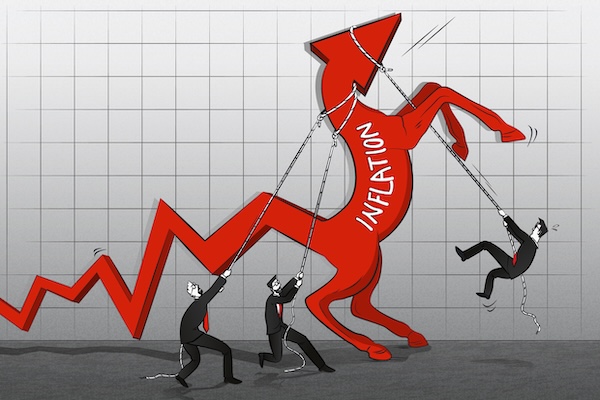
The consequence is that inflation and growth no longer move together. Higher energy prices and input costs raise inflation risks, even as the same forces weaken production, trade, and demand. Monetary policy is no longer operating in an environment where disinflation can be used to support growth. It is operating in one where acting on inflation risks can further weaken growth, and attempts to support growth risk underestimating inflation pressures.
This is a different policy problem.
The change is visible in the way the April statement is constructed.
Earlier communications drew coherence from the idea of policy space. That language disappears. In its place is an explicit acknowledgement of a trade-off. The central bank notes that it is confronted with a supply shock and that the appropriate response is to wait and watch.
The pause, therefore, has a different meaning. It is not about transmission, as in August. It is not about assessing cumulative effects, as in October. It is not about the policy rate being appropriately set, as in February. It reflects the need to assess the balance of risks while retaining the flexibility to respond judiciously to incoming information.
Inflation, which had receded as a constraint over the previous meetings, returns in April with a different character. Headline inflation remains below target, and core inflation is still contained, but the projected trajectory rises, driven by the pass-through of higher global energy prices and the risk of second-round effects, even as core inflation excluding precious metals remains subdued. This is cost-push inflation, where rate action has limited influence on the source of pressure.
Growth, while still supported by domestic demand, is now more conditional. The outlook rests on the assumption that the adverse impact of the conflict remains contained, even as elevated energy costs and supply disruptions act as a drag on domestic production. The projection remains close to earlier levels, but the risks are clearly tilted to the downside. Shipping disruptions, higher logistics costs, and tighter financial conditions introduce headwinds that were not central to earlier assessments.
The most telling feature of the statement is what it avoids doing.
The neutral stance has not changed; only what it means has. This time, it implies flexibility in both directions amid heightened uncertainty. In February, it meant a door left open for further easing.
There is no attempt to signal direction. The central bank does not indicate whether the next move is more likely to be a cut or a hike. It does not refer to policy space. It does not extend the earlier growth-supportive narrative. Instead, it emphasises vigilance and flexibility.
The growth-boosting cycle, in that sense, is no longer the organising framework for policy. It has been overtaken by events.
What replaces it is a regime in which the central bank’s primary task is to manage uncertainty arising from an external supply shock. The economy is now explicitly confronted with a supply shock, and policy shifts from calibrating space to preserving optionality. The policy rate remains unchanged, but it is no longer the sole or even primary signal, as the emphasis moves to managing risks in a setting where inflation pressures and growth impulses diverge.
The war has not only complicated the outlook, it has fundamentally reset the way policy must respond.
More From BasisPoint