.png)

This Was Not in the Job Description
Somewhere between an overwhelming to do list and mid-life enveloping you, things start to feel off. No single moment tips it. It just keeps adding up
Kalyani Srinath, a food curator at www.sizzlingtastebuds.com, is a curious learner and a keen observer of life.
May 9, 2026 at 6:01 AM IST
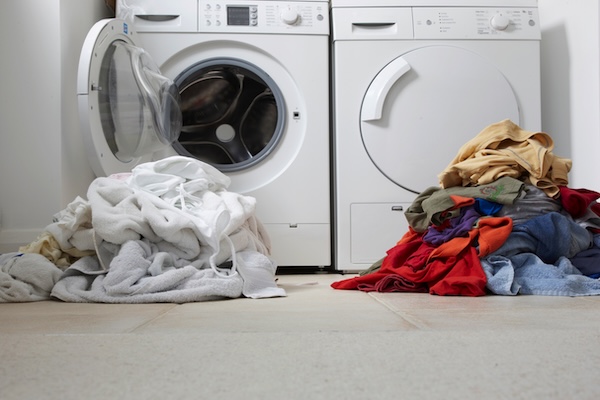
There are grand entry points into existential reflection. War. Inflation. Climate change. Then there is the far more accurate trigger: a laundry basket that has quietly staged a coup while you were looking the other way.
This week, while doing the laundry myself, because domestic help has taken that annual summer sabbatical that is somehow both expected and still emotionally disruptive, I discovered that life does not unravel in dramatic arcs. It unravels in cotton, linen, and the occasional mysteriously damp T-shirt that no one admits to wearing.
The pile grows with a kind of passive-aggressive efficiency. Ignore it for an hour and it doubles. Ignore it for a day and it develops personality. There is always that one teenager’s perfectly folded stack that collapses into chaos within twelve hours, only to reappear in the wash as if to say: Amma, I live here now. Permanently. Top of mind, top of pile.
And then there are the towels. Those impulsive, dopamine-fuelled purchases inspired by an Instagram reel that promised soft luxury and emotional fulfilment at “Buy One Get Second at 50% Off.” The fourth or fifth towel sits there now, judging you. Not for being unnecessary, but for being unused. Meanwhile, the bedspreads, heavy, dignified, and deeply offended, are giving you a sustained side eye because you have demoted them to a regular wash instead of the delicate cycle they clearly deserve. You begin to suspect that fabric has memory. And opinions.
Somewhere between separating whites and colours, you pause and ask yourself a question that feels disproportionate but entirely valid: why does this distress me more than global gold prices and LPG issues during a geopolitical conflict?
Because this is the real theatre of midlife.
You are at that curious crossroads where your parents are slowly becoming your children, your children have promoted themselves to your supervisors, your boss has become either irrelevant or invisible, and your friends are all quietly spinning on their own versions of the same wheel. No one says it out loud, but everyone recognises the choreography. It is a hamster wheel, yes, but one with better upholstery and significantly higher stakes.
And at the centre of it all is the laundry.
A System That Runs Until It Doesn’t
Outside, the summer is unapologetic. Inside, the domestic ecosystem is renegotiating its terms. The maid does not ask for leave. She informs. There is a difference, and it is not subtle. The announcement comes with a tone that suggests both inevitability and a faint possibility of extension, depending on how persuasive her relatives are. You nod, because what else can you do? This is not a negotiation. This is policy.
The dhobi bhaiyya, the press wala who has seen more of your wardrobe than you have, also has plans. He is heading to his native place for what can only be described as the national circus of assembly / state elections. There is talk of money flowing, of Adhaar cards acquiring sudden, almost mythical value. He shares this information with the calm authority of someone who knows that your ironing backlog is not his problem.
You begin to wonder, not for the first time, what exactly you signed up for.
The vegetable vendor, on the other hand, hears everything. He hears your bargaining, your sighs, your reluctant acceptance. He explains, with a mix of resignation and quiet defiance, the rising cost of diesel, the unpredictability of supply, the simple fact that tomatoes are not interested in stabilising your household budget. You find yourself sympathising with him, even as you mentally recalculate dinner.
Somewhere along this chain of small negotiations, the humble idli-vada at the neighbourhood Udupi restaurant begins to look like a luxury purchase. You stare at the menu, mildly offended. Since when did comfort food acquire ambition? You make a firm, almost moral decision: you will cook more at home. It is healthier. It is economical. It is, in theory, empowering.
Except, of course, the cook has also decided that this is the perfect moment to take leave.
There is a pattern here. It is not subtle.
So you return to the laundry. Because unlike people, laundry does not negotiate. It accumulates. It waits. It expands. It reflects back to you the quiet arithmetic of daily living. Every outfit worn, every towel used, every bed-sheet changed becomes part of a growing ledger that demands settlement.
And as you stand there, measuring detergent with the seriousness of someone handling a volatile financial instrument, it dawns on you that this is not really about clothes.
It Was Never About the Clothes
It is about control. Or the illusion of it.
The world outside operates on scales that are too large, too abstract, too distant to influence directly. Gold prices rise and fall. Temperatures climb. Economies wobble. Elections come and go with all the subtlety of a travelling circus. You read about these things, discuss them over coffee, perhaps even worry about them in a vague, ambient way.
But the laundry? The laundry is immediate. It is tangible. It is relentless. It is the one domain where effort leads, almost reliably, to visible outcome. You sort, you wash, you dry, you fold. Order is restored. Briefly.
Until it isn’t.
Because by the time you finish one cycle, another has already begun. A fresh pile is forming somewhere in the house, quietly gathering momentum. A T-shirt has been discarded. A towel has been used once too often. A bed-sheet has crossed some invisible threshold of acceptability.
The cycle continues.
There is, oddly enough, a kind of comfort in this repetition. Not joy, exactly, but familiarity. A rhythm that anchors you even as everything else feels slightly out of sync. You may not be able to stabilise fuel prices or negotiate with electoral dynamics, but you can, at the very least, ensure that your whites remain white and your colours do not bleed into existential grey.
And so you carry on.
Because the alternative is to sit with the larger questions, the ones that do not come with clear instructions or predictable outcomes. The ones that do not fit neatly into a washing machine drum.
Better, perhaps, to deal with what you can hold, sort, and fold.
At least until the season changes.
Because when the monsoon arrives, with its damp insistence and its own set of domestic negotiations, this entire narrative will shift. New challenges will emerge. New rhythms will assert themselves.
And the laundry, faithful and unyielding, will still be there.
More From BasisPoint