.png)

Is the AI Panic Artificial?
Markets are pricing in mass job destruction, but history suggests AI will disrupt selectively, not obliterate whole sectors overnight.


T.K. Arun, ex-Economic Times editor, is a columnist known for incisive analysis of economic and policy matters.
February 13, 2026 at 9:54 AM IST
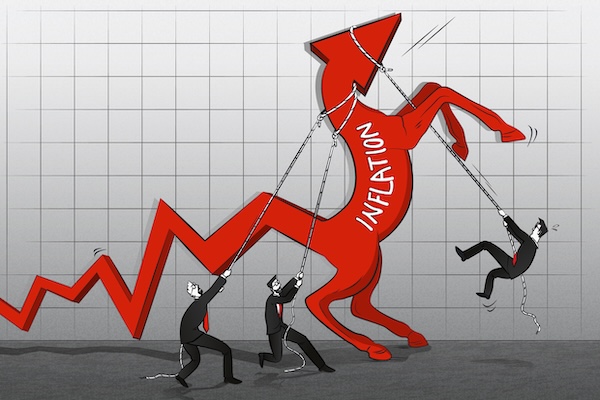
A spectre is haunting American stocks, the spectre of AI hungering for whole sectors of the economy and entire functions currently performed by humans. Stocks and their indices are on the run. True, panic and greed drive markets anywhere, but this is going overboard. AI ravenously on the hunt for human jobs en masse is, as is the normal habit for spectres, unreal. AI will destroy some jobs, but will create many new jobs that do not exist at present, as well, if past technology changes are any guide.
The markets witnessed a rout in software stocks, after one major AI firm, Anthropic, announced that its Claude model now has several agents that can perform routine software development functions, for example, in legal research and in the inter-related functions of sales and customer relations management.
On Thursday, a small logistics firm, Algorhythm Holdings made the claim that its AI-driven platform had allowed it to increase turnover manifold without increasing headcount. This led to a 7% fall in the Russell 3000 Index’s trucking segment. Major trucking and logistics firms saw their stock prices crash, according to Bloomberg.
Bloomberg also reported the effect of a reasonable warning by the CEO of real estate major CBRE on an earnings call that if AI were to destroy a lot of human jobs, that would reduce headcount at most firms, and depress the demand for office space. The result: a rout in real estate stocks. The AI spectre haunted private credit providers, insurance brokerages and wealth managers as well.
At one level, this fear is rational. If you believe that AI is going to fundamentally transform the way we produce goods and services, automating swathes of economic operations, then, of course, in proportion to the rise of AI, there must be decline in the sectors where AI makes its impact felt. And if specific developments reveal the identity of the sectors where the AI blow would be severe, then, it is rational to sell off stock in those sectors.
In other words, if the AI hype is valid, the spectre haunting markets is no figment of feverish imagination but a ghoul with a tangible appetite. The AI-impact stocks should necessarily lose their lustre when the towering edifice of AI casts its shadow on them.
However, a little reflection will show that hype over both AI’s capabilities and its devastating impact is unrealistic, at least for the near future. Let’s take logistics. Sure, AI can make the process a whole lot more efficient, especially because it has been one of the least modernised sectors. Cargo ships run on the most polluting fuel, fuel oil.
The individual packets that go into a container and each of the different containers stacked on a truck bed can, in theory, all carry RFID tags (radio frequency identity tags) that will allow the tracking of goods movement end-to-end. This is going mainstream only now. When RFID tags are universal, AI can come into its own, in managing logistics — but not yet in physical transportation of goods and services.
Even if we assume AI embodied in machinery, say trucks and forklifts, becomes good enough, technically, to dispense with a human in the loop, how long will it take for the regulatory and insurance infrastructure to mature, to permit deployment of unmanned trucks on the roads, their loading, unloading, schedules and fuel stops all controlled by other pieces of AI?
In India, TVS Supplychain Solutions has been performing intelligent optimisation of logistics for more than two decades by now. Incidentally, the stock has run up 20% of late and is probably overpriced at a price-earnings ratio of over 50. It is sensible to assume that logistics management companies that have not started making use of technology to turn intelligent will be hit by AI. But the actual business of loading cargo onto trucks, driving the truck to specified destinations, unloading the goods and forwarding the contents of the containers on the truck to their final destinations will remain labour-intensive for the time being. It is wholly irrational for pure trucking businesses to run from the spectre.
Will AI reduce headcount on a scale that crimps the demand for office space? Most unlikely. Certainly, AI would automate certain functions and render human effort in the activities that have been automated redundant. That could, on its own, play out in two ways. It could increase productivity for existing workers, making them add significantly more value than in the past, making their employer more profitable and themselves more wanted than in the past. Or this could happen in some companies that moved first, and shrink the work available to the competition, leading to downsizing in the industry.
However, AI will not just create redundancy, the way the coming of the Model T, the first mass-produced automobile, made horse carriages, cartwrights, wheelers, blacksmiths, and hostlers and stable boys redundant. AI will also herald altogether new industries, just as the automobile did, ranging from steel and precision engineering to rubber plantations, oil refining, road building and fuel retailing.
What all AI will create new is difficult to predict. However, to take a random example, let us consider nuclear fusion, where AI is expected to solve the problem of how to achieve constant recalibration of the powerful magnetic field to contain the superhot plasma, in which the hydrogen atoms collide with one another and fuse to create helium, converting some mass into energy in the process. If fusion becomes a viable source of cheap power, conventional thermal power generation would wind up, as would much of battery storage and intermittent renewable power. However, entirely new activities could be thrown up, such as boiling the ocean — in bits and pieces, of course — to produce steam, condense it into water and create new systems of irrigation, or running huge fans in different parts of the world to drive carbon dioxide on to sheets of adsorbents to scrub the air free of global warming toxicity, releasing the CO2 in controlled conditions and synthesise chains of polymers that traditionally came from hydrocarbon crackers.
What will be, we do not know. But there will be no AI winter similar to a nuclear winter. When some lines of activity disappear, new ones will come up. What will be will not be nothing. Que sera, sera.
More From BasisPoint