.png)

Europe Has a Defence Budget. It Does Not Yet Have a Kshatriya's Mind
NATO's 5% GDP commitment is the largest peacetime military spending pledge in modern history. But budgets don't build strategic identity, and Europe is confusing the two.

Kirti Tarang Pande is a psychologist, researcher, and brand strategist specialising in the intersection of mental health, societal resilience, and organisational behaviour.
July 12, 2026 at 12:04 PM IST
When the numbers arrive, everyone reaches for a calculator.
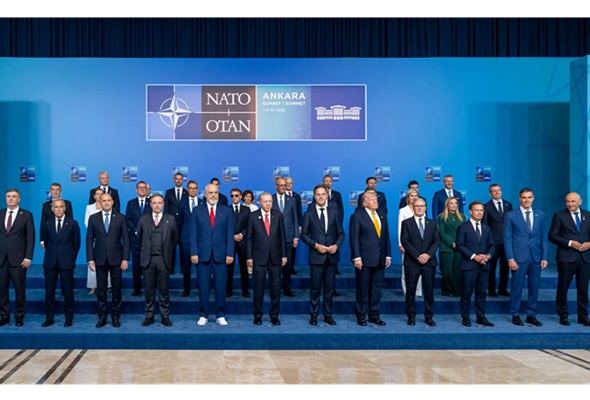
The NATO Ankara summit produced a commitment that would have seemed improbable a decade ago: member states pledging 5% of GDP to defence and security. Of course, it moved the markets, with procurement timelines being revised and defence companies modelling contracts. Political commentators declared that Europe had, finally, turned a strategic corner. Europe has finally stopped being a dependent, passive actor and has become a serious, self-reliant military power. The era of American babysitting is over. Europe is now a strategic actor in its own right. The budget is the evidence and the commitment is the proof that Europe has changed. It is a reasonable analysis, but it is incomplete.
Because the question dominating the coverage is: How much will Europe spend? This is a question of quantity. Will Europe allocate 5% of GDP? Will it hit the target? Will procurement budgets rise? The entire commentary class is focused on the measurable, the quantifiable, the headline-friendly. They are collectively missing the question that will actually determine whether any of this matters. That is a question of identity. Does Europe see itself as a military actor? A civilian power? A strategic pole? A US appendage? Those are different questions. And they lead to very different answers.
If the answer to the "who" question is, “we are a civilian power that happens to spend more on defence,” then Europe is a wealthy bystander with expensive hardware, not a strategic pole.
But if the answer is, “we are a military actor that uses force as an instrument of policy,” then Europe is a genuine strategic pole, and the transformation is real.
These two answers lead to different strategic realities. One is cyclical; the other is structural. One is a budget; the other is a revival. And the revival will take time.
Western commentators lack the psychological toolkit to see this identity crisis clearly, so they focus on what is measurable. But India has a unique psychological text that provides the lens to see things as they are. Here is what it reveals:
Inherited Identity
At Kurukshetra, Arjuna surveys the battlefield from his chariot and sees, arrayed against him, the faces he has known all his life: his teachers, cousins, and grandfather. He does not draw his bow. He asks Krishna to drive him to the centre of the field, as if a closer look at the cost might clarify what he should do. It doesn't. It undoes him.
We all know what follows: Krishna's long counsel across eighteen chapters, one of the ancient world's most sustained arguments about why a person who knows who they are must still act. But notice what the text does not question: whether Arjuna is a warrior. That is settled. His training, his lineage, his entire formation point in one direction. What breaks down at Kurukshetra is not his identity. It is his willingness to perform a particular act.
In clinical terms: a crisis of action, not a crisis of identity.
Krishna's response succeeds because the foundation beneath Arjuna is intact. He does not rebuild a warrior. He simply reminds one. He reframes the act and argues that Arjuna's dharma requires him to fight, that the soul is beyond destruction, and that inaction is itself a form of violence. The argument is intricate. But it works because it operates on top of a complete, unshaken self. So one conversation is sufficient to resolve the crisis.
Arjuna’s crisis was a crisis of action, but Europe is having a crisis of identity.
Forgotten Warrior
After 1945, Europe made a decision that was, by historical standards, extraordinary. Having produced two world wars in thirty years and the Holocaust, amid the rubble of its cities, Europe concluded that its catastrophes shared a common source: the warrior instinct itself. The European project was consciously built as a post-martial civilisation. A civilisation that chose trade over territory, institutions over force, and interdependence as the architecture of peace rather than as merely an aspiration.
It became civilisational. Schools taught it. Whole generations grew up inside a story in which Europe's crowning achievement was not winning wars but transcending the conditions that produce them. Military force, deployed independently and at strategic will, became something that belonged, largely, to someone else. Europe repressed a fundamental dimension of itself.
Carl Jung described what happens when a society represses a fundamental dimension of itself. The capacity does not disappear. It retreats into what he called the shadow. It is present beneath the surface, influential in ways that resist direct observation, but no longer consciously owned or actively maintained. Recovering it requires something far more demanding than a decision. It requires integration: the slow, effortful work of acknowledging what was set aside and gradually reclaiming the capacity without reinstating the conditions that made it dangerous.
This is generational work, not a budget cycle.
For eight decades, America performed the West's warrior function. Washington supplied the deterrence, the command structure, the willingness to use force, and the cultural permission to do so. Brussels supplied economic weight and the moral authority of a continent that had learned, at enormous cost, what happens when nations stop talking. The arrangement succeeded. It was also, in retrospect, a form of psychological and strategic dismemberment.
You can purchase a weapons system in a procurement cycle. You cannot purchase the strategic culture required to deploy it. It requires risk tolerance, the political will to absorb casualties, and the instinct to act without deferring to Washington for authorisation. Those are not line items. They accumulate through cultural transmission, through political courage exercised under pressure, through the repeated experience of making hard choices without a guarantor standing behind you.
Western commentary cannot make this distinction because spending is measurable and identity transformation is not. So the analysis gravitates toward what it can quantify, namely GDP percentage, the procurement timelines and contract values, and treats those numbers as evidence of the thing it cannot measure: strategic will. It reads an intention and concludes a transformation.
The Gita offers a more precise diagnostic. Arjuna's crisis required one conversation. Europe's may require a generation. Knowing which type of crisis you are witnessing changes the entire analytical frame.
And that impacts India.
India's defence export projections, FDI assumptions for co-production, and the EU-India Security and Defence Partnership commitments are all structured on roughly a five-to-ten year horizon. They are premised on a Europe that is becoming a genuine strategic actor within that timeline.
So if Europe is experiencing Arjuna's crisis, meaning it is a capable actor with an intact foundation, temporarily uncertain about a particular act, then that trajectory is credible. Resources translate into capability. Capability accumulates into strategic culture, and identity catches up to the budget.
But if Europe is engaged in the slower, more fundamental work of reconstructing a warrior identity that was deliberately dismantled after 1945, then the timeline shifts by an order of magnitude. Political cultures evolve across decades. Citizens must become comfortable with the sacrifice their parents were never asked to carry. Democracies must relearn a vocabulary of deterrence that peace has allowed them to forget. No communiqué, however historic, can compress that.
Our own history is instructive here. Colonial rule reshaped India's confidence and the civilisational memory of what India had been. The suppression of India's martial traditions across two centuries was not only military disarmament. It was a psychological project. Recovering from it has required decades of deliberate, uneven, and still-incomplete work. So we know, from the inside, that civilisational identity is not rebuilt through declarations. It is rebuilt through time, through choices made under genuine pressure.
If the Western commentariat is asking "how much" rather than "who," then India's defence planners may be pricing in a partner that does not yet exist. And that mispricing has a cost.
At Kurukshetra, Arjuna's crisis dissolved the moment he remembered who he was. The resolution was always latent in the foundation. Europe's crisis will resolve (if it resolves) only when it remembers who it was before it decided to forget. The Ankara summit may be the beginning of an answer. Europe, however, is still in the earlier chapters.
More From BasisPoint