.png)


Datametricx is a veteran journalist tallying the macro game, keeping score of the numbers that shape India’s economy and policy.
February 28, 2026 at 1:13 PM IST
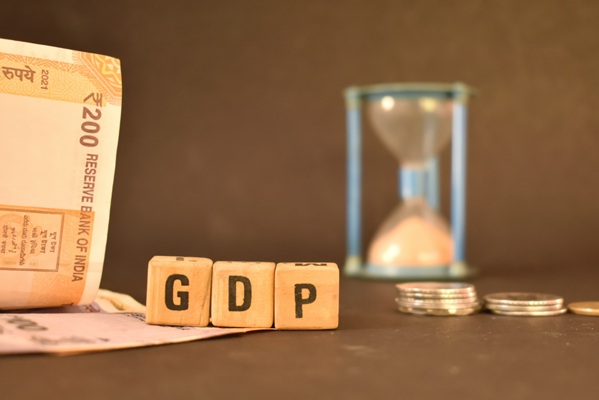
Unlike the sweeping revision in 2015, the updated GDP series broadly aligns with expectations. The National Statistics Office estimates the economy grew 7.1% in 2024-25, higher than the earlier estimate of 6.5%. The NSO has projected growth of 7.6% in the current financial year, compared with its earlier estimate of 7.4%.
The new series, released on Friday, improves coverage of the informal sector and draws on inputs such as goods and services tax filings, e-Vahan vehicle registration data, and digital payment transaction data. It also incorporates methodological changes, shifting to a mix of double deflation and volume extrapolation. Under double deflation, output and intermediate consumption are deflated separately to derive real value added, replacing the single price index, which was applied to both, in the old series.
The statistics office estimates the economy grew 7.8% in the October-December quarter, compared with 8.4% in July-September quarter. The earlier series had estimated July-September growth at 8.2%.
According to the new series, the GDP in absolute terms is about 3.4% lower on average than under the earlier series. A lower GDP base implies the fiscal deficit as a percentage of GDP will be about 10 basis points higher than estimated in the Budget.
The central government’s fiscal position improved sharply in January, aided by a surge in net tax revenues and divestment receipts, along with lower revenue and capital expenditure. The fiscal deficit in April-January narrowed 16.1% to ₹9.81 trillion, reflecting a 50.8% year-on-year contraction in January alone. The deficit accounted for 63.0% of the revised full-year Budget estimate, compared with 74.5% a year earlier.
The improvement was driven primarily by a sharp increase in net tax revenues, which rose more than 2.5 times year-on-year to ₹1.55 trillion in January. Total receipts in April-January increased 12.8% to ₹27.09 trillion, as net tax revenue rose 10.0% to ₹20.94 trillion. Total expenditure grew 3.4% year-on-year to ₹36.90 trillion, well below the 6.7% growth projected in the revised full-year estimate. The increase in spending was led by an 11.2% rise in capital expenditure to ₹8.42 trillion.
The fiscal trend so far suggests the government is on course to meet, if not better, its revised fiscal deficit target of ₹15.58 trillion.
Tax collections strengthened in January, supported by higher corporate tax and customs duty receipts. Total tax collections at end-January stood at ₹32.42 trillion, up 8.6% year-on-year — slightly better than the 7.6% growth assumed in the revised Budget estimate. Collections in January alone rose 10.1% to ₹2.57 trillion.
Corporate tax collections nearly tripled year-on-year to ₹292 billion in January, while customs duty receipts rose 19.7% to ₹239 billion.
To meet the revised target for the full-year of ₹40.78 trillion, tax collections would need to grow just 2.9% in the final two months of the fiscal year. If collections grow maintain the current 8.6% pace, they would exceed the target by around ₹450 billion.
The financial performance of listed private non-financial companies improved markedly in the October-December quarter, with sales rising in double digits for the first time in 12 quarters, according to a Reserve Bank of India study. Overall sales increased 10.1% year-on-year, driven largely by manufacturing companies, compared with 8.0% growth in both July-September and the corresponding quarter a year earlier.
Sales of 1,794 listed private manufacturing companies rose 11.4%, up from 8.5% in the previous quarter and 7.7% a year earlier. The increase was led by automobiles, electrical machinery, and non-ferrous metals.
Information technology companies recorded sales growth of 8.8%, up from 7.8% in July-September and 6.8% a year earlier. Sales of non-IT services companies grew 10.6%, unchanged from a quarter ago but lower than 11.5% a year earlier.
Operating profit growth accelerated to 8.9% from 8.3% in the previous quarter and 6.9% a year earlier. Manufacturing companies posted operating profit growth of 11.8%, up from 10.6% a quarter ago and 3.0% a year earlier. Operating profit growth of IT companies rose to 11.1% from 7.7% in the previous quarter and 5.9% a year earlier, while that of non-IT services companies moderated to 4.0% from 6.5% and 15.6%, respectively.
Annual inflation based on CPI for Industrial Workers rose to a 14-month high of 3.77% in January from 3.13% in December, reflecting a low base and a 2.0% month-on-month increase in the housing index.
Housing prices continued to rise. The Reserve Bank of India’s all-India House Price Index increased to 115.6 in October-December from 114.2 a quarter earlier, driven mainly by gains in Nagpur, Chandigarh, and Jaipur. The index rose 3.6% year-on-year, compared with a 6.9% growth a year earlier.
Bank lending rates rose sharply in January, reversing much of the decline in the previous month. The weighted average lending rate on fresh rupee loans increased by 39 basis points to 8.67%, marking the steepest month-on-month rise in at least 12 years. In contrast, the weighted average rate on new term deposits edged down by 1 basis point to 5.66%. The weighted average lending rate of scheduled commercial banks has moderated by 66 basis points since the start of the policy easing cycle in February 2025, compared with a cumulative 125-basis-point reduction in the policy repo rate. Over the same period, the average rate on fresh term deposits has declined by 96 basis points. The widening gap between lending and deposit rates is expected to improve banks’ net interest margins.
Bank credit to industry moderated to 12.1% as of January 31, down from 13.3% a month earlier but remained higher than 8.3% a year ago. Credit to the services sector accelerated to 15.5% from 15.3% a month earlier and 12.3% a year ago. Growth in credit to agriculture eased to 11.4% from 12.1% a month earlier and 12.2% a year earlier.
India’s services trade surplus narrowed to $21.53 billion in January from $22.67 billion in December, even as imports declined. Services exports rose 9.8% year-on-year to $38.17 billion, while imports contracted 0.5% to $16.63 billion. India’s merchandise trade deficit had widened to $34.68 billion in January, resulting in an overall deficit of $13.15 billion.
India’s foreign exchange reserves eased to $723.61 billion as of February 20, down $2.12 billion from a record $725.73 billion a week ago. Foreign currency assets fell $1.04 billion to $572.56 billion, and gold reserves declined by $977 million to $127.49 billion. Reserves have increased by $55.28 billion so far this fiscal year, driven primarily by gold price appreciation.
Food grain stocks with the government were at record highs as of February 1. Total grain stocks, excluding unmilled paddy, stood at 59.30 million tonnes, the highest level for this date. Rice stocks, excluding unmilled paddy, were at 33.67 million tonnes, marginally lower than a year earlier, while wheat stocks stood at 25.64 million tonnes, the highest February 1 level in four years. The government held 60.25 million tonnes of unmilled paddy, equivalent to about 40.37 million tonnes of rice. High stock levels prompted the government to allow wheat exports after nearly four years. It permitted exports of 2.5 million tonnes of wheat and 1.0 million tonnes of wheat products.
Winter rainfall remained patchy. Cumulative rainfall during January 1-February 27 stood at 15.9 mm, 59% below the long-period average. Reservoir storage levels continued to fall but remained well above historical norms. As of February 26, water levels in 166 reservoirs stood at 108.34 billion cubic metres, or 59% of their total live capacity — 12% higher than a year earlier and 25% above the 10-year average.
Coming up
- Mar 1: GST collections for February
- Mar 2: Index of Industrial Production for January
- Mar 2: HSBC India Manufacturing PMI for February
Tailpiece
India’s per capita income in 2025-26 is projected at ₹207,598, marking a 7.7% increase from a year earlier under the new GDP series. However, this is ₹11,977 lower than ₹219,575 estimated under the previous series, reflecting the downward revision in the GDP base.
More From BasisPoint