.png)


Krishnadevan is Editorial Director at BasisPoint Insight. He has worked in the equity markets, and been a journalist at ET, AFX News, Reuters TV and Cogencis.
April 3, 2026 at 9:06 AM IST
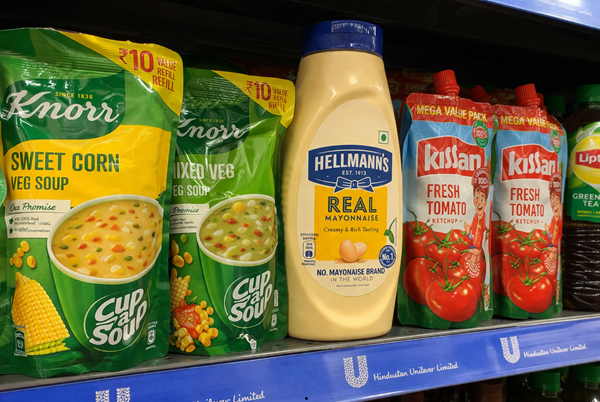
Unilever has agreed to sell its global foods business to McCormick & Co. Its Indian arm, Hindustan Unilever, has clarified that it is not divesting any part of its foods portfolio.
At the global level, Unilever has made a clear choice about its strategic view of the foods category. In India, however, HUL has reiterated that foods remain “an important and attractive business” and that no divestment discussions are underway. The divergence reflects how differently the same category is being positioned across geographies.
The debate has centred on margins. Critics of the deal argue that Unilever’s foods business is not a laggard. Operating margins in the segment are strong and, in some cases, comparable to those in personal care categories. Why sell a high-margin business to a buyer that operates at lower margins?
Markets, however, do not price businesses on absolute margins alone. Valuations reflect a mix of growth, pricing power, and category positioning.
The foods business has distinct operating characteristics. Input costs are more volatile, price increases tend to lag, and working capital is tied up in inventory cycles that are more sensitive to commodity price swings. Personal care categories, particularly premium segments, typically offer greater gross margin stability and faster pricing response. That difference is reflected in the earnings multiples such businesses attract.
A portfolio built around premium personal care, beauty, and home care carries a different set of expectations from one that combines these with packaged foods.
Foods can be a strong business and still dilute the valuation profile of a company positioning itself as a premium, innovation-led consumer franchise. Unilever’s sale of the foods business can be seen as a portfolio design choice.
Large consumer companies have periodically shed category-leading brands, not because they were underperforming, but to sharpen strategic focus. The decision is less about fixing what is broken and more about choosing where future growth will come from.
Unilever’s capital allocation signals point in that direction. The group has emphasised selective, bolt-on acquisitions in faster-growing segments, particularly in markets such as India and the United States, with a focus on premium and digitally native brands.
The Indian foods business is not being treated as part of the same problem set. It is locally embedded, category-diverse, and positioned within growth segments such as health foods and beverages.
It is also integrated into HUL’s distribution system, where shared infrastructure and scale support returns that would be harder to replicate in a standalone structure.
Unilever has described the India business as value-accretive, with strong market positions and a portfolio mix distinct from its global food operations. India remains one of its anchor markets, alongside the US, for both current scale and future growth.
What may appear mature and slower-growing in developed markets can still offer significant headroom in India through premiumisation, distribution expansion, and channel shifts.
In that sense, Unilever is not exiting foods altogether. It is segmenting the category by geography and growth profile. The global foods business is being carved out as part of a broader shift towards higher-growth, higher-multiple categories, while the India foods business is being retained in a market where it continues to align the growth profile.
For HUL, this creates a more nuanced outcome than a simple buy-or-sell question. The portfolio remains intact, and management has been explicit that no divestment is under consideration.
However, as capital increasingly tilts towards premium personal care and digital-first brands, the foods segment assumes greater importance in shaping HUL’s valuation, anchoring its multiple closer to that of a diversified staples company than a focused premium franchise.
Hindustan Unilever now sits between two narratives: that of a diversified, high-quality FMCG company with steady earnings across categories and a more focused, premium-led consumer franchise where growth and pricing power drive valuation.
The deal at the parent level does not force an immediate decision in India. But it does make the strategic question harder to ignore.
(This column reflects the author’s personal views and is based on publicly available information. It is intended for general commentary and analytical purposes only and should not be construed as investment advice.)
More From BasisPoint