.png)

Sharmila Chavaly, a former civil servant who held key roles in the railways and finance ministries, specialises in infrastructure, project finance, and PPPs.
March 17, 2026 at 2:47 PM IST
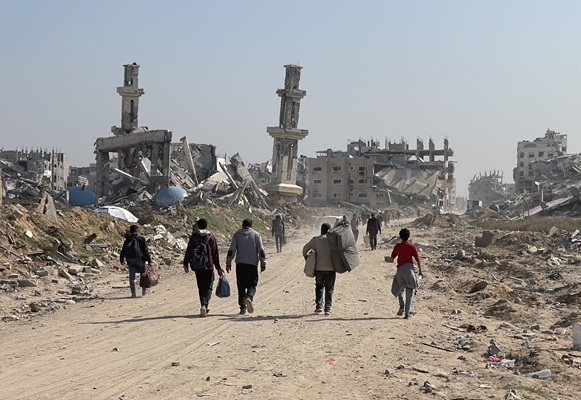
When a war ends, locals see loss of life and livelihoods, the international community sees a checklist, and the world sees rubble. Bridges. Power plants. Water treatment facilities. Schools. Hospitals. These are the tangible losses, the things that can be photographed, measured, and assigned a dollar value. Reconstruction, by its very nature, defaults to hard infrastructure because hard infrastructure is what war destroys most visibly. A collapsed bridge is a fact you cannot argue with. A traumatised population, and the related costs of restoring institutions and social fabric, is a problem for someone else, later.
Such a focus is not wrong; it is just incomplete. And increasingly, it is helping make reconstruction unaffordable, because the numbers have grown so large that they have broken the framework meant to contain them.
In 2022, the World Bank published a number that should have stopped every conversation about post-war reconstruction. To rebuild Syria, the world would need $216 billion.
That figure is abstract until you hold it next to another number: Syria’s entire GDP in 2024 was roughly $22 billion. The reconstruction bill is nearly 10 times what the country produces in a year. At projected growth rates, assuming peace, investment, and stability, none of which exist, it would take Syria 70 years to regain its pre-war GDP*.
But here is the number that matters most: zero. That is approximately how much of that $216 billion has been committed in a serious, funded, multi-year reconstruction framework. Donors gather, pledges are made, but the money does not arrive. And Syria is not an exception but the rule. Take Gaza, where the destruction exceeds annual output, and there is no plausible funding pathway. It is the same in Sudan. In Lebanon, after the 2024 conflict, the World Bank’s LEAP project identified $1 billion in urgent needs. It has secured $250 million. The gap: $750 million.
The global conversation about reconstruction finance assumes someone will pay. Historical records suggest otherwise. The question is not whether the money will come, but what actually happens when it doesn’t?
Empty Shells
Consider Iraq. Between 2003 and 2019, the country is estimated to have spent about $220 billion on reconstruction. Money was made available, bridges were built, and power plants were erected. But the World Bank’s own assessment is damning: projects were built “without ownership”, stalled by governance gaps and weak operations. Electricity remained erratic, and water systems were unreliable. The money bought remarkably little because the institutions to use it did not exist. The visible infrastructure was available, but the invisible social infrastructure - the rule of law, the civil service, the social contract- was missing.
The same pattern appears across most other relatively recent post-conflict reconstruction.
In Bosnia, the international community funded an extensive housing program after the 1992–1995 war. By one estimate, 43% of rebuilt homes remained unoccupied. Displaced residents did not return. They had built new lives elsewhere, or the jobs had not returned, or the social fabric was too damaged. The houses stood empty: infrastructure without people is just expensive ruins waiting for the next disaster.
In Lebanon, the post-civil war Solidere project of the 1990s rebuilt Beirut’s downtown, redeveloped the waterfront, and mobilised private capital. Infrastructure was restored. The visible city gleamed. But by 2019, Lebanon faced one of the deepest financial crises in modern history- the gleaming buildings had masked a hollowed-out state.
The pattern is consistent: physical reconstruction without institutional recovery produces empty shells. The problem is not that money never arrives. The problem is that when it does, it is often inadequate, and we spend it on what we can see and measure, assuming the rest will follow, but it never does.
The Bridges That Got Built
Post-World War II Europe is the template. In 1947, the newly created World Bank made its first loan: $250 million to France. It funded equipment, coal, petroleum, and raw materials, the inputs a functioning industrial economy needed to restart. Within months, the Bank went on to approve another $195 million to the Netherlands.
These were not grants but loans to states that had what mattered: existing tax systems, professional civil services, legal frameworks that could enforce contracts, and populations that had remained in place. The Marshall Plan added $13 billion (roughly $150 billion in today’s money) over four years. But it worked because the underlying machinery of the recipient states was intact, so the money had somewhere to go.
The 1924 French railroad bond offers another model. Goldman Sachs and other private banks floated $20 million in bonds for the Paris-Lyons Mediterranean Railroad, guaranteed by the French government. The funds electrified lines connecting Paris to the Riviera. Private capital flowed in because the risk was manageable. Investors could see the revenue stream: train tickets, freight charges, and a functioning economy behind the guarantee.
Here again, the pattern is consistent: successful reconstruction finance requires a counterparty that can plausibly repay. That means institutions. That means revenue. That means a state that works.
What Actually Works
UNHCR’s Project Flow demonstrates the power of the revolving fund. Refugee camps depend on diesel-powered water pumps, which are expensive, polluting, and constantly require fuel. Project Flow covers the high upfront cost of solarising these systems, then recoups the investment from the fuel savings over time, reinvesting those savings in new projects. The results speak for themselves: up to 70% more cost-effective than traditional grants, over one million refugees and hosts reached in the first phase, and every dollar invested saves thirty cents annually in perpetuity. Donor money is not spent and forgotten; it cycles. This is circular finance in its truest form.
Freetown’s Blue Peace Financing shows what happens when communities own their infrastructure. In Sierra Leone’s capital, only a fraction of the population has water on their premises. Instead of a large, donor-funded centralised system—slow, expensive, and vulnerable to governance problems—the project built solar-powered water kiosks: small, decentralised units that treat and sell water. Concessional financing was linked to sustainability outcomes. Communities helped choose the sites. Women now lead kiosk operations, transformed from water carriers to entrepreneurs. Revenue is reinvested in maintenance and expansion. The system pays for itself, and the people who use it have a stake in keeping it running.
Lebanon’s LEAP project offers a different kind of model: pragmatism. After the 2024 conflict, the World Bank launched the Lebanon Emergency and Recovery Project. The project document lays out the total need: $1 billion. The money available: $250 million. The financing gap: $750 million. It went ahead anyway. It prioritises the most urgent needs (rubble management, securing unsafe buildings, restoring critical road access) but acknowledges that full reconstruction will not happen and works with what it has. Naming the gap is not failure but an acknowledgement of reality.
Scaling Problem
The answer lies in a concept from project finance that is rarely discussed in humanitarian circles: the capital stack. A few examples from the US illustrate why this is relevant. In Charlottesville, Virginia, the Bama Works Fund combined $94 million from four different sources- philanthropy, private investment, city contributions, and federal tax credits- to redevelop public housing. In South Baltimore, a shoreline restoration project layered federal grants, state trust funds, local contributions, and philanthropic capital so that when one source was cut, the project kept moving. In rural California, the Sierra Institute spent a decade stacking EPA cleanup grants, state funding, private investment, and nonprofit support to turn a contaminated sawmill into a functioning wood products campus.
The lesson is that resilient infrastructure requires resilient financing. No single source, whether donors, government, or private capital, can carry the full weight alone. But when they are layered together, each absorbing a different layer of risk, the project becomes bankable. This is blended finance, sharply defined.
The three models from the previous section prove two things that institutional investors require: communities will pay for reliable service, and revenue can be recycled. The next step is to layer these proven revenue streams into a capital stack that can absorb the political risks of fragile states. This is where the multilateral development banks can enter.
Today, MDBs turn each dollar of paid-in capital into roughly four dollars of new investment. Against a global infrastructure finance gap estimated at $4 trillion annually in developing countries, even this leverage is insufficient. But studies suggest that with modest reforms - optimising risk models, accepting slightly lower ratings, or securing new capital injections from shareholders- MDBs could unlock between $600 billion and $1.9 trillion in additional lending capacity.
This is about the structural capacity of development banks to do what they were designed for: use public balance sheets to absorb the risks that keep private capital on the sidelines. Private investors will not lend directly to a post-conflict city rebuilding its water grid. But they will lend to a development bank that guarantees the political risk, and that bank, in turn, can lend to the city. The revenue streams from the kiosks become the repayment mechanism. The community ownership models become evidence that people will pay. And the next piece, the enforceability of sovereign debt, becomes the backstop that gives investors confidence.
Elliott Associates v. Peru
But Singer was not finished. At a deposition, he was asked whether Elliott would ever accept anything less than full payment. His answer is a window into the strategy: “Peru would either pay us in full or be sued.” Elliott appealed and won. Then, it innovated. It found an obscure clause in the bond contracts, the pari passu clause, which requires equal treatment of all creditors, and argued that if Peru paid other bondholders, it had to pay Elliott too. Courts in Belgium and Luxembourg agreed. They froze the payments Peru was trying to make to other creditors until the country settled. Elliott eventually collected $58.45 million, a 5x return.
The significance was this: the case established that sovereign debt is enforceable. A determined creditor can collect. This is terrifying for debtor nations, but it also means that reconstruction bonds with credible legal structures can attract genuine private capital. If investors know they have recourse, that they can actually collect in a default, they will lend.
The problem is not that private capital refuses to touch sovereign risk. The problem is that we have designed instruments that give investors no confidence that they will ever see their money again. The Elliott precedent offers a way forward- not the predatory approach, but the principle: enforceable debt is investable debt. If we can design reconstruction bonds with credible legal structures which give investors confidence they have recourse, backed by the balance sheets of development banks absorbing the political risk, we may be able to open private capital markets that are otherwise closed.
But even if we solve the finance problem, another remains. It is the lesson of a disaster that was not war-related, but offers a perfect analogy for why the hard infrastructure default is not enough.
Fukushima’s Warning
This is the warning for every post-conflict reconstruction. You can rebuild the city. You can stack the capital cleverly. You can make the bonds enforceable. If the people do not come back, you have built a monument, not a recovery. The hard infrastructure was necessary because without it, nothing else is possible. But it was not sufficient. What can be done to address this?
The Unfundable
It includes: the revolving fund that cycles capital rather than spending it once; the revenue-generating asset that pays for itself through water sales or electricity fees; the capital stack that layers risk so projects become bankable; the MDB balance sheet that absorbs political risk and crowds in private capital; the enforceable bond that gives investors confidence they can collect; the sequenced approach that does what it can with what it has and builds institutions before megaprojects; the no-regret investments in education, health, and decentralized energy that pay off regardless of political outcomes; and the community ownership model that ensures people maintain what they helped build.
Not Pointless, But Different
The countries that need reconstruction most - Syria, Yemen, Gaza, Sudan - will not get the money they need, as the global finance architecture does not have limitless funds. That is not pessimism but observation of facts.
But observation also reveals what does work. It reveals the revolving fund in a refugee camp. The water kiosk is run by women entrepreneurs. The pragmatic honest project documents its funding gap and proceeds anyway. The capital stack that turns small revenue streams into bankable projects. The MDB balance sheet absorbs the risk, so private capital will follow. The bond that investors actually trust because they know they can collect. The land readjustment scheme that shares value so communities support change.
None of these requires infinite financial resources. They require a different way of thinking, one that accepts that hard infrastructure is necessary but not sufficient, that people must return or the bridges will stay as just expensive ruins, that revenue streams must be proven before billions can follow, and that finance works only when someone has a credible plan to repay.
The cost of inaction is not that we fail to rebuild. The cost of inaction is that we keep doing the things that do not work, trapped in a fantasy of blank cheques and megaprojects, while the Syrias and Gazas and Sudans wait for a rescue that will never come.
The question is whether we can stop waiting and just start building differently. But then, do we first need the wars to stop?
(* Basis, World Bank data: $216 billion reconstruction cost, $21.4 billion 2024 GDP, and a 2% annual growth projection to close the $46 billion gap to 2010’s pre-war GDP of $67.5 billion. The 70-year figure is illustrative, not a forecast-- it merely shows the scale of impossibility.)
More From BasisPoint