.png)

Antara Haldar is an Associate Professor of Empirical Legal Studies at the University of Cambridge and a visiting faculty member at Harvard University.
February 21, 2026 at 6:34 AM IST
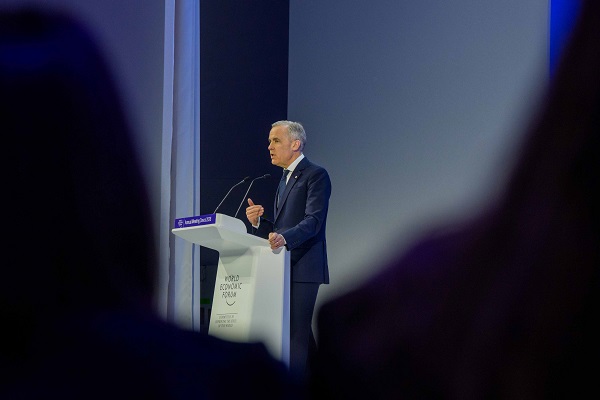
When the late playwright Tom Stoppard’s Rock ‘n’ Roll first opened 20 years ago, it was deeply personal for me as a student at Cambridge studying film in Prague. A meditation on the clash between communism and capitalism in Czechoslovakia (now the Czech Republic and Slovakia), it dwelt on the confrontation between high theory and lived reality in a way that moved me profoundly. Two decades later, Canadian Prime Minister Mark Carney’s recent speech in Davos felt like the sequel.
Stating in no uncertain terms that “the rules-based order is fading,” and that we are undergoing a “rupture, not a transition,” Carney offered a master class in what he calls “naming reality.” For nearly four decades (since the fall of the Berlin Wall), Western policymakers have assumed that the prevailing international order would progressively expand its circle of beneficiaries, constraining power with institutions, markets, and normative frameworks. But Carney, a leading exponent of that order, has discarded this script.
The “great powers,” he noted, are abandoning even “the pretense of rules and values for the unhindered pursuit of their power and interests.” The multilateral institutions that have defined the postwar age are “under threat,” with the UN secretary-general recently acknowledging that his organization is at risk of “imminent financial collapse.” Thucydides’ famous aphorism – “the strong do what they can, and the weak suffer what they must” – is once again becoming the currency of geopolitics.
The intervention of a former central banker (Carney previously led both the Bank of Canada and the Bank of England) serves as a bookend to the brief period of unquestioned Western dominance that is most famously associated with Francis Fukuyama’s “end of history” thesis. Invoking the Czech writer-turned-president Václav Havel’s essay “The Power of the Powerless,” Carney revived a striking insight from the Cold War’s battle of ideas.
For decades, he told the Davos audience, we have been “living within a lie” (quoting Havel) under a system whose “power comes not from its truth but from everyone’s willingness to perform as if it were true.” Systems endure not simply through force, but through the ritual compliance of ordinary participants, like the greengrocer who, “to avoid trouble,” displays a sign reading, “Workers of the world, unite!” Suspending his disbelief, he opts for safety, toeing the party line rather than confronting power.
Carney’s reference to Havel was not some quaint historical aside. He was urging us to open our eyes and recognize that we replaced one lie with another after the Cold War. The world’s middle powers have been especially complicit in the “fiction” of a benign global order. For decades, countries like Canada, Japan, and Western Europe’s advanced economies have chosen to “go along to get along” – accepting asymmetric enforcement of trade rules and tolerating legal exceptions for powerful states – because compliance bought stability.
“We knew the story of the international rules-based order was partially false,” Carney said, “that the strongest would exempt themselves when convenient … and we knew that international law applied with varying rigor depending on the identity of the accused or the victim.” In calling out the double standards, he articulated a truth that the Global South has always known.
Carney’s speech was a timely reminder of what truly sustains economic systems: participants opting in. His speech highlights that we all must reject nostalgia for a rules-based system that never fully delivered on its promises. But we also must reject cynicism about cooperation itself.
Given that the Cold War-era battle between capitalism and communism was as much a struggle between belief systems as between arsenals, the parallels with today are notable. In the 20th century, systems competed not just for material advantages but also for legitimacy. The task was to convince populations, governments, and elites that your model was more than a velvet glove for old-fashioned, iron-fisted coercion.
Today’s competition is no less ideological, even if it is less fully articulated. The hegemonic pretensions of powerful states, the weaponization of interdependence, and the erosion of shared norms all confirm that old certainties have dissolved. That is why Carney has called not for a reincarnation of 20th-century blocs, but for a lucid rejection of complacency – a refusal to be the greengrocer who resignedly participates in the lie.
More than just a pragmatic policy address, Carney’s speech issued a challenge to replace lies with truth, pretense with authenticity, and a global economic architecture of “fortresses” and “walls” with one of “variable geometry … different coalitions for different issues.”
As Havel and Stoppard both understood, systems fall first in the realm of belief. Culture, not politics, is what ultimately undermines dogma. What all tyrannical systems share, Carney reminds us, is “the participation of ordinary people in rituals they privately know to be false.” Accordingly, such regimes’ “fragility comes from the same source,” so that “when even one person stops performing … the illusion begins to crack.”
Carney has stepped onto the international stage as that person, proclaiming an end to “the end of history.” For me, it feels like Prague all over again: Can the end of a comforting fiction become the start of real emancipation?
© Project Syndicate 1995–2026
More From BasisPoint