.png)


Krishnadevan is Editorial Director at BasisPoint Insight. He has worked in the equity markets, and been a journalist at ET, AFX News, Reuters TV and Cogencis.
May 7, 2026 at 1:45 PM IST
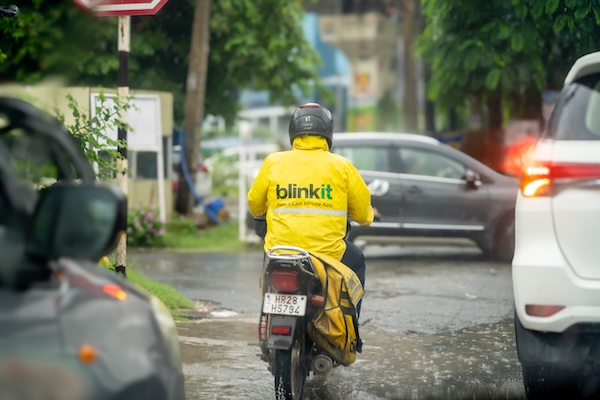
Most investors watching Blinkit focus on the logistics operation, the 2,243 dark stores, the 17 million square feet of warehousing, and the supply chain stitched together over a decade across India's most operationally demanding cities.
That focus is understandable, because Q-commerce leader Blinkit built something genuinely hard to copy. But the margin story that parent Eternal Ltd has promised its shareholders by 2028-29 does not depend on logistics. It depends on advertising, and advertising is a market where proximity and incumbency count for very little when a better-capitalised buyer enters the auction.
Eternal has guided to ₹1 billion in consolidated adjusted EBITDA by 2028-29, with Blinkit carrying the heaviest load in that target. Food delivery already earns at 5.5% adjusted EBITDA margins, a number that has held steady across three consecutive quarters. Blinkit sits at 0.3% of net order value today, which means the segment needs to expand margins roughly 17 to 20 times over to bridge the gap.
The margin expansion can come via three levers. The first is operating leverage as store density rises. The second is indirect cost efficiencies as the network matures. The third is advertising revenue growing alongside order volumes, and it is the only one of the three that depends entirely on brands choosing Blinkit as their preferred quick commerce advertising destination.
Eternal does not separately disclose Blinkit’s advertising income, because it combines those revenues within the broader quick commerce line. Investors therefore cannot independently verify whether advertising, the highest-margin lever in the model, is scaling fast enough to justify the company’s 2028-29 profitability assumptions.
Margin Pressure
Blinkit's advertising business works exactly like a supermarket shelf at eye level: brands pay for the spots that shoppers see first.
Unlike Google or Meta, where brands interrupt someone who may or may not want their product, Blinkit sells visibility to a shopper who has already opened the app to buy something. That makes the intent signal far more valuable to a media buyer and allows Blinkit to command higher rates as a result.
Blinkit runs an auction where brands bid for placements and charges per impression rather than per click, so it earns revenue even when a shopper scrolls past without buying. Advertising margins are estimated to exceed 80%, making this revenue stream disproportionately important to Blinkit’s target EBITDA profile.
This matters because deep-pocketed competitor Amazon Now, the quick commerce arm of Amazon, is pressing into exactly the markets where Blinkit's advertising income is most concentrated.
Amazon Now currently operates 300 micro-fulfilment centres across Delhi-NCR, Mumbai, and Bengaluru, the three cities where Blinkit earns its highest per-store margins and holds its deepest brand relationships.
CEO Andy Jassy told investors on Amazon's January-March earnings call that Amazon Now orders in India are growing 25% month-on-month, with Prime members tripling their shopping frequency after adopting the service. Amazon India's core app already reaches 60 million daily active users who carry saved payment credentials, stored addresses, and a prepaid annual subscription.
When Amazon waived referral fees on all SKUs priced below ₹1,000 earlier this year, brands did not need persuading to redirect a portion of their quick commerce marketing budgets.
Blinkit, by contrast, is asking brands to build a new media-buying practice around a platform whose advertising product is still maturing. Every 100 additional orders per store per day generates roughly 80 to 90 basis points of incremental EBITDA margin, assuming other variables remain stable.
Amazon has committed more than ₹28 billion to expanding across 100 Indian cities with over 1,000 micro-fulfilment centres, though it does not need to execute that full plan to affect ad pricing in three cities where the outcome already matters to Eternal's 2028-29 guidance.
Blinkit's logistics moat is genuine and durable; Delhi-NCR stores are already touching the guided 5% to 6% margin range, confirming that the unit economics work when advertising and throughput align.
The risk is not that Blinkit loses customers or stores. It is that advertising revenue, the least transparent and most profitable part of Blinkit, does not grow as expected.
The market’s pricing of Eternal at 59 times 2027-28 earnings appears to rely on the company’s logistics strength, even as long-term margin expectation hinges on the advertising business.
The ₹1 billion milestone may be achieved; perhaps a year later than estimated, and at a multiple that has had time to adjust on the way.
Amazon does not need to dominate quick commerce to pressure Blinkit’s strategy. It only needs to become credible enough to influence where consumer brands spend their advertising budgets.
(This column reflects the author's personal views and is based on publicly available information. It is intended for general commentary and analytical purposes only and should not be construed as investment advice.)
More From BasisPoint