.png)

The Budget Through a Political Lens
With key elections due in states considered difficult terrain for the ruling BJP, the Budget could double as a political opportunity.
Rajesh Ramachandran is a former Editor-in-Chief of The Tribune group of newspapers and Outlook magazine.
January 23, 2026 at 12:15 PM IST
Even as the world grapples with a new smash-and-grab order and wakes up to economic contingencies of the worst kind, it is politics as usual for the Indian economy. With assembly elections due in West Bengal, Tamil Nadu, Kerala, Assam and Pondicherry over the next three months, the Union Budget 2026 may get weighed down by developmental promises and capital outlays for mega infrastructure projects aimed at voters in these states.
Prime Minister Narendra Modi has already rung in the election season, announcing big-ticket projects in West Bengal and Assam, and is expected to do the same in Kerala on Friday setting in motion the government’s economic priorities, which will inevitably have a bearing on the Budget announcements on February 1. This one, hence, for all political purposes, can be counted as a mini-election Budget. More so because the BJP is facing formidable rivals all around, with its chances of winning thin, but for miracles.
Strikingly, no two contests can be as diverse and mutually incomprehensible as in this round of assembly elections. The BJP is in power only in Assam, and it is the principal Opposition party in West Bengal. It has only 2.6% vote share and four seats in the 234-strong Tamil Nadu assembly, while it does not have a single MLA in Kerala’s 140-member assembly. In fact, the only common factor in these five contests is that the BJP has long been an outlier in four of them, making it desperate to enlarge its electoral footprint.
So, when Nirmala Sitharaman stands up to read out the Budget proposals, some of them, obviously, would be meant to help her party scale some of the electorally impenetrable peaks.
The Prime Minister kicked off his election campaign by visiting Kolkata and Malda on January 18. He flagged off the first Vande Bharat Sleeper train from Howrah to Kamakhya (Guwahati) while announcing projects worth ₹8.30 billion, including the laying of the foundation stone for an Inland Water Transport terminal. Apart from the premier Vande Bharat Express, there were also Amrit Bharat trains for migrant workers.
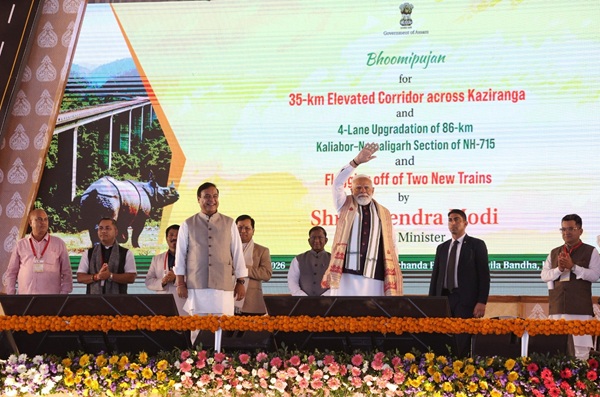
The following day, another foundation stone was laid in Assam for the Kaziranga Elevated Corridor project, estimated to cost ₹69.50 billion, apart from the Amrit Bharat trains. The BJP has been in power in Assam for a decade and does not feel threatened by the Congress Opposition. In fact, in this round, only Assam offers a BJP-Congress faceoff, which normally goes in the former’s favour.
The only instance of the Congress defeating the BJP in a one-on-one contest in the recent past was the 2022 Himachal Pradesh election. The BJP was a poor third in the 2023 triangular Telangana polls, which the Congress won, conclusively defeating Bharat Rashtra Samiti.
But that is not the case in West Bengal, where the Congress and all its allies put together drew a blank in 2021. The Trinamool Congress had won 215 assembly constituencies with the state’s nearly 30% Muslims firmly standing behind TMC chief Mamata Banerjee and refusing to split across the Opposition spectrum. The BJP, despite a spirited fight, had to be content with just 77 MLAs. Hence, there is every possibility of more projects, proposals and largesse being offered to Bengal in the upcoming Budget.
Though there are no strong indicators of an anti-incumbency wave in Bengal, Banerjee has been in power for 15 years, and the state has little to show for employment generation, with able-bodied men and women having to travel across the country in search of unskilled jobs. Amrit Bharat trains are being offered for these people who are at the bottom of the development pyramid. Some budget proposals alleviating their lot need to be factored in.
The installation of the first BJP mayor in Thiruvananthapuram, following the party’s victory in the local body polls in the capital city, has triggered tremendous jubilation among Hindutva outfits across the country. For this was the breach of a hitherto unassailable fortress, whose communal calculus cannot allow the growth of a Hindu-first party. Kerala has close to 30% Muslims (26.6% according to the 2011 census) and 18% Christians; thus, making it impossible for Hindutva to gain a political upper hand.
That leaves the party with only the development plank. And it has chosen a technocrat, former union minister Rajeev Chandrashekhar, who has no ideological baggage, to lead the state unit. The Prime Minister is flying down on Friday to make the announcements that may include a high-speed rail project for the state and a host of other proposals to lure the city-dwellers. The best that the BJP can hope for in Kerala is 20% vote share (which an NDTV opinion poll predicted this week).
The BJP came first in 11 assembly segments across three Parliamentary constituencies in Kerala in 2024, marking a big leap from being only a runner-up in nine seats in the 2021 assembly election, without a single MLA. Earlier this week, Union minister Ramdas Athavale, in his characteristic style, asked the ruling Left Democratic Front to join the NDA for more central funds. The electoral game in the outlier states is played entirely in terms of Central allocations.
Of all the states, the BJP has been struggling to find a toehold in Tamil Nadu. While playing the dealmaker, it has struck an alliance, bringing together the warring splinter groups of the AIADMK. The final shape of the NDA alliance will be revealed at the PM’s rally on Friday at Maduranthakam in Chengalpattu, not far from Chennai. Unlike in Thiruvananthapuram, no clear developmental promises have been discussed yet.
But the formula remains the same for every state election: Hindutva plus development, with the offer of a double-engine growth, which, in fact, is a metaphor for the Centre opening its purse. For a party that used the income tax relief in the last Budget so effectively to turn the tide of opinion in its favour in the Delhi state elections, every policy pronouncement is a political opportunity. So would this Budget be!
More From BasisPoint