.png)


February 11, 2025 at 12:22 PM IST
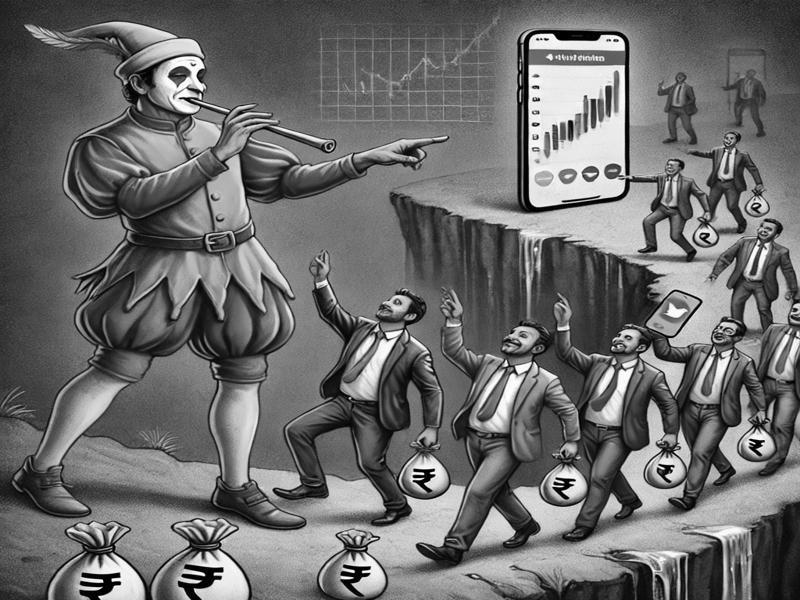
"Investors in blind pursuit of profit through investment in a company without any fundamentals are like children following the proverbial pied-piper of Hamelin."
This remark comes from an interim order in an investigation led by Ashwani Bhatia, a whole-time member of the Securities and Exchange Board of India (SEBI), issued today.
The order, related to manipulative trading in the shares of LS Industries Ltd, comes at a time when over ₹75 trillion in market capitalisation has been wiped out since the peak of September 2024. SEBI's swift action in this case is commendable—one of the quickest this writer has observed. (The investigation began after an article in NDTV Profit on Feb 3, 2025.)
The Pied Pipers of today are finfluencers—and many, though not all, of those whose jobs or compensation depend on selling an investment story and fueling the Fear of Missing Out (FOMO).
Ashwani Bhatia's invocation of the Pied Piper of Hamelin serves as a stark warning against the herd mentality that lures investors into believing there is easy money to be made in the stock market.
His analogy underscores a pressing issue: the growing susceptibility of investors to narratives and cognitive biases that cloud rational decision-making.
Continuing with the reference to Pied Piper, SEBI said, "Markets can be generous at times but cannot be so generous to give outlandish gains. In a market where unscrupulous elements seem to be casting their net wide by indulging in various manipulative practices, the investors must not allow the lure of easy profits get the better of them."
This is a reference to the Gambler's Fallacy, where you ignore the independence of market events and, believe that because the market has been generous in the past it will be generous again.
The SEBI order points out to the spate of corporate announcements around the 'hook' word 'AI'.
LS Industries changed to AI Tech Ltd, then appointed foreign nationals to its board, announced a Dubai subsidiary in AI Tech & Hydroponics and then acquired a zero-sales (across quarters) company that was a AI-powered robotic chef startup.
All these were sufficient raw material to create a saleable story and to build compelling narratives around a stock's performance, ignoring fundamental analysis in favour of a good story.
They weaved such a good story that it missed investors that the company had no sales and had 58,416 debtor days of trade receivables in FY24.
Last 3 years' financial statements of LS Industries Ltd
|
Particulars |
FY 2021-22 | FY 2022-23 | FY 2023-24 |
| Sales/Revenue from Operations | 4.3 | 4.5 | 4.5 |
| Other Income | 0.8 | 0.8 | 1.3 |
| Total Income | 5.1 | 5.3 | 5.8 |
| Cost of material consumed | 0.0 | 0.0 | 0.0 |
| Purchase of Inventory | 0.0 | 0.0 | 0.0 |
| Other Expenses | 22.0 | 90.3 | 36.2 |
| Total Expenses | 22.0 | 90.3 | 36.2 |
| Profit (Loss) Before Tax | -16.9 | -85.0 | -30.4 |
| Profit (Loss) After Tax | -20.4 | -88.3 | -33.2 |
It was a compelling story, amplified by authority bias—after all, a mutual fund had purchased 8,300 shares of the company, according to BSE data.
SEBI has acknowledged the "absurdities" of the case and, to prevent pump-and-dump scammers from exiting the stock, has banned the accused from trading in it while imposing additional restrictions.
SEBI’s swift action serves as a well-timed reality check, deflating herd mentality, FOMO, gambler’s fallacy, narrative fallacy, and authority bias. It is a stark reminder to investors that if something seems too good to be true, it probably is.
More From BasisPoint