.png)

Nepal’s Angst Has Produced a New Leader. Now Comes the Hard Part
For India, the emerging political landscape presents both uncertainty and opportunity.
Saibal Dasgupta is an author, veteran journalist, and noted China expert who has reported from Beijing since 2005 and contributes to global media and think-tanks.
March 7, 2026 at 2:38 PM IST
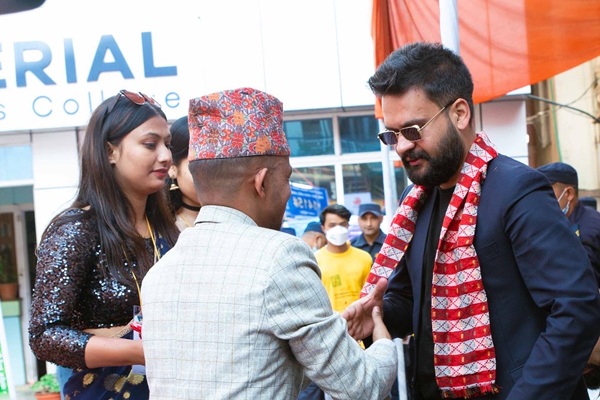
A generational political upheaval has brought Balendra Shah, a 35-year-old rapper and former mayor of Kathmandu, to the threshold of national leadership in a country where the median age is just 26. Whether Shah, set to take over as Nepal’s prime minister can transform political anger into constructive diplomacy may determine the country’s next phase of stability.
Nepal’s voters have delivered a decisive rejection of the old political order. Many of the country’s aging leaders have been swept aside, including the pro-China former prime minister K P Sharma Oli, 72, and his Communist Party of Nepal (Unified Marxist-Leninist). The electoral outcome signals a deep public backlash against entrenched political elites and the inheritance politics that has dominated Nepal’s democratic era.
The Rastriya Swatantra Party, only three years old, has emerged as the central force in this political transformation. Riding a wave of Gen Z mobilisation, the party is set for a landslide victory.
The surge of support for the RSP followed a period of intense political unrest. The immediate trigger was a social media ban imposed in September 2025 that sparked widespread protests and ultimately led to the collapse of the Oli government. Young voters, already frustrated with corruption and economic stagnation, turned the protests into a broader political revolt.
Resistance to the traditional methods of political campaigning also played a role. Older parties such as the Nepali Congress and the UML had long relied on money and muscle power during elections. However, the interim administration led by Sushila Karki after the student uprising encouraged digital payments and reduced the circulation of cash in political activity. The violent protests during the movement had already shaken the business community, making corporate donors wary of backing established political parties.
The RSP capitalised on this moment of public discontent. Its campaign relied heavily on social media and centred on promises of systemic reform, anti-corruption measures and job creation. Yet beyond the broad demand for change, the party has offered relatively few concrete details about how it plans to revive Nepal’s fragile economy.
Shah’s political image has evolved rapidly during his rise. As mayor of Kathmandu he gained attention for his assertive governance style. In February 2025 he drew criticism after banning public celebrations during the Chinese New Year, which led some observers to label him anti-China. He also questioned delays in the expansion of Kathmandu’s ring road project, which was being constructed by a Chinese company.
His image took another controversial turn when a map labelled “Greater Nepal” appeared in his office. The map included territories that are currently part of India. This prompted speculation among political observers about whether Shah was also adopting a nationalist posture toward India.
At the same time, Shah has tried to project independence from all major geopolitical players. The new leadership around him has repeatedly indicated that Nepal should pursue policies free from the influence of the United States, China and India. This positioning reflects a broader sentiment among younger Nepalis who are increasingly wary of external influence in domestic politics.
Despite the sweeping electoral victory, analysts are still trying to interpret the depth of the political shift. The scale of the RSP’s success suggests that voters may be seeking not only a change in leadership but also a redefinition of how Nepal’s political system functions.
For India, the emerging political landscape presents both uncertainty and opportunity. Relations between New Delhi and Kathmandu have experienced periodic tensions in recent years, allowing China to expand its influence through infrastructure projects linked to the Belt and Road Initiative.
India’s strategic interest in Nepal remains significant because the two countries share open borders and deep economic ties. New Delhi may now see an opportunity to rebuild goodwill among ordinary Nepalis by emphasising cooperation in infrastructure, particularly railway connectivity and electricity trade.
At the same time, Nepal’s new leadership faces the difficult task of balancing relations with both India and China while addressing domestic expectations for reform and economic growth.
Whether Shah can channel the anger that propelled his party to power into pragmatic diplomacy and effective governance will determine whether Nepal’s political earthquake becomes a lasting democratic renewal or merely another phase of instability.
More From BasisPoint