.png)

Sujit Kumar is Chief Economist at National Bank for Financing Infrastructure and Development.
September 15, 2026 at 4:15 AM IST
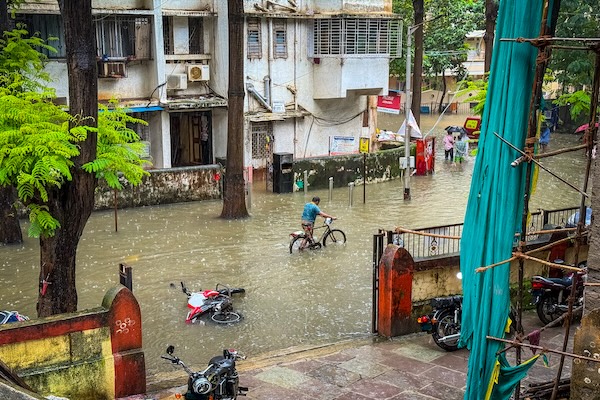
Every summer, through May and June, Mumbai keeps a keen eye on its reservoirs. Water levels at Upper Vaitarna, Bhatsa and Tansa are monitored and reported, water cuts are announced when storage runs short, and the arrival of the monsoon brings a sense of relief. Yet, within weeks, the much-awaited rainfall interrupts the city’s trains, power supply and working days. Mumbai’s relationship with water is therefore dual in character, and the city continues to build and reform its systems to manage it.
The machinery is substantial and evolving. The Brihanmumbai Municipal Corporation (BMC) budget for 2026–27 stands at ₹809 billion, of which capital expenditure accounts for ₹481 billion, close to 60% of the total. Stormwater drainage projects carry a provision of ₹18 billion, while the corporation’s Climate Budget allocates ₹180 billion in capital expenditure for urban flooding and water resource management under the Mumbai Climate Action Plan. Pumping stations have been installed across Haji Ali, Irla and Britannia. Railway tracks are raised at chronic flooding points, and desilting is carried out before every season. The pace of this work is debated each monsoon, and BRIMSTOWAD, conceived after the 2005 floods, remains a work in progress. These investments are imperative, and the city would be considerably worse off without them.
Beyond Assets
What this apparatus shares is a rather peculiar way of assessing whether the city’s preparedness is adequate. Was the load adequately carried by drains? Was the pumping station running? Did the track remain usable? These questions centre on whether infrastructure survives an event, and they have clear, measurable answers.
There is a more important underlying question, however, and it is asked far less often. Rainfall, while the same when it arrives, does not impose the same cost on everyone it reaches. For a salaried household, a morning of heavy rain and flooding may result mostly in lost time, an inconvenience that is recoverable. For a household whose income depends on physical presence, however, the same waterlogging can mean lost earnings. For gig workers, domestic help and daily-wage labourers, the loss can extend beyond the event itself through damaged stock and days of work missed while a market or worksite remains shut. Drainage clears the street for both on the same timeline, but the economic disruption it leaves behind can be vastly different. That difference follows lines of occupation and income, not rainfall.
This is the pivotal distinction between infrastructure that survives an event and infrastructure that keeps a city functioning through one. The first concerns the asset itself, how it is maintained and what precautions are taken to prevent structural damage. The second concerns the service the asset exists to provide, and whether it continues to reach the people who depend on it.
Mumbai’s post-monsoon evaluation currently speaks almost exclusively the first language. It reports that pumps operated at capacity, trains resumed normal services and supply was restored quickly. Each statement is accurate, but each describes the system rather than the working day of the person relying on it. An asset can perform exactly as designed, yet the true test of climate resilience is whether the service, as experienced by a household, continued as intended or stopped altogether.
Much of what is needed to carry out this evaluation already exists. The Mumbai Climate Action Plan includes ward-level flood vulnerability mapping. The corporation maintains records of chronic waterlogging locations from year to year. Ward-level data on workforce composition, including how many households depend on daily physical presence for income, is available in the Census. Bringing these together would add a layer to mapping already underway: alongside elevation and inundation history, it could show how long a location remains economically out of action, and for whom.
Measuring Recovery
The suggestion, then, is a modest one. As the city continues to strengthen its flood infrastructure, its assessment of that infrastructure could widen to include a second measure: not only how quickly water clears from a location, but how soon the location is genuinely usable again, and how that varies across wards.
For institutions financing urban climate resilience, this addition matters. Appraisal based solely on asset performance will tend to understate the value of investment in areas where the main cost of flooding is interrupted livelihoods rather than damaged property. A fuller measure of what flooding costs would provide a fuller picture of what flood protection is worth.
Mumbai has become good at measuring the rain, and increasingly good at managing the water. What it has not yet learned to measure is recovery. That is where the monsoon becomes a lived experience, one working day at a time. An asset can perform exactly as designed and still leave a household stranded, because the question that matters is not whether the drain held, but whether the commute happened, the shift was worked and the day went on.
*Views are personal.
More From BasisPoint