.png)


Dev Chandrasekhar advises corporates on big picture narratives relating to strategy, markets, and policy.
March 25, 2026 at 7:03 AM IST
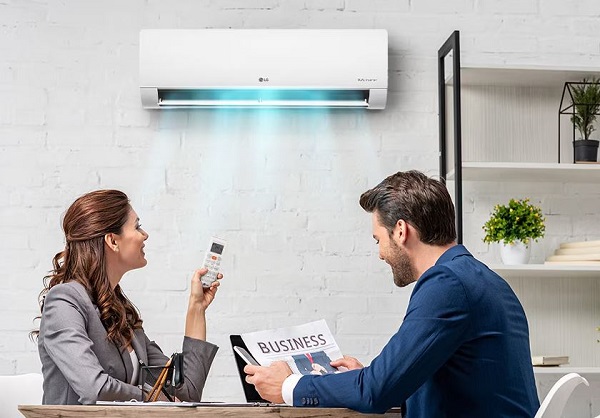
For LG Electronics India, the April–June cooling season is the year’s most important revenue event. The company sells roughly a third of its air conditioners in that window. This year, with margins compressed and the first three quarters of 2025-26 delivering a 2.2% revenue decline, that quarter is carrying extra weight. Although March has thrown in an unwelcome wrinkle, January and February have already shown year-on-year improvement.
India’s largest room air conditioner brand by premium market share enters the season with normalised channel inventory, a 7–10% price hike already landed in January, and a management team that spent the better part of a recent plant visit in Pune telling analysts there is nothing to worry about.
Following that visit, three brokerages reiterated outright Buy ratings and another maintained an Add. The broader community is similarly aligned: 17 analysts tracked by Investing.com carry a Strong Buy consensus, with an average 12-month price target of ₹1,865. Their thesis rests on a hot Indian summer, a normalised trade pipeline, and a company structurally outpacing peers on premium mix.
The backdrop, though, is less comforting. In the October–December quarter, EBITDA margins fell nearly 300 basis points year-on-year, dragged by raw material cost inflation and currency headwinds, while PAT fell over 60%. The balance sheet remains strong, with net cash of nearly ₹40 billion and return ratios among the best in Indian consumer durables.
The less comfortable part sits in the footnotes. LG India’s exposure to the Iran–Israel conflict and broader Red Sea disruptions may be indirect but real. Exports contribute around 6% of revenues, with the Middle East forming a meaningful slice. Elevated freight costs have weighed on export demand, though the direct revenue hit remains limited at around $2–3 million per quarter, less than 1% of total revenue, according to an HDFC Securities note.
That number is small. The direction of travel is not reassuring. Raw material availability is the sharper concern. The conflict has pushed up crude-linked and petrochemical inputs. Resins central to appliance manufacturing were already volatile before the latest escalation. Management expects supply disruptions to stabilise by early April, a projection that carries geopolitical assumptions.
Thin Margins
The LPG problem sits in the same neighbourhood. A domestic gas shortage, partly driven by tightening Gulf import logistics, has forced LG to accelerate a transition to PNG and diesel at Ranjangaon. The company insists no production stoppage is imminent, but vendors are less insulated. Component suppliers within a 25 km radius are navigating procurement constraints that LG cannot fully control.
Then there is the weather. An unusual western disturbance travelling in a straight line from Afghanistan through Pakistan into India swept across North and peninsular India this week, bringing heavy rain, thunderstorms, and winter-like temperatures to states that should by now be reaching for their air conditioner remotes. The India Meteorological Department says the relief is short-lived and above-normal heatwave conditions are expected from April. But the season has already lost weeks it cannot easily recover.
The 2026-27 recovery thesis — revenue growth of 13–14%, EBITDA expanding back towards 11–12%, and exports targeted at 2x — remains intact on paper. LG India’s domestic business, which drives over 93% of revenues, is built for Indian summers, and the Sri City plant coming online through 2027–29 deepens long-term self-sufficiency.
What the weather system and the conflict together do is narrow the margin for error. A delayed cooling season, a vendor LPG disruption extending beyond March, or a freight cost spike bleeding into the April–June quarter of 2026-27 could each push the recovery thesis out by a quarter. None of these individually is fatal to the bull case. Together, they would be.
The consensus is pricing in 21% upside from current levels. That return assumes 2026-27 delivers. Weather and geopolitics are variables that analyst confidence cannot neutralise. Right now, both are moving in the wrong direction.
(This column reflects the author’s personal views and is based on publicly available information. It is intended for general commentary and analytical purposes only and should not be construed as investment advice.)
More From BasisPoint