.png)

Khamenei’s Funeral and the Unravelling of the Islamabad MOU
Iran’s greatest act of military defiance is its rising threshold for misery, not missiles or drones; the Strait remains its only leverage in war.

Rajesh Ramachandran is a former Editor-in-Chief of The Tribune group of newspapers and Outlook magazine.
July 10, 2026 at 1:23 PM IST
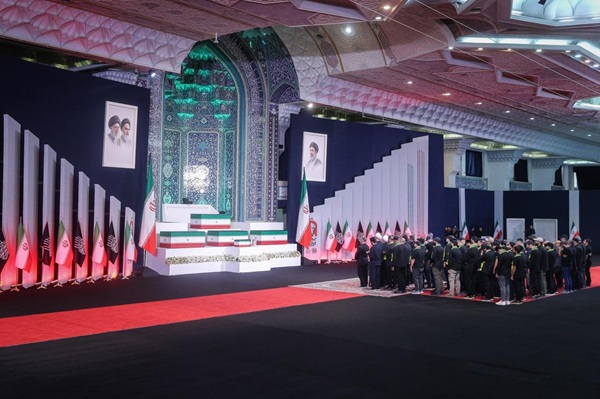
It has been a week of the grand theatre of grief in Tehran, in Najaf, and in Karbala, across two nations divided by colonial boundaries and united in mourning. No national wartime leader has had such a final journey with representatives from all over the world queueing up to pay respects and millions of ordinary people thronging the streets and clenching their fists against the US-Israel combine, proving that they have not been defeated by nearly five decades of sanctions and the recent relentless bombing of their homes, schools, and military installations.
It has also been a week of broken promises. Along with the Islamabad Memorandum of Understanding, the post-World War rules-based order lies in tatters. The US proved that it does not believe in mutually agreed rules. The latest round of US bombing that happened during Ayatollah Ali Khamenei’s funeral was triggered by Iran’s actions to enforce a vital clause in the MOU. It was as if the US was waiting for Iran to get provoked before unleashing its bombers.
The MOU places Iran at the centre of arrangements for the passage of commercial vessels through the Strait of Hormuz. After the US attack on the oil tanker MT Settebello on June 10 in the Gulf of Oman, which killed three Indian sailors, Tehran could argue that the agreement entitled it to challenge commercial vessels sailing on July 6 without coordinating with it. “What is good for the US is obviously not good for Iran” is the neo-colonial message that has been conveyed to Asian countries over the past five months. In this context, it is worth re-reading Point No. 5 of the MOU:
“Iran will make arrangements using its best efforts for the safe passage of commercial vessels with no charge for 60 days, only from the Persian Gulf to the Sea of Oman and vice versa. The traffic of commercial vessels will immediately start and considering the need for removing the tactical and military obstacles and de-mining by Iran will be initiated within 30 days. Iran will conduct dialogue with Oman to define the future of administration and maritime services in the Strait of Hormuz, in discussion with the Persian Gulf littoral states in line with the applicable international law and the sovereign rights of coastal states of the Strait of Hormuz.”
The clause recognises a substantial Iranian role in arranging safe passage, removing obstacles, and shaping the Strait’s future administration. US acceptance of the MOU amounted, at the very least, to an acknowledgement of that role. Point No. 5 was therefore at the heart of the Iran-US deal, because the Strait represented Iran’s principal leverage against the forces attacking it. If Iran relinquishes control of the Strait, making it open to control by the US directly or through proxies, Iran will have fought in vain. It was in this context that Iran challenged commercial vessels that disregarded the arrangements and continued sailing as though the war begun by the US and Israel on February 28 had not altered the status quo.
US President Donald Trump, in his daily rhetoric about Iran, helps to draw an obfuscating curtain over the attack on Iran, the assassination of its Supreme Leader, the devastation of its civilian and military facilities, including the strike on the Minab school that killed 120 children. Those were the starting points of this war and not the Iranian response. Iran has so far bombed only US bases and military assets in the region while suffering immense losses and absorbing incalculable pain.
In fact, Iran’s greatest act of military defiance has been its ever-rising threshold for misery rather than radar-defying missiles or drones. This people’s resolve was on display on the streets of Iran and even in Iraq, which had fought an eight-year war engineered by Saddam Hussein, who was then aided by the West. The latest round of bombings by the US seems more an attack on the Iranian people’s will than a response to Iran’s avowal of sovereignty over its extended territorial waters. Again, the US often makes the world forget that the Strait was open before the war and Iran closed it as its only leverage against attacks.
Iran retaliated by striking US bases in Jordan, Bahrain, Qatar and Kuwait; the price of oil immediately spiralled up by about 5-6%; the US re-imposed sanctions on Iranian oil; and Trump indulged in inflammatory language about the people of Iran. All this while, the funeral rites of the Ayatollah and his family members, including a child, who were killed by the US and Israel, were still going on. The contrast between the widening war and the language of liberty surrounding the United States’ 250th-anniversary celebrations was stark.
The strange coincidence of the anniversary and the heightened bombing of Iran just proved that the American rules-based order is a metaphor for Western neocolonialism: seizing resources and conquering Afro-Asian people. The saga of the last 250 years of regime-change attempts continues with Iran as the latest milestone in the Anglo-American imperial enterprise that began with the high point of the installation of Mir Jafar after the Battle of Plassey in 1757.
Meanwhile, Israeli Prime Minister Benjamin Netanyahu has claimed that 1.4 billion Indians offer “absolutely crazy support” for Israel. Sure, the Sangh Parivar and the BJP consider Israel to be an ideological ally against the global Islamist agenda, particularly in the context of religious separatism in Jammu and Kashmir. But this is in no way the Indian population’s endorsement of Israel’s role in protecting Anglo-American interests in the Persian Gulf and in its treatment of Palestinians.
More From BasisPoint