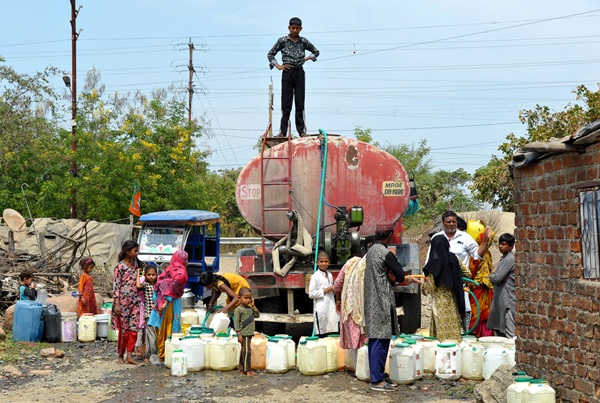
We are at the beginning of July, and much of the country is already facing a severe water shortage. The heatwave in April and May dried up subsoil moisture, the southwest monsoon arrived late and reservoir levels remain under pressure.
This has become another year to blame El Niño. It certainly has a role, bringing below normal rainfall and disrupting the kharif season for crops such as paddy, coarse cereals, pulses, oilseeds and cotton. But the weather alone cannot explain why India finds itself in this position year after year.
The truth is that India is living with the consequences of years of neglect. The risks posed by climate change and global warming to a tropical country like ours have been well understood for at least two decades. We knew what lay ahead, but failed to prepare for it.
The irony is that India is not short of water resources. The country receives an average of 870 mm of rainfall during the southwest monsoon, has hundreds of rivers, a coastline stretching over 7,500 km and an extensive network of major and medium reservoirs.
Yet we find ourselves in a position reminiscent of the old saying that India is only one poor monsoon away from an agricultural crisis. We have taken water for granted for far too long.
India has 17% of the world's population but only about 4% of its freshwater resources. That imbalance cannot be wished away. Demand for water will continue to rise as agriculture, industry and cities expand.
Water security can no longer be treated as a sectoral issue. It is central to the country's long term economic resilience.
For years, agricultural policy has been driven largely by the need to raise output, with too little thought given to how water would be managed in a changing climate. Yet farming, including livestock and poultry, accounts for nearly 80% of the country's freshwater use.
Policy incentives have also encouraged cultivation of water intensive crops such as paddy and sugarcane. Flood irrigation remains common in many regions, drawing heavily on groundwater and steadily depleting aquifers that took decades to build up. When India exports rice, and at times sugar, it is effectively exporting scarce water. While exports may benefit farmers in the short term, those gains will prove unsustainable if water itself becomes scarce.
Policy Priorities
This crisis should serve as a wake up call. India needs a coordinated and long term strategy to secure its water future.
First, pending irrigation projects must be completed without further delay. Many remain stalled because of funding shortages, delays in techno economic approvals, interstate disputes and weak project execution. Completing last mile connectivity is equally critical.
Second, crop incentives need to change. Millets, pulses and oilseeds should receive greater policy support, particularly in arid regions. This would not only reduce water consumption but also lower India's heavy dependence on imports of pulses and edible oils.
Third, investment in agricultural research must increase. Developing short duration, heat tolerant and drought resistant seed varieties requires sustained funding and policy continuity. As results take five to seven years to emerge, governments must remain committed if private investment is to follow.
Fourth, water saving technologies such as drip irrigation and sprinklers should be adopted much more widely, especially for horticulture.
Fifth, India must revive its traditional water bodies. There was a time when almost every village had a pond, and towns too maintained local water storage systems. Many have since disappeared or fallen into neglect. Restoring, rejuvenating and desilting these water bodies should become a national priority.
Finally, agricultural universities and Krishi Vigyan Kendras should play a much larger role in training Farmer Producer Organisations and rural communities in scientific water management and conservation practices.
Water may be a State subject under the Constitution, but water security is unquestionably a national responsibility. The Centre must bring the states together before recurring shortages become the new normal. India cannot afford to make water its Waterloo.
.png)