.png)


Dhananjay Sinha, CEO and Co-Head of Institutional Equities at Systematix Group, has over 25 years of experience in macroeconomics, strategy, and equity research. A prolific writer, Dhananjay is known for his data-driven views on markets, sectors, and cycles.
April 23, 2026 at 1:17 PM IST
On most weekends, value fashion stores across India project an image of effortless success. Crowded aisles, brisk billing counters, and racks of trend-led clothing priced under ₹1,000 create the sense of a format that has tapped into a deep and durable demand pool.
For a generation of price-conscious but aspirational consumers, this segment has come to represent democratised fashion, accessible, contemporary, and increasingly organised.
That visible momentum has shaped the broader narrative around India’s value fashion industry, one of the fastest-growing segments in retail. Chains across the spectrum have expanded aggressively over the past five years, adding thousands of stores and pushing into Tier-2 and Tier-3 cities, where organised retail is steadily gaining share from traditional markets.
The proposition has been simple and compelling: combine private labels, efficient sourcing, and rapid inventory turns to deliver fashionable products at near-bazaar prices, while maintaining the consistency and experience of organised retail.
That proposition is now encountering its limits.
Channel checks across multiple regions indicate that store-level demand growth has slowed meaningfully. Mature stores, including those in urban clusters, are reporting same-store sales growth of just 2–4%, a sharp moderation from earlier periods when expansion was accompanied by strong like-for-like performance.
The divergence between headline growth and underlying operating trends is becoming increasingly visible.
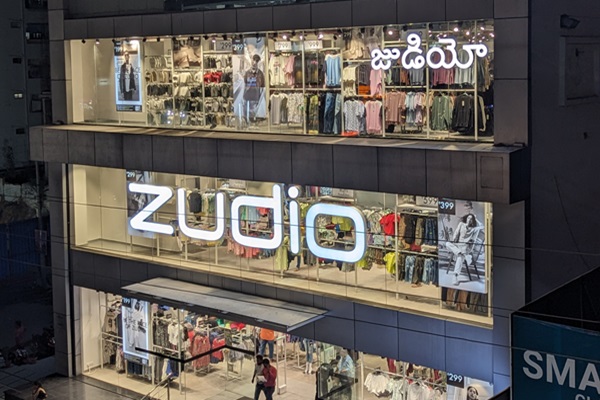
A large part of the sector’s growth continues to be driven by aggressive network expansion rather than improvement in existing stores. Zudio, one of the most prominent players in this space, offers a useful lens. Its parent has reported strong revenue growth and margin expansion, yet much of that performance has been supported by new store additions and tactical discounting, with like-for-like growth remaining subdued.
This dynamic is not confined to one company. It reflects a broader structural pattern across the segment.
Expansion Fatigue
The impact is evident in store economics. Payback periods for new stores, once relatively short at around 18 months, are now stretching closer to 30 months. At the same time, productivity metrics are under pressure. Average monthly sales per square foot in many locations are hovering around ₹1,200–1,300, with daily store revenues often ranging between ₹700,000 and ₹1.2 million. While flagship stores can outperform, system-wide averages are showing signs of plateauing.
These trends suggest that expansion is no longer delivering the same incremental returns as before.
Retailers are beginning to respond with adjustments that point to a more constrained operating environment.
Format Shift
Zudio’s pivot toward smaller stores reflects this recalibration, as does the broader industry’s focus on optimising store footprint rather than simply expanding it.
Inventory management is also evolving. The emphasis is shifting from holding larger quantities of fewer styles to offering greater variety with tighter inventory control. Faster replenishment cycles, supported by automated systems, are being used to maintain freshness while reducing the risk of unsold stock.
Operational discipline is becoming more visible across the board. Retailers are adopting lower-cost hiring models, introducing automation in billing and stock management, and tightening overheads to preserve margins. These measures, while incremental in isolation, collectively point to a business model that is becoming more demanding to sustain.
Pricing dynamics are also shifting. What was once a clear competitive advantage is increasingly turning into a source of pressure. Discounting has intensified, with deeper price cuts, bundle offers, and extended sale periods becoming more common. In some cases, entry-level price points have been lowered further to sustain volumes.
The cumulative effect is a gradual erosion of pricing power.
External conditions are adding to these pressures. Input costs, particularly for synthetic fabrics such as polyester and Lycra, have risen due to supply disruptions linked to geopolitical tensions. Given the segment’s reliance on such materials, this has a direct impact on margins.
At the same time, macro conditions remain uncertain. A weaker monsoon outlook could affect rural incomes, while potential increases in fuel prices may compress discretionary spending. For a segment that depends heavily on value-conscious consumers, these factors are significant.
Competition continues to intensify. Regional and unorganised players remain resilient, often adapting more quickly to local preferences and price sensitivities. E-commerce adds another layer of complexity, with high return rates and the need for rapid fulfilment increasing operational strain.
Taken together, these dynamics point to a transition in the segment.
The value fashion story is not unravelling, but it is evolving. The early phase, characterised by rapid expansion and strong operating leverage, is giving way to a more demanding environment where growth is harder to translate into profitability.
Zudio’s trajectory, often viewed as a benchmark for the segment, underscores this shift. Its ongoing adjustments in store formats, inventory strategies, and cost structures suggest that even the most efficient operators are responding to pressures that are structural rather than cyclical.
For investors, the distinction is important. Growth driven by store additions can sustain topline momentum for a period, but weakening store-level economics and longer payback cycles alter the risk-reward equation.
The segment continues to offer scale, but scale alone is no longer sufficient. Execution discipline, cost control, and the ability to adapt formats to local demand conditions are becoming decisive.
The perception of value fashion has long been shaped by its accessibility and rapid growth. The emerging reality is more nuanced. It is a business where margins are tight, competition is relentless, and expansion brings both opportunity and strain.
What once appeared to be a straightforward growth story is now revealing itself as a more complex operating challenge.
More From BasisPoint