.png)


Dr Raj K. Kattula is a Project Fellow at the Council for Social Development, Hyderabad
July 18, 2026 at 7:21 AM IST
India’s tea industry is accustomed to familiar anxieties: rising costs, unpredictable monsoons, volatile global prices and wage bills that estates say are increasingly difficult to carry. These pressures are real. But beneath them lies a quieter and potentially more damaging crisis—the gradual erosion of the skilled workforce that gives premium Indian tea its quality.
During recent field research among women workers on Assam’s tea estates, I repeatedly encountered a troubling change. Plantation work is losing its meaning. For many workers, particularly the younger generation, it is no longer an occupation associated with competence, continuity or belonging. It is increasingly seen as a job taken because alternatives remain limited, housing and welfare benefits are tied to employment, or moving elsewhere is difficult.
An estate may be able to fill a vacant position, but it cannot quickly replace the judgment accumulated through years of working with the tea bush.
Tea Board of India data show that the country produced 1,284.78 million kilograms of tea in 2024, down from 1,393.66 million kilograms in 2023. Assam alone produced 649.84 million kilograms—slightly more than half of India’s total crop.
Estimates of direct employment in the industry range from just over one million to around 1.5 million workers, with several million more depending on tea indirectly. Women constitute roughly 50-60% of the plantation workforce. In Assam, assessments suggest that women account for as much as 80% of tea pluckers.
The industry therefore depends heavily on women’s labour, but its policies and employment structures rarely reflect the realities of their lives.
Indispensable Workforce
Women workers routinely combine physically demanding plantation labour with unpaid domestic responsibilities. Field evidence also points to verbal abuse, economic control and, in some cases, physical violence as recurring features of their daily lives. Research conducted on Assam’s plantations has documented poor access to reproductive healthcare and high levels of anaemia among women workers. A 2024 study by the Council for Social Development also linked gender-based violence to substantial productivity losses through absenteeism and related effects.
These are often treated as welfare concerns that lie outside the industry’s principal business calculations. That is a mistake. Health, safety and dignity directly affect attendance, concentration, physical stamina, morale and retention. They also influence whether experienced workers are willing to remain in the sector and pass their knowledge to the next generation.
At the same time, educational opportunities are expanding the aspirations of younger plantation workers. This should be welcomed. The problem is not that young people want better lives; it is that the tea economy has failed to create better opportunities for them.
Plantation employment continues to offer limited career progression, relatively low wages and considerable geographic isolation. For many families, subsidised housing and statutory welfare provisions have become the principal reasons to remain—not confidence in the occupation or its future.
An industry cannot sustain a premium product through a workforce that stays only because leaving is difficult.
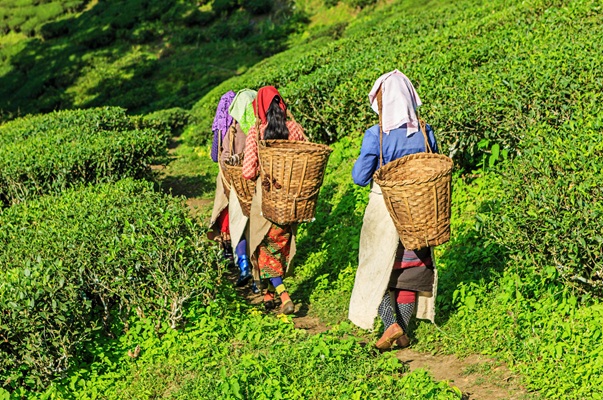
This is especially important because high-quality tea is a judgement-driven product, not merely a labour-intensive one. The familiar standard of “two leaves and a bud” may sound like a simple instruction, but applying it consistently requires experience. Across a tea bush, shoots mature at different rates. A skilled plucker must decide which shoots are ready, which should be left for another round and how to maintain uniformity without damaging the plant.
Thousands of such decisions are made during a working day. Together, they influence the character of the harvested leaf and, ultimately, the flavour, aroma, consistency and market value of the finished tea. This is tacit knowledge acquired over years; it cannot be reproduced simply by adding more workers to the payroll.
Skill vs Technology
Mechanisation undoubtedly has a role. It can help estates respond to labour scarcity, manage peak harvesting periods and produce lower grades more efficiently. The question, however, is not whether machines should replace people. It is where technology can complement human judgement without undermining the quality on which Indian tea’s reputation depends.
Research on mechanically harvested CTC tea in southern India indicates that machine harvesting can mix mature leaves with tender shoots, reducing uniformity and affecting the biochemical characteristics associated with made-tea quality. Selective and AI-assisted harvesting technologies may improve over time, but they remain at an early stage. Estates should not assume that technology can immediately reproduce the judgement of an experienced plucker, particularly in premium segments.
The appropriate policy response must therefore extend beyond the conventional wage debate.
Estate management should treat workforce retention as part of its quality strategy. Safe workplaces, credible grievance mechanisms, gender equality, healthcare and decent housing are not simply social obligations; they are investments in productivity and long-term competitiveness.
State governments must strengthen access to occupational and reproductive healthcare and ensure that workers can report abuse without fear of retaliation. The Tea Board and industry associations should develop recognised skill-certification programmes and clearer career pathways into supervision, quality control, nursery management, technical operations and entrepreneurship.
Technology investments should also be accompanied by training that enables workers to move into more skilled and better-paid roles. Educated young people should not have to choose only between remaining pluckers and leaving the tea economy altogether.
India’s soil, climate and tea-growing heritage remain significant advantages. But none of them can substitute for the experience of workers who know what to pluck, what to leave and how to protect the quality of the crop.
Once those experienced hands leave the industry, their knowledge will not return with the next recruitment drive.
Rebuilding trust, dignity and professional opportunity on India’s tea estates is therefore not merely a labour-welfare objective. It is an investment in quality, competitiveness and the future global standing of Indian tea.
More From BasisPoint