.png)


Surendar Singh is Associate Professor, Jindal School of Liberal Arts and Humanities, O.P. Jindal Global University, Sonipat.
July 22, 2026 at 4:28 AM IST
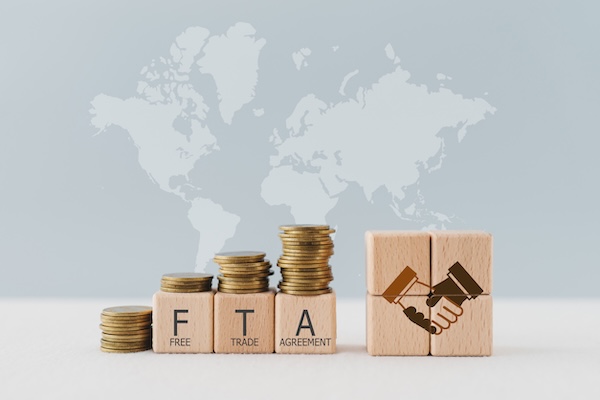
India is signing free trade agreements at a pace not seen before. India has already signed FTAs with the UAE, Australia, the UK and, most recently, New Zealand, while negotiations continue with the EU, the US, Oman, the Gulf countries and Canada. The expectation is that these agreements will expand export opportunities, integrate Indian firms into global value chains and strengthen the country's competitiveness.
That belief has increasingly shaped India's trade policy. FTAs are now seen not only as commercial agreements but also as instruments of economic strategy and geopolitical influence.
The problem is that the evidence is far less conclusive than the narrative suggests. India's experience with existing FTAs raises an obvious question: if these agreements are delivering greater market access, why have export competitiveness and GVC integration remained so weak?
India's performance with some of its oldest FTA partners tells a different story. In ASEAN, Japan, South Korea and Singapore, preferential market access has not translated into a stronger export presence. In several cases, India's share of their import markets has actually declined.
The erosion is most visible in ASEAN. India's share of the bloc's imports has halved, falling from 3.42% in 2012 to 1.71% in 2025. The picture is no better elsewhere. Its share of Singapore's imports has slipped from 2.27% to 1.71%, while South Korea's has fallen from 1.33% to 1.02%. In Japan, India's presence has barely changed over the period.
The figures point to a simple conclusion. Lower tariffs, by themselves, have not been enough to improve India's export competitiveness or secure a stronger position in regional manufacturing networks.
The reasons lie largely within the domestic economy. Trade agreements cannot fix weaknesses in the domestic economy. Indian firms continue to be held back by poor infrastructure, high logistics costs, rigid factor markets and weak manufacturing capabilities. Until these structural constraints are addressed, signing more FTAs will do little to improve export competitiveness.

Source: ITC trade map,
Without a stronger industrial base, trade agreements could end up opening India's market faster than they expand its exports, widening trade imbalances instead of narrowing them.
Industrial Priorities
FTAs are also expected to facilitate integration into GVCs by reducing barriers to cross-border production and encouraging industrial upgrading. However, India's record on this front is equally mixed.
GVC-related trade as a share of India's total trade declined from 37.13% in 2012 to 34.38% in 2020, indicating weaker integration with global production networks.
The pattern is similar across several Asian FTA partners. India's GVC-related trade as a share of total trade declined with South Korea, Japan, Indonesia, Thailand, Vietnam and Cambodia. Only Malaysia, Singapore and the Philippines recorded improvements.
|
India's GVC related trade % gross trade with Asian FTA partners |
|||
|
|
2012 |
2020 |
GVC Integration (Increase/Decrease) |
|
World |
37.13 |
34.38 |
▼ |
|
Indonesia |
41.77 |
30.1 |
▼ |
|
Japan |
41.07 |
28.44 |
▼ |
|
Malaysia |
49.92 |
50.26 |
▲ |
|
South Korea |
63.18 |
41.58 |
▼ |
|
Thailand |
48.32 |
47.65 |
▼ |
|
Singapore |
66.87 |
69.54 |
▲ |
|
Philippines |
30.47 |
33.9 |
▲ |
|
Vietnam |
56.89 |
54.57 |
▼ |
|
Cambodia |
47.43 |
44.34 |
▼ |
Source: WITS,
The evidence suggests that preferential market access alone has not enabled India to participate more deeply in global production networks. This challenges the conventional assumption that trade liberalisation automatically strengthens GVC integration. It also raises doubts about whether broader commitments on market access and regulatory alignment are sufficient to transform industrial competitiveness.
None of this implies that FTAs lack value. They can certainly improve access in selected sectors, diversify export opportunities and strengthen strategic relationships. But their ability to build productive capacity remains limited unless supported by domestic reforms.
India's FTA strategy therefore needs a broader foundation. Trade agreements should complement, not substitute for, industrial policy. Greater emphasis is needed on technological upgrading, supply chain resilience, domestic value addition, infrastructure, logistics, investment and factor market reforms. These measures determine whether firms can exploit the opportunities that FTAs create.
The success of India's trade strategy will ultimately depend less on the number of agreements it signs than on the competitiveness of its domestic economy. Without stronger industrial capabilities, FTAs will remain instruments of trade liberalisation rather than catalysts for industrial transformation.
More From BasisPoint