.png)

India-New Zealand Announce Conclusion of Free Trade Agreement Negotiation
India and New Zealand have sealed a comprehensive FTA, cutting tariffs, expanding services and mobility, and unlocking trade, investment, and supply-chain ties.
December 22, 2025 at 12:35 PM IST
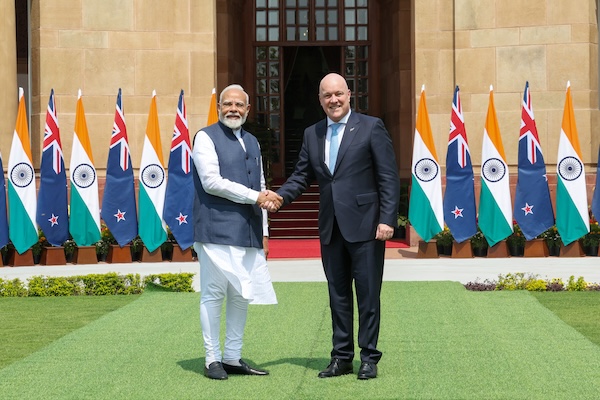
India and New Zealand have concluded negotiations for a comprehensive Free Trade Agreement (FTA), Ministry of Commerce & Industry said in a release today.
Under the agreement, New Zealand will eliminate tariffs on 100% of its tariff lines, providing immediate duty-free access for Indian exports including textiles, apparel, leather, footwear, marine products, gems and jewellery, handicrafts, engineering goods, and automobiles. The Ministry stated this would integrate Indian MSMEs into global value chains.
India has offered tariff liberalisation on 70% of its tariff lines, shielding sensitive sectors while covering 95% of bilateral trade. The deal eliminates or reduces tariffs on 95% of New Zealand’s exports to India. Specifically, 57% of these exports will enter duty-free from day one, increasing to 82% upon full implementation. The remaining 13% will face sharp tariff cuts, including the immediate elimination of duties on sheep meat, wool, coal, and over 95% of forestry exports.
The agreement excludes sensitive agricultural and dairy sectors from market access to protect domestic interests. The exclusion list comprises dairy, coffee, milk, cream, cheese, yoghurts, whey, caseins, onions, sugar, spices, edible oils, and rubber. Conversely, India secured duty-free inputs for its manufacturing sector, including wooden logs, coking coal, and metal waste and scraps.
The pact includes a commitment to facilitate the registration of India’s Geographical Indications (GIs), including wines, spirits, and other goods, through amendments to New Zealand’s law.
The FTA opens 118 services sectors, described as New Zealand’s "best and most ambitious services offer" to date. Key sectors include IT, engineering, construction, tourism, different business services, and audio-visual services. New Zealand also provided Most-Favoured-Nation (MFN) commitments in approximately 139 sub-sectors.
Mobility provisions remove numerical caps on post-study work visas. STEM Bachelor’s and Master’s graduates receive post-study work rights of up to three years, and Doctoral scholars up to four years.
A new "Temporary Employment Entry" visa pathway allows for a quota of 5,000 Indian professionals at any given time, valid for up to three years. Eligible professions include AYUSH practitioners, yoga instructors, Indian chefs, music teachers, and skilled workers in IT, healthcare, and education. An additional 1,000 "Work and Holiday" visas have been agreed upon.
New Zealand has committed to facilitate $20 billion in investments into India over a 15-year period to support the "Make in India" framework across manufacturing, infrastructure, and services. Cooperation extends to AYUSH, culture, fisheries, and forestry.
For the pharmaceutical sector, the agreement enables the acceptance of Good Manufacturing Practice (GMP) and Good Clinical Practice (GCP) inspection reports from comparable regulators, specifically listing the US FDA, European Medicines Agency (EMA), and UK MHRA. This measure intends to lower compliance costs and reduce duplicative inspections.
In agriculture, the nations established "Agricultural Productivity Partnerships" with Centres of Excellence for apples, kiwifruit, and honey. While prioritising productivity and technology transfer, market access for these commodities remains restricted via quotas andMinimum Import Prices (MIP).
More From BasisPoint