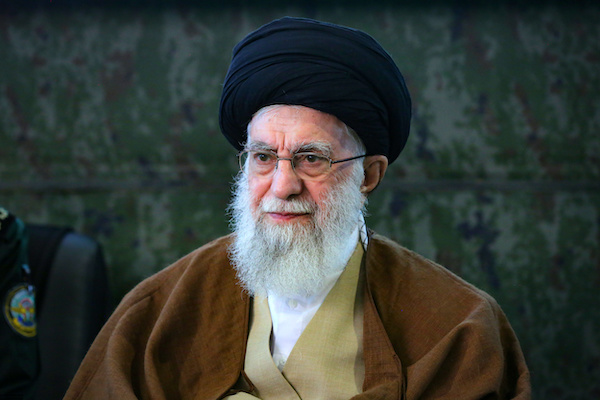
Iranian President Masoud Pezeshkian has invited Prime Minister Narendra Modi to the funeral of former Supreme Leader Ayatollah Ali Khamenei. The funeral rites are slated to begin on July 4 in Tehran, ending with the burial five days later in Khamenei’s hometown of Mashhad in northeastern Iran. Former Vice-President Jagdeep Dhankhar had attended former President Ebrahim Raisi’s burial in 2024, hence India now has to be represented by one of the most senior political figures, preferably the prime minister himself.
Here are five reasons why.
First: Khamenei’s death was the result of a violent assassination aimed at forcing a change of regime in Iran. The 86-year-old leader was targeted and killed on the first day of the war by the US-Israeli coalition on February 28. Though it was a repeat of similar politico-military operations in Iraq and Libya not so long ago, the brazenly murderous attempt to foist a puppet government on a sovereign nation sent shockwaves across the world.
If assassinations become the new regime-change template, there would be no need for elaborate political plots as they unfolded in Pakistan, Sri Lanka, Bangladesh or Nepal in the recent past. All it takes is a direct missile hit at a leader’s residence to create a puppet government. In fact, US President Donald Trump, a month after killing Khamenei, openly proclaimed that the US had achieved regime change in Iran.
This is an unacceptable politico-military strategy for any developing nation, friend or foe of the US. So, attending the funeral of the victim or the martyr of such a regime-change assassination is a political, diplomatic, and military statement of resistance that must be made by every head of government of a truly independent nation. India cannot afford not to attend the funeral, particularly when its governing party repeatedly talks of regime-change attempts being made by Western billionaire-speculators.
Second: India made a terrible mistake by undertaking a geopolitical cost-benefit analysis when Modi visited Israel on February 25 and 26, just two days before Khamenei was assassinated. What prompted this diplomatic faux pas will remain a secret as long as the principal players refuse to speak about it. But the world took note of it, particularly when India remained reluctant to condemn the murder.
Only on March 5, when it became clear that Iran was not capitulating, nor was there a new puppet government in place in Tehran, did External Affairs Minister S. Jaishankar speak to his Iranian counterpart Seyed Abas Araghchi to offer his condolences. Foreign Secretary Vikram Misri drove into the Iranian embassy to sign the condolence book the same day. But that was a much-delayed afterthought.
Behind-the-scenes efforts already seem to have helped India overcome this diplomatic misstep, but Prime Minister Modi’s visit to Tehran to offer final respects to the departed leader would fully mitigate Iran’s grievances, if any. Also, such a visit would be read as a statement of genuine contrition.
Third: India has to accept and respect the changed power structure in West Asia. Iran is no longer a museum piece – the seat of an ancient civilisation – nor is it just another oil-rich colony up for grabs. This repository of the world’s third-largest oil and second-biggest gas reserves is now the greatest regional military power. It won this status without even going nuclear, fighting the world’s lone superpower and a neighbour that boasts of an Iron Dome, deadly cyber weapons and an unmatched spy service.
What Iran achieved in 110 days is more than what any nation could have hoped for in a battlefield, and it did it without letting the vastly superior enemy occupy an inch of its territory. The prime minister’s visit would be an acknowledgement of this changed situation. Practical diplomacy respects only power and no other shibboleths of fraternity.
Fourth: India still has not responded politically to the killing of three unarmed sailors on June 10, when an aircraft from the US Central Command shot a precision munition into the engine room of MT Settebello for what it claims to be a violation of the naval blockade of Iran. Apart from vacuous gestures of diplomatic correctness, India is yet to express its anger, assert its maritime rights and refute the imposition of unilateral military blockades in sea lanes of energy traffic.
The US attack on the tanker carrying oil to India was a crude message of rogue military muscle-flexing. Such messages need a ready, strong reply, at least a political if not a military response. Prime Minister Modi’s visit to Tehran would be the ideal response to the reckless kinetic action against unarmed Indian sailors bringing in crucial energy supplies.
Fifth: There have been many attempts to hyphenate India and Pakistan yet again over the Iran-US deal starting from a former Israeli government spokesperson to many pro-West commentators to US Vice President JD Vance, who needlessly invoked his wife’s country of origin while talking to Pakistani interlocutors. Pakistan remains the US’s crucial vassal, its instrument of diplomacy in the Muslim world, military base, source for useful Islamist radicalism and much else. But it is no longer a source of strategic concern for India.
Hence, Prime Minister Modi’s visit to Tehran would prove all those who try to re-hyphenate India and Pakistan wrong, because India does not care. Also, there has been an attempt by the pro-West commentariat to blame India for leveraging its multilateralism as a weapon of diplomacy against one superpower or the other. It is absolutely wrong to suggest that India uses its proximity with Russia as leverage against the US.
When Yassar Arafat and Fidel Castro hugged Indira Gandhi in a meeting of the Non-Aligned Movement in Delhi in the early 1980s, she was not leveraging her global stature against the US. Similarly, when Prime Minister Modi visits Tehran and hugs Mojtaba Khamenei, it will be an assertion of India’s standing in the world, still fighting forces of neo-colonialism, completely unmindful of small instruments of Anglo-American imperialism in the neighbourhood.
.png)