.png)

Amitabh Tiwari, formerly a corporate and investment banker, now follows his passion for politics and elections, startups and education. He is Founding Partner at VoteVibe.
June 14, 2026 at 5:58 AM IST
A nationwide snap poll by VoteVibe released on June 13, 2026 paints a vivid — and complicated — picture of the Cockroach Janta Party as it flirts with electoral politics. The numbers show a party with a passionate core, a sceptical establishment, and a vast undecided middle that could yet decide its fate.
Known, But Not Yet Understood
But awareness and understanding are different things. Among those aged 55 and above — the demographic that shows up most reliably on election day — only 37.5% say they know CJP well. Among Upper Caste Hindus, who constitute one of India's most electorally decisive blocs, scepticism runs deep across nearly every question in the survey. Awareness may be high, but CJP's narrative has not yet landed with the voters it most needs to persuade.
The group where CJP has made the deepest impression is Scheduled Castes: 65.9% say they know a lot about the organisation, the highest of any social group. Combined with strong awareness among youth — 62.4% of 18–24 year olds say they know CJP well — this suggests a base that skews young and Dalit, energetic but not yet broad enough to win seats on its own.
A Leadership Rating That Divides
Age, again, is the sharpest dividing line. Among 18–24 year olds, 43.8% rate the leadership “Excellent”. By the time you reach the 45–54 age bracket, that figure collapses to 17.4%, and a quarter of those voters say "Very Poor". Muslims and Scheduled Castes give the most favourable ratings among social groups; Upper Caste Hindus deliver the harshest verdict, with 27.5% rating leadership Very Poor — the highest negative score across all communities.
The Jantar Mantar Question
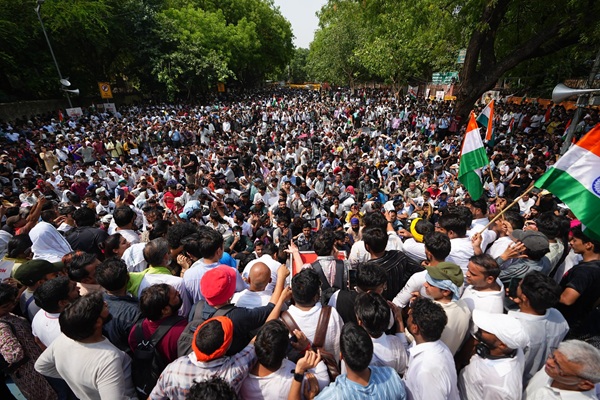
The poll reflects this split: 28.7% call the rally a "complete failure" against 19.6% who call it a "major success" — a roughly 3:2 negative-to-positive ratio. So called “Upper” Caste Hindus are the harshest judges, with 38.2% calling it a complete failure. Scheduled Castes offer the most generous assessment, at 28% calling it a major success.
One finding stands out: urban respondents are significantly more critical (37.2% complete failure) than rural ones (25%). For a movement that was built in cities and amplified by urban social media, this is a gap worth watching. If CJP cannot convince urban audiences — the people most likely to have seen the rally coverage — its path to relevance becomes narrower.
Instagram Is Not a Ballot Box
This matters enormously. CJP's rise has been powered by digital momentum — viral videos, celebrity endorsements, and a highly engaged online community. Voters, it seems, are already applying a discount to that momentum when thinking about the ballot box. The party's task is to build institutions, ground-level networks, and a policy identity that outlasts any single viral moment.
On celebrity and activist support, the poll is only slightly more encouraging. A plurality — 38.4% — simply don't know whether such endorsements help. Among those who do have a view, more say it strengthens CJP than weakens it, and the backlash from celebrity association is negligible (just 7.9% think it hurts). But the sheer size of the "Don't Know" bloc suggests this is not the defining asset CJP's communications team might hope it is.
Who Does CJP Actually Threaten?
This has significant implications. It means voters broadly perceive CJP not as a left-liberal vote-splitter pulling from the opposition, but as something that eats into the ruling party's support base. Whether that perception is accurate is a separate question. But if voters believe it, it may shape how opposition parties choose to engage — or not engage — with CJP going forward.
Political start-ups in the past - AAP damaged the Congress in both Delhi and Punjab, and lately TVK damaged the DMK, indicating such experiments damage the incumbent governments more.
The Electoral Question: Mandate Still Missing
The breakdown is telling. Among 18–24 year olds, a majority (50.4%) say yes — the only age group where this is the case. Among Muslims, 43.2% support the idea. Among Upper Caste Hindus, 36.2% actively oppose it. And on voting intention, 38.4% lean toward voting CJP against 34.9% who lean against — a slim positive tilt underpinned by a large pool of 26.7% who genuinely haven't decided.
What the Numbers Really Say
But the ceiling is also visible. Older voters are unconvinced. Urban audiences are more critical than rural ones. Social media reach is not trusted as electoral proof. And the largest group across almost every question is, simply, undecided.
CJP's story, the poll suggests, is still being written. Whether the next chapter is electoral breakthrough or activist plateau depends on choices the organisation has not yet made — and on millions of voters who are still watching.
More From BasisPoint