.png)

Bangladesh Polls: BNP Gets a Foothold, Jamaat a Toehold; Fingers Crossed in Delhi
As Bangladesh heads into elections, the BNP strengthens its position, Jamaat tests the waters, and Delhi watches anxiously—hoping the outcome doesn’t tilt the region’s fragile balance.
Saibal Dasgupta is an author, veteran journalist, and noted China expert who has reported from Beijing since 2005 and contributes to global media and think-tanks.
December 31, 2025 at 12:09 PM IST
Begum Khaleda Zia, 80, Bangladesh’s former prime minister, died on Tuesday just five days after her son, Tarique Rahman, returned to the country after 17 years in exile in the United Kingdom. The most important question being asked in the political arena is whether her death will unleash a sympathy wave helping Zia’s Bangladesh National Party to comfortably win the coming election in February.
India has strong reasons to closely watch the emerging situation because Zia and the BNP always had strong leanings towards Pakistan even as they fought the India-friendly Begum Sheikh Hasina, who held the prime ministerial position for 20 years until she was ousted in a student revolt in August 2024. Hasina is in exile in India while her Awami League has been banned.
BNP and Jamaat e Islami are the main players in the coming elections because Awami League is out of action. Jamaat, a fundamentalist party with much stronger links with Pakistan than BNP, is a smaller player though it engages in high-pitched politics in the name of religion. Both contenders are critical of India leaving Indian diplomats with little manoeuvring room.
India figures in political speeches of Bangladeshi leaders of all parties contesting the election. They are not just making emotional speeches blaming India for supporting the alleged atrocities of the Hasina regime but also promising to take a tough stance towards New Delhi after getting elected.
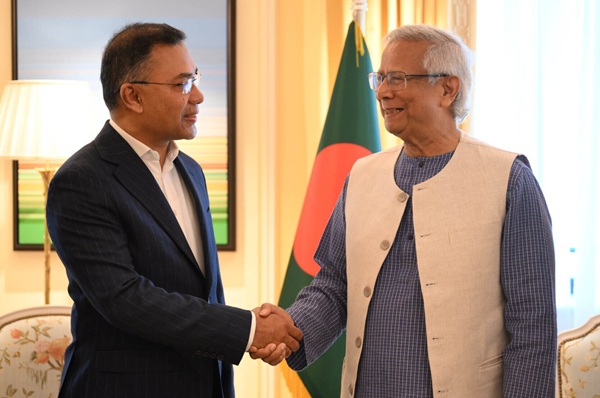
Rahman, 58, is expected to take a somewhat less harsh stance towards India and minorities compared to the hardcore Jamaat. Some analysts have even suggested that ISI, Pakistan’s spy agency, has built influence within Jamaat’s cadres. Jamaat is also known to be close to the caretaker government of Mohammad Yunus, a Nobel laureate.
“It is time for us all to build the country together,” Rahman said after returning to Dhaka on Christmas Day. “In this country, there are people from the hills, plains, Muslims, Hindus, Buddhists, Christians. We want to build a safe Bangladesh. In Bangladesh, no matter who a woman, man, or child is, they should be able to leave their homes safely and return safely."
Some analysts believe Rahman, BNP’s working president, would take a balanced view towards India if he wins the election and becomes the next prime minister although this is a difficult task amid anti-India sentiment being whipped up by Jamaat. He is expected to restore trade because Bangladesh is going through an economic crisis and Indian support would go a long way.
“Tarique Rahman has emerged as a more mature leader. I believe he understands that Bangladesh must uphold its foreign policy principle of ‘friendship to all, malice to none.’ Saber Ahmed Chowdhury, former chairman of the Department of Peace and Conflict Studies at the University of Dhaka told the author. “Greater emphasis should also be placed on Track II diplomacy with India”.
Chowdhury says Rahman’s BNP has a strong chance of winning the election. “BNP has a strong popular vote bank. People are eager for change and are willing to see a new government. In addition, the sympathy factor over Begum Khaleda Zia’s death is also likely to work in its favour,” he says.
Bangladesh watchers think the sympathy wave will be limited because she has been extremely sick for a long time. BNP may be able to garner half of the seats in the 300-member parliament while Jamaat may improve on its past performance by winning 40-50 seats. It used to win about 20 seats in previous polls.
The role of the Election Commission under Yunus-led caretaker government will be crucial, particularly because Jamaat is closely associated with it.
A key focus of political debate is the demand of all parties that India should deport Sheikh Hasina, who continues to be used as a hate symbol.
Awami League has massive support among millions though the party is banned and many of its leaders are in jail. Hasina’s presence is felt strongly with her ardent supporter hoping she would return to lead them.
An important question is whether the Yunus led government will postpone the election if BNP gets stronger and Jamaat appears weak. The interim government was initially very reluctant to announce elections even after several public demonstrations demanding polls.
“Yunus wants Jamaat-e-Islami in power because they have agreed to make him President. Jamaat and Yunus are made for each other — Jamaat wants a West-accepted Nobel laureate at the head of a mullah-dominated government,” Subir Bhaumik, author and Bangladesh analyst told the author.
Some observers feel Yunus may find ways to postpone the elections, possibly using the worsening law and order situation as an excuse.
“Yunus wants their backing to be President, which secures him immunity from prosecution and puts him as Supreme Commander of Armed Forces. So it is likely Yunus may use the worsening law and order to justify delaying the elections if he and the Jamaat are unsure of victory,” Subir Bhaumik, author and Bangladesh analyst told the author.
A judicial commission appointed by the interim government in Dhaka recently awarded her a death sentence for allegedly ordering the killing of several students during the 2024 uprising.
“If they (India) choose to shelter an autocrat and become unpopular with the people of Bangladesh, there’s nothing we can do… I must stand with my people.” Tarique Rahman of BNP said earlier.
The interim government recently summoned the Indian ambassador to protest against Hasina’s activities in India. It accused India of permitting Hasina to make “provocative statements calling on leaders and activists to engage in terrorist activities" in Bangladesh.
India has rejected the accusation. “India has consistently reiterated its position in favour of free, fair, inclusive and credible elections being held in Bangladesh in a peaceful atmosphere," the Ministry of External Affairs said while refuting allegations that it was trying to interfere in Bangladesh’s internal affairs.
“We expect that the interim government of Bangladesh will take all necessary measures for ensuring internal law and order, including for the purpose of holding peaceful elections,” the MEA added.
More From BasisPoint