.png)


Dev Chandrasekhar advises corporates on big picture narratives relating to strategy, markets, and policy.
March 20, 2026 at 8:55 AM IST
India's private hospital sector has spent the better part of a decade competing on expansion. New cities, new floors, new beds.
Apollo Hospitals Enterprise Ltd is making a different argument. The bet is that high-acuity medicine compounds faster than volume. The planned demerger of its pharmacy and digital health business will force investors to confront that argument directly.
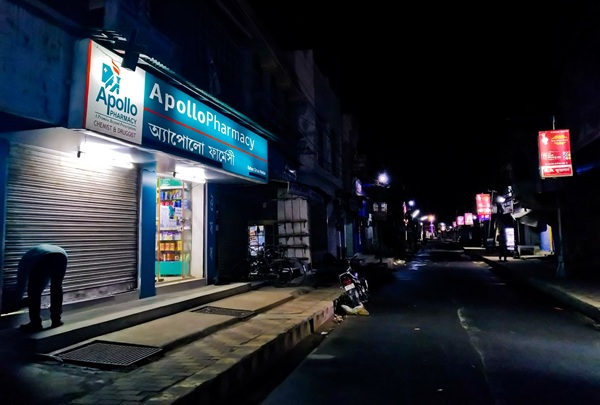
The entity being separated is Apollo HealthCo — an unlisted subsidiary housing three businesses: the 7,100-plus-store Apollo Pharmacy network, a wholesale pharmaceutical distribution operation, and Apollo 24/7, a digital health marketplace serving 46 million users across 19,000 pincodes.
Apollo HealthCo was carved out from the listed parent to comply with FDI restrictions on multi-brand retail — a hospital company with foreign institutional investors on its register could not directly hold a pharmacy business.
It later absorbed the digital platform, becoming a loss-making drag on consolidated margins and muddying the hospital thesis.
The demerger resolves that anomaly.
The approved structure involves three steps: the demerger of Apollo's omnichannel pharmacy and Apollo 24/7 into Apollo Healthtech Limited; the amalgamation of Apollo HealthCo into that entity; and the simultaneous merger of Keimed, India’s largest pharmaceutical wholesaler by scale and Apollo’s supply chain backbone, into the same vehicle.
Apollo Hospitals retains a 15% stake. For every 100 shares of Apollo Hospitals, shareholders receive 195.2 shares of the new company. Listing is targeted for January-March next year, from a previously envisaged April 2026.
Managing Director Suneeta Reddy has said that Apollo Hospitals will focus on healthcare delivery, while the new entity will accelerate its efforts on customer engagement and penetration, “with clear capital allocation outlays, growth plans and management teams driving both."
This is as much a separation of capital allocation logic as of businesses.
Keimed operates nearly 100 distribution centres serving over 70,000 pharmacies. The management positions the combined entity as an integrated supply chain linking physical pharmacies, digital access, and wholesale distribution.
The combined entity targets revenues of ₹250 billion and a 7% EBITDA margin by Q4 FY27, against 3.2% in FY25. Analysts estimate it requires margin expansion in Keimed, 100 basis points in offline pharmacy, a two-thirds reduction in ESOP costs, and Apollo 24/7 reaching cash EBITDA breakeven by next January-March.
The digital segment was burning ₹7.6 billion in Q3 FY25. Losses have since narrowed 61% to ₹2.9 billion in Q3 FY26. Separating it frees capital for the hospital entity, which needs ₹83 billion for a five-year bed expansion.
What remains in the hospital entity is the argument Apollo has been building for years. Average revenue per inpatient reached ₹180,917 in the December quarter, up 11% year-on-year. Average length of stay fell 4.1% year-on-year to 3.16 days.
Higher revenue per admission alongside faster bed turns signals case-mix enrichment despite low volume growth. Average revenue per procedure grew 9.6% year-on-year to ₹175,499 in April-December 2025, driven by the pivot toward CONGO-T specialties — cardiology, oncology, neurosciences, gastroenterology, orthopaedics, and transplants. In these, reputation commands pricing power and reimbursement pressure is limited.
With Metro hospitals at 71% occupancy, Apollo plans to add 3,600 census beds over five years, taking its network to 13,100, with 1,660 operational by the end of 2026-2027 across Sarjapur, Kolkata, Hyderabad, and Gurugram. New facilities are expected to reach breakeven in twelve to fourteen months.
The demerger complicates one thing, though. Apollo’s integrated ecosystem — diagnosis, pharmacy fulfilment, and hospital care — depends on referral pathways that will now cross corporate boundaries. Post-demerger, those pathways will need to be governed by commercial agreements. Once HealthCo is independent, those relationships must be governed by commercial agreements. The retained 15% stake helps, but does not fully solve this.
A hospital business at 24.8% EBITDA margins, with ₹170 billion in capacity under construction, becomes a cleaner institutional equity story.
Today, pharmacy margins of 4.5% dilute that profile against hospital margins near 25%. Apollo’s moat has been integration. The demerger tests whether that moat survives disaggregation. It will also show how much of this separation is already priced in.
(This column reflects the author’s personal views and is based on publicly available information. It is intended for general commentary and analytical purposes only and should not be construed as investment advice.)
More From BasisPoint