.png)

Michael Patra is an economist, a career central banker, and a former RBI Deputy Governor who led monetary policy and helped shape India’s inflation targeting framework.
January 15, 2026 at 3:42 AM IST
Around the world, reading is becoming an endangered activity. People are giving it up in favour of endless scrolling through social media or binge-watching videos on YouTube, TikTok, Instagram, and similar platforms. In the US, an extensive study published in August 2025, based on the American Time Use Survey, found that over the last two decades, daily reading declined by about 3% per year. Just 16% of those surveyed now spend time reading for pleasure (books, magazines, newspapers in print, electronic or audio form) on an average day. Ethnic, income, education level, and gender biases are also observed, but the decline in reading is predominantly among younger people.
In the UK, the 16-24 age group recorded the lowest level of regular readers at 32%. Reasons ascribed are the feeling of being unrepresented in reading materials, lack of time, distraction of social media, depression or anxiety. 35% of adults reported they are lapsed readers – they used to read regularly for pleasure but rarely or never do so now. In India, a recent study by the National Literacy Trust found that only 34.6% of children aged 8-18 read in their free time, an 8.8% decline from the previous year.
Despite regional variation, reading is steadily declining worldwide. At the same time, there is a growing polarisation between readers and non-readers. While the proportion of people who are turning away from reading is rising rapidly, those who still read are spending more time and money on it than they did 20 years ago. Perhaps this is what is keeping the publishing industry afloat!
Extensive research has explored the benefits of reading. They are found to range from direct gains in comprehension skills, vocabulary, logical reasoning, imagination, emotional intelligence and empathy, to relatively indirect links with academic achievement, financially rewarding employment, career growth and involvement in civic life. Reading is also correlated with promoting health, reducing stress and anxiety, supporting better sleep, slowing cognitive decline in older adults, and, hence, increasing longevity. Shared experiences in reading strengthen parent-child bonds, bridge cultural gaps and build a sense of belonging and identity.
There was once an era when books were a human’s best friend. Cherished companions, they offered solace and insight across the whole spectrum of human emotions. Turning a page used to be a tactile pleasure. In ancient Greece and Rome, books existed as long scrolls, making reproduction difficult. Even after the eighth century AD, when most of them were copied into codex form – individual pages sewn or glued at one edge to a spine with hinged boards – the difficulty of reproduction remained. Yet, both inconvenience and scarcity were offset by the paucity of need: few people could read – literacy was largely the province of clerics and scholars.
It wasn't until around 1450 AD when Gutenberg invented movable type that this technical difficulty was overcome. Printing presses came up all over Europe, and by the beginning of the sixteenth century, over nine million volumes were being produced. Literacy began to spread, and the world would never be the same.
Fading Rituals
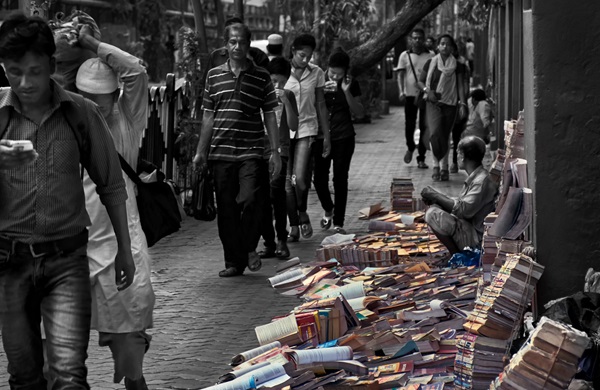
Sadly, books are becoming talismanic objects from a past culture. Pulitzer Prize-winning writer Larry McMurtry once mourned the end of the era of books and reading: “It's just sad that what is being left behind is a very beautiful culture, the culture of the book. I think it's gone, I don't think it will come back.” Some people will continue to buy books online. But absent will be the irreplaceable experience — the romance of browsing — with all the attendant smells and textures, old wooden shelves and the ever-present possibility of stumbling across that unexpected work of genius.
The former Vice President of India, Shri Venkaiah Naidu, lamented the dying passion of reading in India evocatively in 2019. Referring to India as a civilisation that, since time immemorial, accorded a divine status to the letter – a status equivalent to that of God – he pointed out that India’s tryst with books and literature is almost as old as the 5000-year-old civilisation itself. We always considered it of paramount importance to record knowledge. Accordingly, we have a repository of an astounding wealth of the written word that embodies our diversity in unity and our cultural pluralism within a framework of interconnectedness. In his words: “Books are informative, illuminative and inspiring, and they are our best companions, counsellors and change agents. Books help widen our horizons. Books quench our thirst for knowledge. Through books, we comprehend history, understand different cultures and lifestyles, and even learn new languages. Books open our minds to new ideas. Books have the power to inspire and motivate us with stories of people who have fought against odds to succeed. Whether it is the journey of a fictional character or the real-life achievements of a historical figure, books encourage us to stay positive and keep moving forward. Books have the power to stir our creativity and stimulate innovative and inventive ideas.”
As he pointed out, reading enhances language skills and fluency, enabling us to express our thoughts and ideas more effectively and to communicate more effectively. Reading keeps one’s brain healthy by improving one's cognitive function and memory. It improves focus and supports the development of analytical skills.
We should be a nation that reads.
He also lamented the decline in interest in reading, especially among young Indians, and their preference for quick online searches and video content that is cursory and superficial, failing to promote deep reflection and introspection.
How do we revive this dying habit? Denmark has announced the abolition of its 25% sales tax on books in an effort to combat the “reading crisis.” In the UK, books are VAT-free. In China, a dedicated programme emphasises the emotional and personal dimensions of reading through a three-pronged strategy: abundant readily available books; time to read; and faculty and staff who are committed to reading. In developing countries, initiatives such as the World Bank’s Read@Home programme help governments distribute high-quality reading materials to vulnerable families and children.
‘Catch them young’ is perhaps the best approach. Children can develop a habit of reading when encouraged to read for pleasure. Parents can serve as reading role models. Schools can establish reading camps and workshops and maintain libraries.
The revival of reading must be undertaken in a mission-oriented manner. India’s demographic dividend will be realised only by expanding the number of readers and improving literacy rates. This has to be the remit of our generation — rage against the dying of the light so that those that follow may walk illumined.
More From BasisPoint