.png)

Amitabh Tiwari, formerly a corporate and investment banker, now follows his passion for politics and elections, startups and education. He is Founding Partner at VoteVibe.
April 16, 2026 at 4:52 AM IST
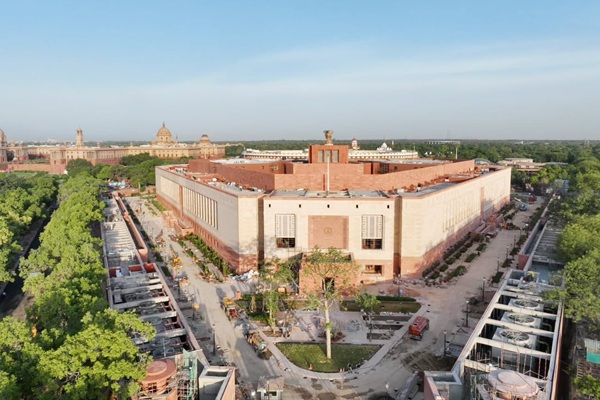
The Union Government has proposed a significant overhaul of the composition of the House of the People through the Constitution (One Hundred and Thirty-First Amendment) Bill, 2026, which seeks to increase the strength of the Lok Sabha from the existing 543 to 850.
Few constitutional exercises carry as much political charge in India as delimitation — the periodic redrawing of parliamentary constituency boundaries and, crucially, the reallocation of Lok Sabha seats among states. The process, frozen since 1976 and locked in by the 84th Constitutional Amendment until 2026, has now emerged as one of the most divisive debates of the current political season.
At its heart lies a stark and uncomfortable arithmetic: states that control their populations fear being penalised for their success, while states with higher population growth could gain representation. The Opposition is up in arms, accusing the government of slipping in delimitation in the garb of implementing the Women’s Reservation Bill.
What Would the New Lok Sabha Look Like
1. New seats based on the current proportion
According to the author’s calculations, modelling three possible scenarios for an 850-seat expanded Lok Sabha with women's reservation incorporated, the chasm between northern and southern India widens dramatically under any configuration based on the current population. Uttar Pradesh, with 80 seats today, would increase to 125 seats under Scenario 1 (proportional to current seats), 138 seats under Scenario 2 (based on 2011 Census population), and 120 seats under Scenario 3 (a 50% uniform increase). Bihar would jump from 40 to between 60 and 72 seats.
All three scenarios are constructed around a House of approximately 850 seats, with about 283 seats reserved for women, reflecting the fixed one-third reservation principle. The core political tension is between Scenario 2 (fair to the population, unfair to development-focused states) and Scenarios 1 & 3 (status quo-friendly but demographically outdated).
UP, Bihar, and Maharashtra are the biggest beneficiaries in every scenario — their combined seat count would approach about 280–290 out of 850.
|
NEW LOK SABHA STRENGTH - TOP 10 STATES |
||||
|
State |
Current (No. of Seats) |
Scenario 1: Current (Proportion of Seats) |
Scenario 2: Based on 2011 Census |
Scenario 3: 50% Increase for All States |
|
Uttar Pradesh |
80 |
125 |
138 |
120 |
|
Maharashtra |
48 |
75 |
78 |
72 |
|
West Bengal |
42 |
66 |
63 |
63 |
|
Bihar |
40 |
63 |
72 |
60 |
|
Tamil Nadu |
39 |
61 |
50 |
59 |
|
Madhya Pradesh |
29 |
45 |
50 |
44 |
|
Karnataka |
28 |
44 |
42 |
42 |
|
Gujarat |
26 |
41 |
42 |
39 |
|
Andhra Pradesh |
25 |
39 |
34 |
38 |
|
Rajasthan |
25 |
38 |
47 |
36 |
The Southern States' Grievance
The southern states' grievance is not merely sentimental. These states invested decades in family planning, female education, healthcare infrastructure, and economic development — and the results are visible in fertility trends. Fertility rates in Tamil Nadu, Kerala, Karnataka, and Andhra Pradesh have long been at or below replacement level.
The Northern States' Counterargument
This tension is constitutionally genuine, not manufactured. The founding framers grappled with exactly this dilemma and chose population as the basis for representation in Articles 81 and 170. The freeze imposed in 1976 and extended in 2026 was always intended as a temporary accommodation to incentivise family planning — not a permanent structural feature of Indian democracy. From a strictly constitutional standpoint, the northern argument has considerable merit.
The Women's Reservation Dimension
The women's reservation angle has further inflamed the north-south debate. A reservation quota based on the 2011 census delivers seats disproportionately to northern states, where women's education and workforce participation remain lower, but it may not automatically translate into substantive gender empowerment. It may, critics argue, simply deliver more seats to dynastic political families who field women candidates as proxies.
Is There a Way Out?
None of these solutions is constitutionally clean or politically painless. Any formula that departs from strict population proportionality invites legal challenge. Any formula that follows population strictly invites political rebellion from the South. This has the potential to become a major political issue in the Tamil Nadu elections, with the DMK set to exploit it to stoke sub-nationalist sentiment.
As the 2026 deadline approaches, the north-south fault line — sharpened by decades of diverging demographics, economic trajectories, and political cultures — threatens to become the defining cleavage of the next phase of Indian democracy. How the political class navigates it will shape not just Parliament's composition, but the very character of the Indian Union for a generation.
More From BasisPoint