.png)

Sangeeta Godbole is a former IRS officer and trade negotiator. She currently researches the trade and environment intersection.
December 6, 2025 at 4:03 PM IST
India calls itself a rising manufacturing power, and there is some justification to this. Over the past decade, the country has shed much of its earlier hesitation and begun engaging the global economy with confidence. The new India–UK trade agreement, revived negotiations with Israel, and ongoing, though complicated talks with the United States signal a nation ready to shape global trade rules rather than merely absorb them.
But beneath this momentum lies a stubborn contradiction: Indian industry often fails to move together. The result is what policymakers would describe as industrial incoherence. A fragmentation of incentives, capacities, and regulatory readiness that weakens India’s competitiveness just when it is trying to project strength.
The recent saga of Quality Control Orders is the quintessential example of chaotic policy making and industry responses. Large firms were happy with these standards as essential to curb substandard imports and upgrade Indian manufacturing. MSMEs, meanwhile, felt crushed by compliance costs and overwhelmed by the technical requirements. The same policy that one group sees as progress, another feels is an existential threat.
This split is not limited to quality regulation. India’s vast domestic market allows companies to comfortably sell products at home that would never meet European or American norms. A two-tier system, one quality for export markets, another for Indian consumers creates quality complacency for some firms even as others move ahead in export markets.
The EU’s Carbon Border Adjustment Mechanism is another test. It has triggered everything from panic to denial to quiet acceptance, depending on which segment of industry you talk to. Each new regulation, global or domestic brings out a consistent cacophony: protect us, help us scale, we are already compliant, delay this, do more, do less, this is unfair!
For a country staking its future on manufacturing, this is unsustainable. What India needs is a clearer way to understand its own industrial diversity and respond to it strategically.
A basic typology based on two factors, capacity and quality, can help strategise industrial policy and create a coherent industrial base. It groups firms into four broad categories based on their manufacturing capacity and quality/regulatory compliance. Export champions who are already aligned with global norms; high-quality but small-scale niche players; domestic-oriented firms that aspire to upgrade but lack certainty; and finally, vulnerable MSMEs struggling at the entry-level of compliance.
Such an exercise offers a practical solution to the incoherence problem. By acknowledging that different groups of industry will respond in distinct ways to regulatory and market signals, it provides policymakers with a lens to differentiate engagement, both before policy formulation and after implementation. The typology could be applied in multiple dimensions - sector, subsector, or geography.
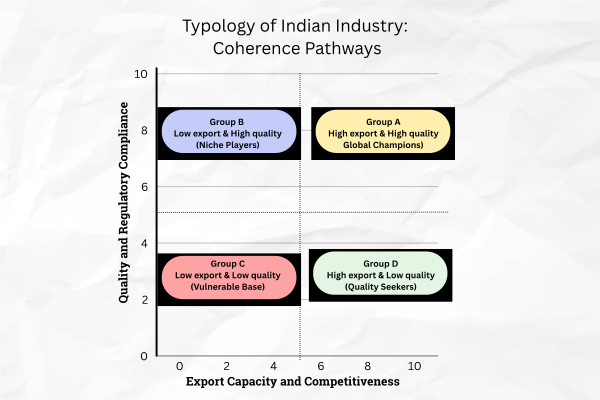
While designing a policy, government should not consult all industry with the same objectives. Export champions can help anticipate global trends. Smaller but high-quality producers need support to scale. Domestic-focused firms need clarity on why quality matters even if they don’t export. MSMEs require technical help and phased transitions rather than surprise mandates.
After a policy is rolled out, implementation must differ too. Group A needs predictability and market access. Group B needs access to finance and infrastructure. Group C needs regulatory nudges. Group D needs time and shared facilities for testing and certification. Industrial coherence cannot be imposed through blanket regulation. It has to be cultivated through differentiated strategies.
A coherent industrial ecosystem would steadily raise the quality of goods available in the domestic market, ensuring that Indian consumers enjoy products of the same standards as those destined for export, thereby enhancing everyday quality of life. Such integration carries with it not only economic gains but also strategic weight, enabling India to anchor its aspirations with a stronger voice in global economic governance and a sturdier foundation of domestic prosperity.
If India gets this right, the payoff is enormous. A coherent industrial ecosystem lifts quality across the entire economy, raises consumer standards, strengthens export competitiveness, and amplifies India’s voice in trade negotiations. It makes “Viksit Bharat” not just a slogan but a plausible economic path.
India is clearly willing to take big swings in manufacturing and trade. But bold ambition needs a stable foundation. For that, coherence is not optional. It is the missing ingredient in India’s industrial rise.
More From BasisPoint