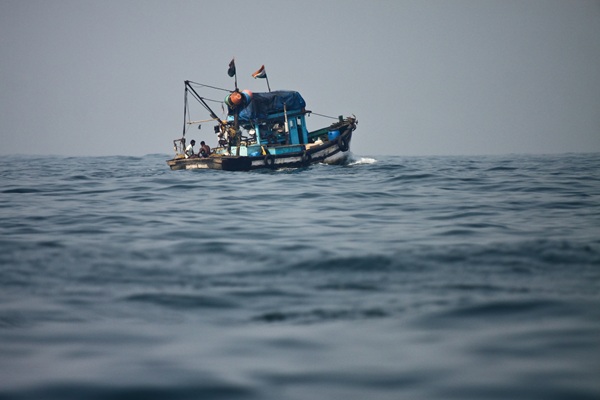
India has traditionally been a coastal fishing nation, with most fishing activity concentrated within 40–50 nautical miles of the coast.
With around 11,000 km of coastline and about 2.4 million sq km of Exclusive Economic Zone, India has vast potential for marine fisheries.
India recently launched a national programme to issue Letters of Authorisation for the Sustainable Harnessing of Fisheries in the High Seas. The Vice President of India distributed these LoAs—official approvals for Indian-flagged vessels to conduct fishing and related activities on the high seas—to Fish Farmers Producer Organisations and fishermen from across the country.
This was not an isolated development. Last December, the government released the Guidelines for Sustainable Harnessing of Fisheries in the High Seas, establishing a broader policy framework for high-seas fishing.
India is the world’s second-largest fish producer, after China, accounting for around 17% of global production. It also earns substantial revenue through marine-product exports.
In 2024-2025, more than ₹620 billion worth of marine products were exported. The figure is notable given the global shocks facing the sector and highlights the resilience of India’s fisheries industry.
The deep-sea fishing programme could create new opportunities for fishermen in marine capture fisheries and enhance the incomes of coastal communities. However, the production structure remains heavily skewed towards inland fisheries, which account for around three-fourths of total output. Marine fisheries contribute only about one-fourth.
Inland fish production rose from 4.98 million tonnes in 2010-2011 to 15.16 million tonnes in 2024-2025. Marine fish production increased from 3.25 million tonnes to 4.61 million tonnes over the same period.
Policy & Global Rules
India’s effort to expand sustainable fishing in its EEZ must also contend with global developments, particularly negotiations on the WTO Fisheries Subsidies Agreement.
The first part of the agreement, often called Fish 1, covers subsidies related to illegal, unreported and unregulated fishing. It was implemented in September last year. However, India, after serious hesitation and opposition, ratified it in July and became the 123rd member to join the pact. This development has seen wide protests from the traditional fishing communities, which see this move as a threat to the financial assistance provided to them under different public schemes.
The second part, referred to as Fish 2, is still being negotiated. It seeks to discipline subsidies that contribute to overcapacity and overfishing.
India’s opposition, at the WTO, to Fish 1 previously and now to Fish 2 stems partly from the structure of its fisheries sector, which is dominated by artisanal and small-scale fishermen.
According to Department of Fisheries data, motorised traditional craft account for 52.1% of fishing vessels, traditional craft 34.3%, and mechanised boats only 13.5%.
High-seas fishing, however, requires advanced mechanised vessels and substantial financial support. The Union and state governments provide subsidies to modernise vessels. That is where friction with Fish 2 negotiations could arise. Such support may fall within the scope of fisheries subsidies and could be viewed as contributing to overfishing, even if that is not necessarily its effect in practice.
Another challenge is export concentration.
India’s marine-product exports rose from 1.15 million tonnes in 2020-2021 to 1.70 million tonnes in 2024-2025. But frozen shrimp account for more than 43% of exports.
This concentration leaves the sector vulnerable to disease outbreaks, changing consumer preferences, and trade restrictions.
International seafood markets, particularly in the European Union and the United States, are also demanding greater traceability and proof that seafood originates from legal and sustainable sources.
Any perception of weak compliance could affect India’s export competitiveness.
Volume to Value
India could consider periodic stock assessments and greater disclosure of the results. Annual fishing quotas may also help support sustainable harvesting.
Technology could play a larger role. Blockchain-based traceability systems, for instance, could help track vessels and verify the origin of catches.
Deep-sea fishing also requires specialised vessels with onboard preservation facilities. India therefore needs stronger international collaboration and financial incentives aligned with global sustainability standards. The larger shift should be from a quantity-based fisheries model towards a value-based one.
Policy should focus not merely on increasing fish production, but on maximising value addition per tonne of catch.
Moving beyond a shrimp-dominated export basket towards higher-value marine species such as tuna and pomfret could increase export earnings without proportionately increasing fishing pressure.
India’s deep-sea fishing initiative should therefore be viewed as a strategic investment in the country’s maritime future.
If implemented with strong governance, modern technology and science-based resource management, it could simultaneously support marine sustainability, export competitiveness and coastal livelihoods.
.png)