.png)

Why India Should Roll Back the Fuel Price Hike Immediately
With crude prices back to pre-war levels, the economic case for rolling back the fuel price hike has strengthened. An immediate rollback would help contain inflation, support household budgets and reinforce confidence in market-linked fuel pricing regime.

Rajesh Mahapatra, ex-Editor of PTI, has deep experience in political and economic journalism, shaping media coverage of key events.
July 2, 2026 at 8:44 AM IST
As shipping through the Strait of Hormuz normalises, and global crude oil prices retreat to pre-war levels, calls for an immediate rollback of the recent fuel price hike are gathering momentum.
The government should respond without delay by directing state-owned oil marketing companies to restore pump prices to their pre-war levels. The case for doing so goes beyond providing relief to consumers. It is also about preventing the inflationary effects of the conflict from becoming more deeply entrenched across the economy.
Although the balance sheets of the OMCs continue to reflect tens of thousands of millions in under-recoveries, they have sufficient financial capacity to absorb the shock and roll back the price hike.
The numbers speak for themselves. India’s five largest state-owned oil and gas companies reported a cumulative standalone net profit of nearly ₹3.28 trillion over the past three financial years (see table). During the same period, the Indian crude oil basket averaged around $77 per barrel.
Following the sharp spike during the Iran war, global crude prices have eased to around $72 per barrel, with the Indian crude oil basket trading slightly below that level. While prices may edge up in the coming months, most analysts expect global crude prices to average about $80 per barrel over the next year.
Restoring fuel prices to their pre-war levels is therefore unlikely to push India’s state-owned OMCs into losses. At worst, their profit margins may come under modest pressure in 2026-27. Even that risk could be mitigated if the government continues the central excise duty waiver on petrol and diesel that it announced in April to cushion the impact of the conflict on India’s oil economy.
The revenue foregone from the excise duty cuts over a full year – estimated at around ₹1.6 trillion – is substantially higher than the OMCs’ under-recoveries. While the government’s finances will inevitably bear the cost of the tax relief, extending the waiver would ultimately serve the interests of both consumers and the wider economy.
Economic Rationale
Fuel is not just another commodity; it is an input cost embedded in almost every aspect of economic activity, from food and transport to services, small businesses and everyday mobility.
When pump prices rise sharply, as they did in the aftermath of the conflict, the effects spread rapidly through the economy. Truckers pay more to transport vegetables, milk, medicines and manufactured goods. Bus operators, taxi drivers, delivery workers and small businesses face higher operating costs. Ultimately, households pay more for essential goods and services even though their incomes remain unchanged.
Rolling back the fuel price hike would therefore be much more than a populist gesture. It would be a timely anti-inflation measure. At present, there is a wide gap between Wholesale Price Index-based inflation rate, at 9.7%, and Consumer Price Index-based retail inflation, at 3.9%.
That gap is likely to narrow over the coming weeks. Wholesale inflation should moderate as global crude prices soften, while retail inflation is likely to edge higher as increased petrol and diesel prices work their way through the economy. This is precisely why the fuel price hike should be reversed before higher transport costs become more firmly entrenched in retail prices.
Neighbouring Sri Lanka, where companies like Indian Oil Corp operate fuel retail outlets, has already reduced fuel prices. On Wednesday, Nayara Energy – India’s largest private fuel retailers – cut petrol prices by ₹5 per litre and diesel prices by ₹3 per litre. There is little justification for state-owned OMCs to delay a similar move.
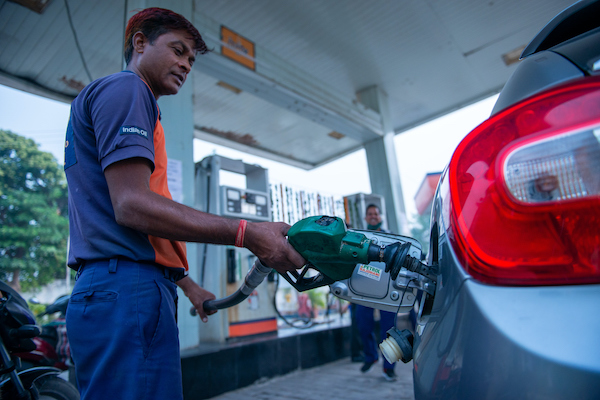
Fuel price increases have a cascading effect because diesel powers freight movement and public transport, while petrol directly affects millions of commuters and two-wheeler users. In a country where many households devote a significant share of their income to transport and food, even a modest reduction in pump prices can meaningfully ease monthly budgets.
When global crude prices fall, consumers should benefit from lower fuel prices rather than being asked to wait while companies rebuild their balance sheets or governments safeguard revenues. Fiscal prudence is important, but it should not depend disproportionately on taxing a product that affects virtually every citizen, directly or indirectly.
Rolling back the hike would also strengthen public confidence in India’s fuel-pricing framework. Consumers are repeatedly told that fuel prices are market-linked, yet price increases are often passed through quickly while reductions tend to lag when crude prices fall. Restoring pre-war prices now and clearly communicating the basis for future revisions, would make fuel pricing more transparent, predictable and credible.
Critics may argue that a rollback would weaken OMC finances or widen the fiscal deficit. Those concerns deserve consideration, but they should not become a justification for transferring the entire burden of a temporary external shock to consumers. A rollback need not amount to an open-ended subsidy; it would simply represent prudent shock absorption at a time of exceptional volatility.
With inflationary pressures, employment insecurity and rural distress still weighing on the economy, and the prospect of a deficient monsoon adding fresh uncertainty, cheaper fuel would provide immediate and broad-based relief. It would lower transportation costs, ease supply-chain pressures and signal that economic policy is responsive not only to fiscal arithmetic but also to the everyday realities faced by households.
The principle is straightforward: when fuel prices rise, the costs are borne across the economy; when they fall, the benefits should be shared just as widely. The government should therefore immediately roll back the fuel price hike and accompany it with a transparent, predictable and consumer-oriented pricing framework. In a democracy, economic policy should do more than balance the books; it should also protect citizens from avoidable hardship.
More From BasisPoint