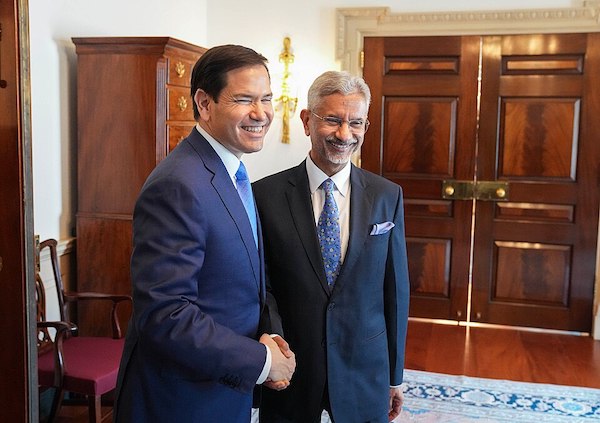
Marco Rubio’s four-day visit to India last week yielded a joint press conference, a critical minerals framework, and a White House invitation for Prime Minister Narendra Modi. It produced neither a tariff settlement, nor a resolution on the question of Russian oil.
On changes in mobility rules affecting Indian professionals, Rubio claimed the new rules were ‘not about India’ but broader immigration reforms. The visit was, in that sense, a mirror of where this relationship now stands—necessary, performative, and transactional. India needs to make peace with that reality and operate within it.
New Playbook
This is clearly the new playbook for American diplomacy on tour. US President Donald Trump’s summit with China’s Xi Jinping in mid-May was built around atmospherics. Xi called for a ‘stable and predictable’ bilateral relationship, and Trump declared ‘fantastic trade deals’ with few binding commitments attached.
Rubio’s New Delhi visit followed a similar logic: bilateral talks with External Affairs Minister S. Jaishankar to steady ties that both sides acknowledged had fallen to their lowest point in over two decades, effusive claims about ‘exciting and new announcements’, a joke about the heat in Delhi, warm words about India being the cornerstone of American Indo-Pacific strategy, and photo-ops at Amer Fort, the Missionaries of Charity, and the Taj Mahal.
Past American engagements with India have followed pre-negotiated outcomes, often years in the making. The civil nuclear deal is the clearest illustration. The framework was laid in a joint statement between Manmohan Singh and George W. Bush in July 2005, negotiations were concluded in July 2007, the Hyde Act in the US was passed in 2006, cleared by the IAEA and the NSG, and finally signed in October 2008, marking three years of sustained institutional labour across two governments, two legislatures, and an international safeguards body.
Three foundational defence agreements have followed the same logic. LEMOA in 2016, COMCASA in 2018, BECA in 2020, each built incrementally on the last, locking in specific interoperability commitments that reshaped the bilateral security architecture over a decade. High-level visits were, in effect, contract closings with the principals on deliverables that had already been negotiated and cleared.
In contrast, the current visit was merely an attempt to establish that the relationship still functions despite friction over tariffs, Pakistan, and Russian oil. Before arriving in India, Rubio told reporters that Washington wants India to buy more American oil and gas. He subsequently told the Prime Minister that ‘US energy products have the potential to diversify India’s energy supply’. While in India, he claimed in a social media post that India committed to purchasing $500 billion in US goods over the next five years—a claim that India has not corroborated.
Energy Focus
The opening move for a Secretary of State’s first-ever visit to a major strategic partner is rarely about energy sales. In a visit that was more of a progress check, the statements were a reminder of the announcement of the interim trade deal made in February. The same announcement that claimed India had committed to increasing imports of American energy, technology, and agricultural products, as well as to stopping imports of Russian oil, leading to removal of the 25% punitive tariff on Indian goods.
Perhaps this also explains why the trip’s signature deliverable, a critical minerals bilateral framework, arrived not at the start of the visit but on its final day, announced after the Quad Foreign Ministers’ meeting. The Quad had released its own Critical Minerals Initiative Framework the same day, pledging to mobilise up to $20 billion across mining, processing, and recycling supply chains. The India-US bilateral pact came alongside a multilateral announcement rather than standing as a pre-planned centrepiece of Rubio’s India trip.
This ad hoc quality reflects a deeper feature of the new transactional grammar of American foreign policy. The pressure on India has been explicit and cumulative along three fault lines.
Elephant in the Room
First, the tariff question remains unresolved even as the countries negotiate a trade deal. New Section 301 investigations by the Office of the US Trade Representative (USTR) keep the prospect of uncertain levies alive, even if the current temporary tariffs expire in July. Second, America’s tactical re-engagement with Pakistan creates asymmetric pressure on India’s security calculus, and third, Washington’s shifting posture toward China, oscillating between confrontation and accommodation, makes it harder for India to calibrate its own China policy. For India, strictly wedded to the concept of strategic autonomy in foreign policy, the challenge is to remain a partner that Washington needs, without becoming one it takes for granted.
India must navigate this through three simultaneous moves. The first is diversifying strategic relationships as a genuine expansion of India’s geopolitical bandwidth. The India-EU Security and Defence Partnership, signed in January 2026 alongside the announcement of the India-EU Free Trade Agreement, is a comprehensive framework structuring cooperation across maritime security, defence industry, cyber and hybrid threats, and counterterrorism. With Japan, the 2025 Joint Vision for the Next Decade, and the updated Joint Declaration on Security Cooperation prioritise technological and industrial collaboration and supply chain linkages for critical minerals. In the Gulf, the India-UAE engagement now includes critical defence manufacturing and financial integration, and collaboration on expanding strategic energy reserves. Prime Minister Narendra Modi’s April 2025 visit to Saudi Arabia resulted in $100 billion in agreements spanning energy, infrastructure, and critical minerals.
The second is to invest in the institutional depth of the American relationship. India’s engagement with Washington has historically concentrated at the summit level, while underserving the bodies that shape day-to-day policy. The US Congress, for instance, is actively legislating on the Quad. The ‘Strengthening the Quad Act‘ passed the full House in May 2025, and the ‘Quad Economic Security Act‘ was introduced to secure critical supply chains. If passed, these could materially shape the terms of India’s technology and minerals partnerships. The Senate Foreign Relations Committee, USTR, the Commerce Department’s Bureau of Industry and Security, the NSC’s Indo-Pacific directorate, the House India Caucus and the Senate India Caucus are all bodies that can weigh in on export licence approvals, terms of the trade agreement, and sanctions carve-outs. India needs sustained, structured engagement with them.
The third is to speak transactionalism back to Washington. If the US wants India to reduce its purchases of Russian and Iranian energy, India should price that concession explicitly and use it to extract movement on the items that matter most to New Delhi. This may include a durable tariff settlement, expanded market access for Indian services and goods, or a favourable visa regime for Indian professionals. The logic of the marketplace cuts both ways.
The Rubio visit underlined the grammar of the US-India relationship, which, for now, involves hard bargaining between two powers whose interests converge enough to cooperate and diverge enough to keep score. In the age of America First, strategic autonomy needs to translate into strategic leverage. That means offering pricing concessions in exchange for alignment, rather than in the hope of goodwill.
.png)