.png)

The OPD Waiting Room Is A National Anxiety Clinic
This column looks at why the OPD waiting room has become one of the most revealing spaces in the country, where fear, hierarchy, and everyday absurdity all sit together.
Dr. Srinath Sridharan is a Corporate Advisor & Independent Director on Corporate Boards. He is the author of ‘Family and Dhanda’.
March 28, 2026 at 7:06 AM IST
This column looks at why the OPD waiting room has become one of the most revealing spaces in the country, where fear, hierarchy, and everyday absurdity all sit together.
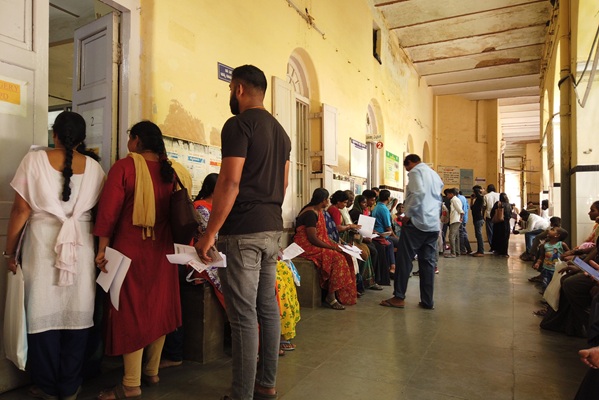
There are few places in modern life more emotionally revealing than an Indian hospital waiting room. Airports are performative. Weddings are deceptive. Corporate meetings are fictional. But a hospital waiting room has no interest in preserving anyone’s dignity. It shows human beings exactly as they are. Nervous, impatient, helpless, overinformed, underexplained, and trying very hard to remain polite because the person they need is wearing a white coat.
You enter with a stomach ache, a scan report, a suspicious lump, or simply a rising fear that something inside you has decided to misbehave. Your heart rate is already higher than usual. You are about to discuss blood markers, organs, or probabilities. This would normally be enough anxiety for one setting. But the Indian hospital, always committed to a full-service experience, adds a television blaring Hindi news.
Nothing says healing like a TV red ticker announcing some horrific crash or stock market collapse.
The waiting room television is one of the least examined cruelties of urban India. Patients sit under fluorescent lights while anchors scream about outrage, corruption, war, scandal, and impending doom. The volume is always slightly too high, the debate always slightly too aggressive, and the emotional effect always completely wrong for a place where people are trying not to imagine the worst. You could be waiting to discuss a biopsy and still be forced to absorb a panel discussion on civilisational decline.
One begins to suspect that the purpose of the screen is not information. It is ambience for collective panic.
Why hospitals do this remains a mystery. Perhaps silence makes institutions nervous. Perhaps management believes news channels create a sense of seriousness. Perhaps nobody has ever sat down and asked the radical administrative question: should anxious people be made more anxious before meeting a doctor. Or perhaps this is simply the Indian way of decorating distress. We cannot leave people alone with their thoughts, so we drown them in somebody else’s hysteria.
Then comes the second ritual of the waiting room. Time loses moral meaning.
Your appointment was at 11:30. It is now 12:20. Then 12:50. Nobody gives you a clear answer. The receptionist smiles with the vague tenderness of someone who has long stopped believing in clocks. You ask how much longer. She says, “बस आ रहे हैं,” a phrase that in India can mean anything from two minutes to the collapse of the current government.
This is where the god complex conversation begins.
In Indian society, especially in medicine, surgeons and senior doctors are given a status somewhere between expert and deity. This is partly earned. They hold life and death in their hands. They make decisions ordinary people cannot make. They cut open the human body and occasionally put it back together in ways that feel very close to magic. There is skill there, and courage, and years of punishing discipline. It is not irrational to admire them.
But admiration, in India, quickly mutates into exemption.
The doctor begins to occupy a category above ordinary civic expectations. Punctuality becomes optional. Explanation becomes generous rather than necessary. Waiting becomes the patient’s moral duty. Time discipline, that strict little rule imposed on everyone from schoolchildren to junior executives, suddenly no longer applies. The doctor is important. The patient, by implication, is available.
To be fair, hospitals are not lying when they say medicine is unpredictable. Doctors do not work in neat 30-minute units like salon appointments. Surgeries run over time. Emergencies disrupt schedules. Complications appear. A patient in distress cannot be told, “Please hold, I have an outpatient waiting.” There are also layers of hospital hierarchy invisible to the average person. If an owner calls, if an influential family arrives, if an elite referral is sent in, the queue bends in ways nobody announces but everybody notices.
Medicine is not a punctual profession because the human body is not a punctual machine.
And Indian doctors, unlike many of their Western counterparts, often see an extraordinary number of patients in a day. Partly this is structural. Fees, though not cheap by Indian standards, are still often far lower than in richer countries, especially relative to workload and demand. So the doctor compensates the only way the Indian middle class understands any service imbalance. By volume. More patients. More consultations. More spillover. More waiting rooms full of people trying to look calm.
This is also why doctors themselves are often the least compliant citizens of their own wellness lectures. They advise meal discipline while skipping lunch. They recommend sleep while functioning on fragments of it. They speak about exercise with moral clarity and then spend fourteen hours in motion between wards, OPDs, emergency calls, and surgeries. The doctor is often living proof that medical knowledge and personal lifestyle are not close friends.
So yes, the god complex exists. But so does the god workload.
The problem is not merely arrogance. It is a culture that trains both doctor and patient into an unhealthy arrangement. The doctor learns that authority justifies opacity. The patient learns that gratitude requires submission. Add fear to this equation and the imbalance becomes complete. A frightened human being waiting for medical reassurance is rarely in the mood to demand procedural dignity.
And yet dignity matters. Especially there.
Carl Jung is supposed to have said, “Medicine cures diseases, but only doctors can cure patients.” It is one of those lines that survives because it contains a deeper accusation. Patients do not come only for prescriptions. They come for interpretation, reassurance, proportion, and sometimes a face that does not treat them like the least important variable in the room.
This is why the hospital waiting room reveals more than institutional inefficiency. It reveals our entire social architecture. Noise instead of calm. Authority instead of communication. Hierarchy instead of transparency. We are asked to sit quietly, trust the process, absorb uncertainty, and not make a fuss. In short, we are asked to behave like ideal Indians.
The tragedy is that Indian healthcare is also full of genuine excellence. Where else can one often get an MRI the same day, a specialist opinion quickly, or emergency intervention with astonishing speed when things are truly serious. The system is stretched, unequal, sometimes chaotic, but often remarkably responsive when compared to much richer countries. That is precisely why its small everyday indignities feel so unnecessary. If you can organise advanced diagnostics at speed, perhaps you can also change the channel in the waiting room.
Or better still, turn it off.
Because a hospital should not feel like a news studio with a pharmacy attached. It should not demand devotional patience from frightened people while offering them outrage on television and vagueness at the desk.
After all, people are there because something in their life has already become uncertain.
More From BasisPoint