.png)

Tamil Nadu 2026: The Three-Cornered Battle That Could Rewrite History
Tamil Nadu's 2026 elections are no longer a two-party race. With actor-turned-politician Vijay's TVK challenging the DMK-AIADMK duopoly, deep anti-incumbency, and wafer-thin poll margins, this could be the election that rewrites the state's political playbook.
Amitabh Tiwari, formerly a corporate and investment banker, now follows his passion for politics and elections, startups and education. He is Founding Partner at VoteVibe.
February 27, 2026 at 6:54 AM IST
Tamil Nadu has always been a state that plays by its own rules. Decades of Dravidian dominance, a revolving door between two political giants, and an electorate that has consistently punished complacency — these are the defining traits of one of India's most politically sophisticated states.
But as the 2026 assembly elections approach, something feels different. For the first time in a generation, the 234-seat legislature may not simply alternate hands between the DMK and the AIADMK. A third force has arrived — Vijay and his party, Tamilaga Vettri Kazhagam (TVK).
Three-Way Contest
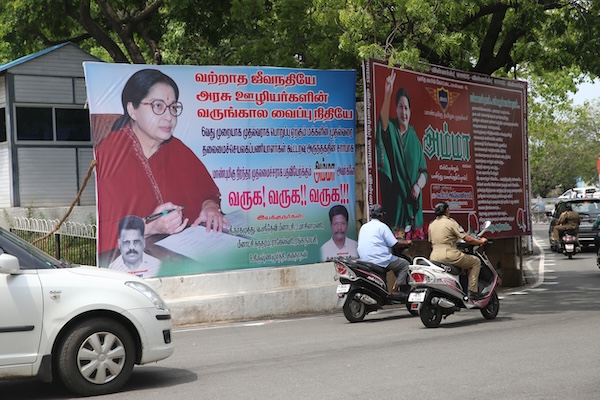
The DMK, led by incumbent Chief Minister M.K. Stalin enters the election with a familiar and stable coalition — Congress, the Left parties, VCK, MDMK and now DMDK — projecting administrative competence and a record of welfare delivery. Stalin remains reasonably popular as chief minister, though the same cannot be said of many of his MLAs.
On the other side, a shaken AIADMK has spent the years since its 2021 defeat rebuilding. Under Edappadi K. Palaniswami, the party has regrouped, consolidated its leadership, and widened its tent by realigning with the BJP and bringing in the PMK, AMMK and the Tamil Manila Congress, in an effort to prevent the vote fragmentation that contributed to its last loss.
Then there is Vijay. The actor-turned-politician’s TVK rallies have drawn massive crowds. His sharp anti-establishment and anti-DMK rhetoric appears to be striking a chord, particularly with younger and female voters. However, a deadly stampede at a TVK rally in Karur in 2025, followed by a CBI inquiry, has introduced political risk into his trajectory. Whether his screen popularity translates into votes on polling day remains uncertain.
Revolving Door
To understand what is at stake, one must first understand the history. Tamil Nadu politics was fundamentally reshaped in 1972 when MGR broke from the DMK to form the AIADMK. In the eleven elections that followed, the AIADMK won seven and the DMK won four — a structural advantage that also shows up in vote share. The AIADMK outpolled the DMK in eight of those eleven contests, with an average vote share of 34.6% compared with the DMK's 29.4% between 1977 and 2021.
From 1984 to 2016, the state operated under a near-perfect revolving-door mechanism, with the AIADMK and the DMK alternating in power with striking regularity. That pattern was broken in 2016 when Jayalalithaa led the AIADMK to a rare consecutive victory. The 2021 election restored the cycle, with the DMK routing the incumbent AIADMK.
Now, heading into 2026, 44% of voters, according to VoteVibe, believe the trend of unseating the incumbent government is likely to repeat, while only 21% think otherwise. History, in other words, appears to tilt against the incumbent.
Too Close to Call
Recent survey data from VoteVibe paints a picture of genuine uncertainty. On voting intentions, the DMK-led alliance stands at 35.8%, against the AIADMK's 33.8% — a margin of just two percentage points, well within the margin of error. The TVK sits at 19.2%, a significant tally that could prove decisive. A further 4.7% remain undecided, small enough to overlook, yet large enough to tip a razor-thin race.
Chief ministerial preference mirrors this fragmentation. Stalin leads at 33.3%, followed by Palaniswami at 29.8% and Vijay at 23.2%. The demographic split is telling: youth voters strongly favour Vijay; middle-aged voters lean towards Palaniswami; and senior citizens back Stalin. This generational divide could prove crucial on polling day.
Anti-incumbency, meanwhile, runs deep. A striking 53.7% of respondents say they are unlikely to support their sitting MLA, including 33.4% who say they are highly unlikely to do so. Meanwhile, 41.9% rate the incumbent government's performance as poor or very poor, compared with 36.1% who view it positively, while 14.5% rate it as average.
These are numbers that should concern any incumbent government. They suggest that, whatever the DMK's narrow alliance-level lead, constituency-level outcomes could prove more volatile than top line numbers suggest.
The most consequential unknown is not which of the two Dravidian parties will prevail, but what Vijay's TVK will do to the arithmetic. Voter assessments are sharply divided. Only 18% believe TVK will form the government, while 8% see it as a potential kingmaker in a hung assembly. More significantly, 22% believe it will function primarily as a vote-cutter, while 31% predict it will fade, much like Prashant Kishor's still-unproven political experiment in Bihar.
The damage the TVK is expected to inflict appears asymmetric. Survey data shows that 32% believe Vijay will hurt the DMK most, compared with 20% who say the AIADMK and 17% who say both equally.
Game of Alliances
At the heart of this contest lies the classic distinction between enthusiasm and votes. Tamil Nadu's political architecture is deeply alliance-driven. The two Dravidian blocs have historically commanded a combined 70% of the vote. The remaining 30% is shared among smaller parties — many of which, including the PMK, the Left, the VCK, the MDMK and the AMMK, have already been absorbed into one or the other coalition.
Roughly 12-13% of the vote belongs to non-aligned parties such as the NTK and independents. The TVK is competing for what remains: a sliver of genuine swing voters, disillusioned youth and first-time voters. Whether that universe is large enough to convert crowd energy into elected seats remains the defining question of this election.
Alliance-hopping is common in Tamil Nadu. The Congress was earlier with the AIADMK and is now with the DMK. The BJP was earlier with the DMK and is now with the AIADMK. Smaller parties such as the PMK, DMDK, MDMK, VCK, and the Left have switched sides frequently.
Both major parties are firming up alliances. The AIADMK has secured the PMK and the AMMK, consolidating support among Vanniyars and Thevars. The DMK has brought in DMDK, with an eye on segments of the Telugu-speaking vote.
Meanwhile, the Congress is exerting pressure on the DMK for a larger share and even demanding power-sharing, a proposal the DMK has rejected. At the same time, it is seen as flirting with the TVK, with a section within the party favouring an alliance with Vijay. In the end, it may amount to little more than bargaining leverage.
History vs Disruption
Tamil Nadu 2026 presents a genuine dilemma. History argues for an AIADMK return: the revolving-door mechanism, the structural anti-incumbency, the party's historically higher vote share and its broader alliance. The survey data, however, shows the DMK still narrowly ahead — despite anti-incumbency — largely because of a split in opposition votes. The TVK factor, if it cuts into both parties, could scramble every projection.
More From BasisPoint