.png)


Sharmila Chavaly, a former civil servant who held key roles in the railways and finance ministries, specialises in infrastructure, project finance, and PPPs.
July 18, 2026 at 7:42 AM IST
The death of an 11-year-old boy in Mumbai, crushed by a falling tree, is a heartbreaking symptom of a crisis that has been decades in the making. This tragedy, and others like it, force a necessary and painful conversation about how our cities treat their trees and the infrastructure with which they share space.
The problem is not limited to Mumbai. It is a pan-India issue, where a systemic, unscientific and starkly brutal approach to managing urban greenery in public spaces has been making our cities hotter, more polluted and, ultimately, more dangerous.
The recent incident in Mumbai is the tip of the iceberg. The civic inquiry into the incident is examining whether recent road excavation damaged the tree’s structural roots, triggering internal decay. This is symptomatic of a citywide and, indeed, national problem.
In most cities, a similar pattern emerges: a bureaucratic process, often invoking the Disaster Management Act, has led to the needless felling of healthy trees or the removal of healthy, growing branches for perceived convenience.
The roots of this crisis run deep.
Decades of road widening, utility trenching, redevelopment and the relentless spread of concrete around tree trunks have weakened many trees. This leaves them vulnerable to the increasingly intense weather events brought about by climate change.
A Cycle of Mutilation
The result is a system that rewards speed over sense, sacrificing vital natural urban infrastructure for a misplaced notion of safety.
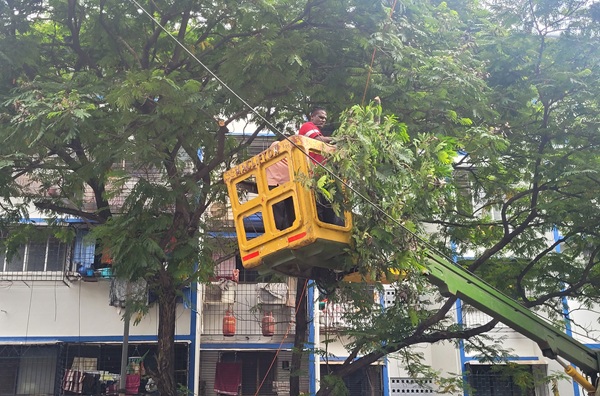
Tree branches are brutally chopped down before the monsoon, or whenever they interfere with overhead wires, traffic signals or even shop signs. This practice, known as ‘topping’ in arboriculture, is an outdated and destructive technique.
The ghosts of these trees stand in rows along our streets, their branches disfigured and their growth stunted. This is not pruning but repeated annual punishment. It creates a self-defeating cycle: severe chopping weakens the tree, destroys its shade canopy and leads to weak, unstable new growth that creates an even worse problem in the future.
This practice is the direct opposite of a common-sense approach to urban forestry, which would keep trunks free of concrete, allow roots the space they need and employ scientific pruning techniques.
Is Underground the Answer?
The most significant barrier is cost. It is astronomically expensive, which is a key reason it cannot be implemented everywhere. Moreover, undergrounding is not a perfect fix.
The installation process, which involves trenching, can sever critical roots, directly weakening the very trees the city is trying to save. Digging also often causes massive traffic disruption and power outages.
A Different Path: Solutions for a Greener, Safer Future
--Expert Pruning and Proactive Planning
This is the most immediate and cost-effective change. Instead of chopping branches indiscriminately, arborists should practise ‘directional pruning’. This involves selectively removing only the branches growing towards wires and cutting them back to a natural branch junction.
A clear municipal policy mandating such standards and explicitly banning topping is the first crucial step.
Proactive planning is equally vital. Suzhou in China has innovatively addressed tree-wire conflicts by using three-dimensional modelling and growth-prediction technologies. By collaborating with power departments, the authorities develop customised pruning plans for each road, effectively resolving thousands of such conflicts while preserving the urban landscape.
Similarly, in Shanghai’s Qingpu District, the government and the power company have signed agreements to integrate their planning processes, preventing conflicts at the design stage rather than reacting to them later.
--Technology for Precision: The Montreal Model
India can also leapfrog to a smarter approach by using technology. The utility Hydro-Québec in Montreal uses a powerful combination of LiDAR, or laser scanning, and artificial intelligence to create ‘digital twins’ of its power network.
This technology allows it to map trees precisely and predict which branches are most likely to break during storms, enabling intervention with surgical precision.
Instead of using a ‘shotgun approach’, in which as many branches as possible are eliminated, the utility is intervening in a much more targeted manner, reconciling the need for more trees with the need for a reliable power grid.
Beyond technology, it is also experimenting with growth-manipulation techniques, using stakes to guide trees to grow in a ‘Y’ shape that naturally avoids power lines. This is about learning to grow large trees in cities while minimising the risk of damage to the electricity network.
--National Policies for Urban Greening
India has also taken steps in the right direction, at least on paper and at the policy level.
- Nagar Van Yojana: This central government scheme aims to develop 1,000 Nagar Vans, or urban forests, by 2027. It provides financial assistance to create green spaces in cities for recreation and environmental resilience.
- Ahmedabad’s mandate: In a pioneering move, the Ahmedabad Municipal Corporation has mandated that 5% of all new town-planning schemes must be dedicated to green spaces. It also requires at least 1% to be set aside for dense Miyawaki forests. The jury is still out on whether this will be effective, but it is a direct response to the urban heat-island effect and air-quality problems, creating a legal framework for green infrastructure.
- Delhi’s ecological shift: Delhi’s approach is purportedly undergoing a fundamental shift, from mere tree planting to deep, system-level ecological restoration. The official credo now is that street redevelopment will prioritise greening over paving, and it has become difficult to obtain permission to fell a tree, although the indiscriminate lopping of branches continues. The city plans to integrate its streets, parks, forests and floodplains into a single ecological network.
Long-Term Vision
This requires collaboration between civic departments, respect for scientific expertise and a fundamental commitment to treating urban trees not as obstacles, but as essential natural infrastructure.
In an age of climate crisis, trees are the first line of defence against heat, pollution and flooding.
More From BasisPoint