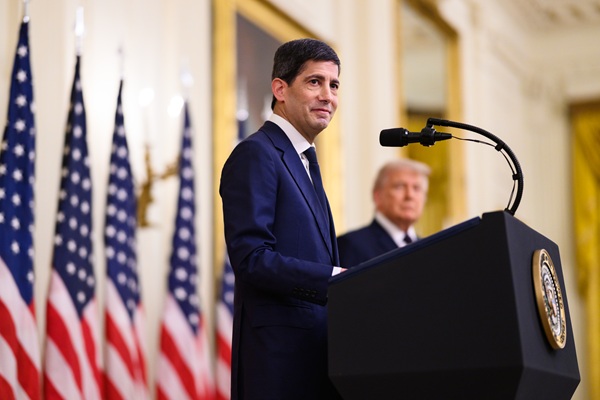
In his remarks to this year’s gathering of central bankers in Jackson Hole, Wyoming, US Federal Reserve Chair Kevin Warsh called for the Fed to “receive the full range of ideas” on monetary policy in order to “construct more reliable models.” Apparently, and to his credit, he recognises that the current models, rooted in mainstream economics, are not very good. He also rightly acknowledged the Fed’s dual goals, set by law, of full employment and price stability, though he erred in describing the 2% inflation target as part of “our mandate.” (In fact, it is only an internal goal.)
Warsh’s hard line on inflation runs up against a key weakness in his models. His remarks treat AI as “a new factor of production” that introduces the “potential for substantially higher growth” and a “sustained rise in productivity.” This description reflects the standard textbook “production function”—which tracks the interaction of capital and labour—under which advancing technology always enhances economic growth. But the textbook model is categorically wrong.
Technology is a force of creative destruction, and destruction destroys. New technologies drive older technologies to the wall, rendering the functions served by previously scarce and valuable goods so abundant and cheap that they fade from the economy—and from the data. Anyone old enough to remember the expensive communications junk of the analog age knows this well.
Back when cars, trucks, roads, oil fields, refineries, gas stations, and repair shops displaced grass-fed horses and coal-fed trains, technology also worked (with government help) to bring new economic activity into being, inaugurating the automotive and electrical age. But information and AI tend to erase market activity by making communications and analysis fast and cheap, and it is not yet clear what (if anything) comes in their place. The creative destruction they have unleashed is also transnational. Warsh did not mention the risk that superior Chinese AI models may one day pose to American ones; that inconvenient prospect cannot be framed in terms of “production functions.”
With products whose prices have collapsed disappearing from the economic data, the inflation rate reflects the price of what remains in the index. For most people, the basket is constantly shifting toward essentials like food, fuel, rent, and health care, all of which are becoming more expensive. Nobody feels rich by dint of e-postage being free; our budgets are reallocated to cover those things we still have to pay for. The inflation rate we experience is not driven by wages (whose growth has been “moderate,” as Warsh said), but by profits, by AI driving up the cost of electricity, and by US President Donald Trump, who seems determined to wreck the oil trade. These forces do not respond directly to rising interest rates.
On interest rates, Warsh dispelled a lot of nonsense with splendid candor: “We determine the path of short-term interest rates.” A brass plaque with those words should be sent to all the Washington think tanks and lobby groups that exist to prattle on about the federal budget deficit. The short-term interest rate is always exactly what the Fed wants it to be, and in setting short-term rates, the Fed is also the driving force behind long-term rates. When the Fed keeps short rates low for a long time, long rates follow the short rates down. The recent rise in long-term rates—what has been called a global “bond rout”—mainly reflects an expectation that short rates will be raised. It’s not complicated; all other factors are secondary.
But higher interest rates cannot “cure” today’s inflation—not even by causing a slump. In 1981, the Fed raised interest rates to 20% and manufacturing employment, investment, unions, wages, and household purchasing power collapsed, the dollar soared, and imports became cheaper. Today, manufacturing is much smaller, unions are already feeble, many consumer goods are made abroad, and the dollar has been weakening. If housing construction falls, as it may do, rental rates will rise.
Crucially, the federal debt is about four times larger, relative to GDP, than in the early 1980s. Raising rates now would pump money into financial assets and into economic activity, most of which is services. When former Fed Chair Jerome Powell raised the federal funds rate by more than 500 basis points, the stock market boomed, the economy did not slow down, and there was no effect on inflation.
Short-term interest rates are the Fed’s only weapon, but it has jammed, and Warsh cannot get it working again. Stuck on mainstream models, he has committed himself, and his reputation, to a goal he cannot achieve. Reining in inflation would require different measures—including peace with Iran, detente with China and Russia, and strategic controls over prices and profits—that are not within the Fed’s power.
So, what should Warsh do? He cannot cut interest rates, because Trump has foreclosed that possibility merely by wanting it to happen. That leaves only one proper course of action: Do nothing. Wait and see. Warsh should show spine by resisting pressure from every angle, and spend his time seeking out the new ideas, sharp critiques, and original minds who might be able to pull the Fed out of its ideological rut.
Project Syndicate
.png)