.png)

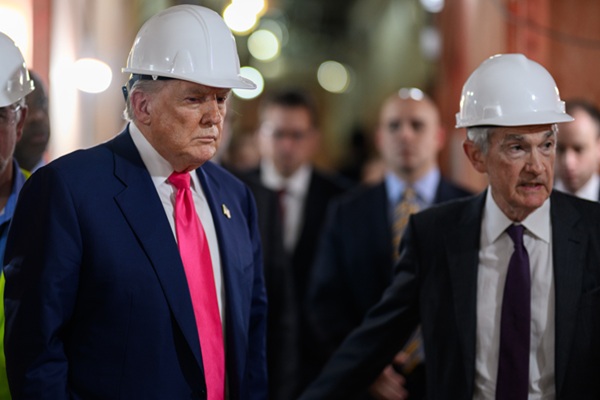

Call it one of the biggest turnarounds in the US Federal Reserve’s storied history. When Jerome Powell concludes his two-term tenure as Fed chair on May 15, his legacy is likely to reflect a striking irony: it will have been secured by the man who sought most aggressively to undermine him.
History is often written in the shadows of conflict, and Powell’s leadership at the Fed is no exception. The narrative that will likely endure is not one of multiple failures, but of political resilience. Rather than dwelling on a long list of mishaps—significant policy errors, protracted periods of the Fed overshooting its inflation target, poor communication and compliance, supervisory and other lapses—commentators and historians will remember Powell as the chair who became a bulwark against unprecedented attacks on the central bank’s independence.
Armed with the overwhelming historical consensus that central-bank autonomy is a prerequisite for long-term economic well-being, Powell went to extraordinary lengths to insulate the Fed from executive overreach. Throughout both his first term, and especially his second, he was forced to navigate a minefield of political pressures. The multifaceted campaign against him included not just public verbal broadsides and an attempt at televised humiliation, but even a Department of Justice investigation.
Powell’s defining moment as Fed chair came when he decided to “play offense.” In January 2026, breaking with his institution’s tradition of quiet diplomacy, he released a dramatic public video whose message was as clinically crafted as it was unambiguous. In an unprecedented and previously unthinkable manner, he bluntly accused the president of the United States of seeking inappropriately to influence interest-rate policies.
Without this high-stakes defense of the institution, Powell’s record would undoubtedly be viewed more harshly. In strictly economic terms, his tenure was marked by a series of significant “misses.” For example, US domestic data had begun to paint a more troubling inflation picture even before the US-Israeli attack on Iran provided an exogenous shock to explain price pressures.
Consider the January 2026 report on personal consumption expenditures (PCE) inflation, widely viewed as the Fed’s preferred measure. Monthly core inflation (which excludes volatile food and energy prices) was edging higher, giving the lie to the notion that the central bank was on the “last mile” toward its 2% inflation target. Annual core inflation remained stubbornly anchored at around 3%, well above target, and the goods component was flashing yellow—indicating renewed supply-chain or trade distortions—while the services sector remained untamed. The inflation numbers then deteriorated markedly in March, with monthly PCE inflation jumping to 0.7% as the fallout from the war with Iran started to percolate through the global economy.
The data suggest that Powell would have left the Fed with inflation not only above target for the sixth consecutive year, but also increasingly structural and sticky in nature. Even absent the latest geopolitical volatility, the US economy would be poised for several more years of above-target inflation.
Beyond still-high inflation, various other mistakes have also loomed large over the Powell era. The first was the related “transitory” miscalculation, when the Fed’s failure to recognize the persistence of post-pandemic inflation resulted in price growth rising all the way to 9.1%, dealing a severe blow to Americans’ budgets—especially those of the poorest households. Much of this pain is still being felt today, fueling a troubling “affordability crisis.”
Then there were the bank-supervision lapses, which allowed for the dramatic failure of Silicon Valley Bank—followed soon after by Signature Bank and First Republic—and the de facto universal extension of federal deposit insurance. The Powell Fed also fell short on communication, with the chair himself often heightening market volatility by giving confused or confusing signals at his regular press conferences.
Finally, there were signs of internal strain or a cultural misalignment, with several Federal Open Market Committee (FOMC) members resigning amid allegations of financial irregularities. And there was the Fed’s failure to arrive at a new guiding policy framework. A 2025 reform to the Monetary Policy Framework remains unfinished, following a previous attempt, in 2020, that was essentially dead on arrival, owing to its focus on the problems of the previous decade. More broadly, the Powell Fed has repeatedly been unable to break away from the narrow confines of rigid models to incorporate a more holistic understanding of global structural shifts.
Yet all this will likely be sidelined in the history books because of Powell’s staunch defense of the Fed’s independence. This defining feature of his legacy will be further reinforced by his final decision to dramatically buck tradition by remaining on as a Fed governor after the conclusion of his chairmanship. In explaining this move at his final press conference, Powell voiced concerns that the Fed is still under attack, with the executive branch engaged in legal maneuvers that are “unprecedented in our 113-year history.” Ultimately, “the things that have happened, really in the last three months,” he argued, “have left me no choice.”
Yet his decision is proving polarizing. To some, it is a heroic act: a commitment to providing a “steady hand” on the board of governors, and to ensuring that the Fed’s institutional defenses remain intact. To others, Powell has adopted a self-serving strategy to manage both his own legal exposure and the broader narrative. Moreover, some see him as slighting his successor and colleagues on the FOMC, and others worry that the move will provoke more attacks on an already weakened institution.
By staying on beyond the end of his tenure as chair, Powell can keep the focus on his role as the “defender of the Fed.” But that also means he can sideline substantive policy critiques that would otherwise have defined his mixed legacy. He has his main critic to thank for that.