.png)

India Economy is Growing, But Data Gives a Reality Check on Youth Employment
Low levels of education, limited skills, and concentration in the lowest earnings percentile – these are only some of the issues that ail India’s youth. Further, the gender divide is real, and wide. These factors are keeping the youth from being meaningful partners in India’s growth story.


Dr. Smita Roy Trivedi is an Associate Professor at the National Institute of Bank Management (NIBM), Pune.

Dr. Abhiman Das is a Professor of Economics at the Indian Institute of Management Ahmedabad.
July 30, 2026 at 3:57 AM IST
India waits for the transition to a $30 trillion economy by 2047. Yet, there are too many young ‘unemployed’ people - reportedly called ‘cockroaches’. In a month when the Government reiterates 7% plus growth, we witnessed glimpses of a seething young people’s protests around the country resulting in the resignation of the Education Minister. Now, it may not be easy to dismiss the movement as rhetoric or myopic. An understanding of the underlying concerns is perhaps necessary.
India’s demographic dividend is the stuff of legends. For years, we believed the demographic dividend will create an educated (indeed, mostly over-qualified for available jobs), English-speaking (from clerks of the British, we are now back-office ‘engineers’ for the world) and hardworking (since opportunities are limited and stakes high) labour force that can take the service-dominant Indian economy to its $30 trillion dreams.
#Notes (all figures): Estimates are based on unit-level PLFS data from 2017–18 to 2023–24 (agricultural year: July–June) and the 2025 calendar-year PLFS (January–December 2025). Labour force participation, and unemployment follows the official MoSPI Usual Principal and Subsidiary Status (UPSS) definition. All estimates are nationally representative and use the official PLFS person-level survey weights. Youth cover ages 15-29, and Adult 15-59. Unpaid family worker is included in employed. Data source: PLFS, MOSPI
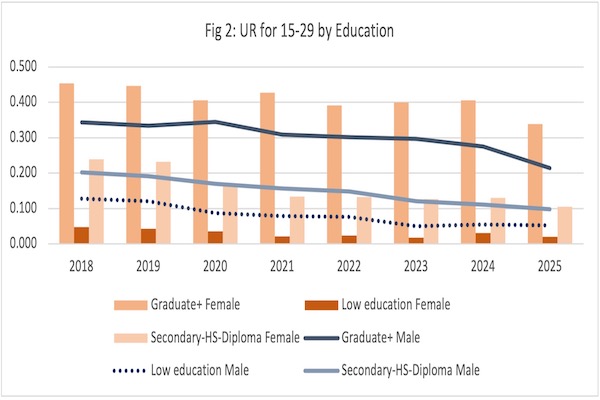
A more granular look at the division by education shows that all three educational brackets have largely seen stagnating UR, with a fall in 2025. Graduates continue to have the highest unemployment rate (Figure 2). UR for female graduates has almost stagnated, or even witnessed a slight increase, and for male graduates the decline has been limited. The sharpest fall is for the low-education male cohort, while among women with low education, unemployment has largely stagnated. In simple terms, on average, every third person with a graduate degree is unemployed in India.
When we look at earnings, a more worrying picture emerges (Figures 3a, 3b and 3c). Median daily wages have largely stagnated in recent years for women, and increased ever so slightly for men in the low education (below secondary school) bracket. For the lowest percentile, this stagnation in the post-COVID-19 period is particularly notable. This is probably the most vulnerable section of young India: those with low levels of education, limited skills, and consequently concentrated in the lowest earnings percentile. For the highest percentile in this group, incomes have risen for men but not for women, and there is a strong gender gap such that women in the highest percentile earn around the median income of men.
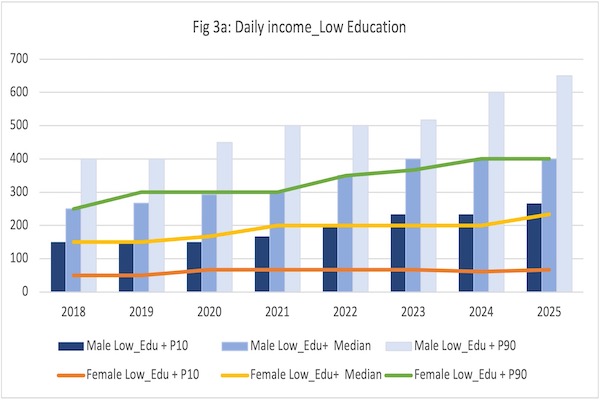
Notes for Fig 3a, 3b and 3c: Estimates are based on unit-level PLFS data from 2017–18 to 2023–24 (agricultural year: July–June) and the 2025 calendar-year PLFS (January–December 2025).
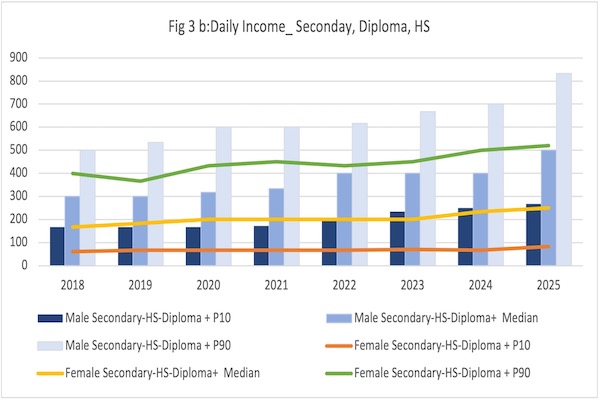
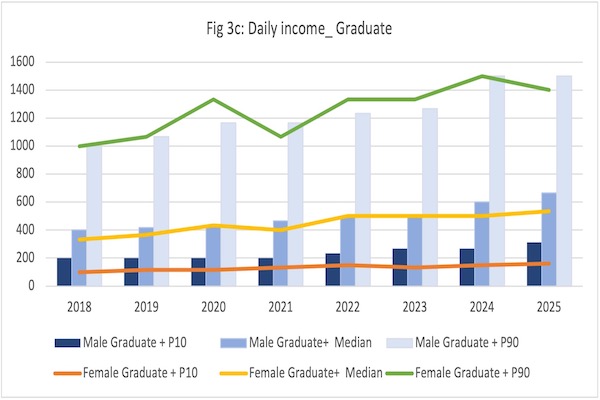
The picture emerging, therefore, tells us that the employment scenario is not robust enough to have led to better earnings for a vast majority of the young. With the gig economy hiring a lot of such young people, the income they are earning, their productivity, and overall contribution to the economy comes into question. The Economic Survey reports that the gig economy, covering “delivery, ridesharing, and freelancing”, increased by 55% to 12 million workers in FY25 (2% of the total workforce in India), and the growth of gig workers outpaces overall employment. According to NITI Aayog, low-skilled gig workers will constitute 33.8% of the gig workforce by 2030, in contrast to 27.5% for high-skilled workers. The skill formation, employability and hence earnings continue to dominate discussion yet make little dent of the ground realities.
Policies are many, and are often discussed by educators ad nauseam; we skip them here. What we need to do, is look beyond numbers to understand employment and what ails the youth. Do they get better jobs, the ones that pay well enough to sustain their families? Are the returns on education high for all?
*The opinions of the authors are personal, informed by professional expertise.
More From BasisPoint