.png)

Hasn’t Central Banking Moved Beyond Brainard?
A famous monetary policy principle holds that central banks should act cautiously amid uncertainty. Modern theory worries that excessive caution may itself become the bigger risk.
May 20, 2026 at 3:31 AM IST
Central bankers love William Brainard.
Economists later called this the attenuation principle.
The intuition sounds obvious enough: When the room is dark, walk slowly, as former ECB President Mario Draghi once said.
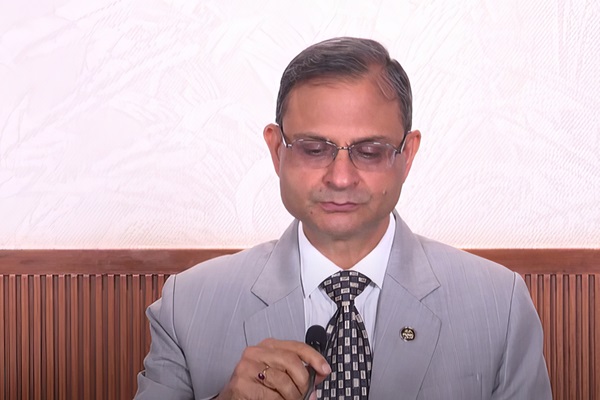
That logic resurfaced prominently in Reserve Bank of India Governor Sanjay Malhotra’s recent remarks at the Swiss National Bank-International Monetary Fund conference, where he invoked the “Brainard principle of attenuation” while defending gradualism, flexibility and caution amid the latest global energy shock.
Malhotra argued that central banks confronting uncertain supply shocks should avoid overreacting to temporary inflation spikes, remain data dependent, and use the flexibility provided until inflation pressures become broader and more persistent.
At one level, there is little controversy about this.
But India, at this juncture, is exposed to an unusual combination of supply shocks. Food carries a very large weight in the inflation basket. Monsoon variability remains economically significant. Oil imports shape inflation, the current account deficit and currency stability simultaneously. Monetary tightening cannot produce crude oil, reopen shipping lanes or eliminate geopolitical conflict.
Yet modern monetary economics has gradually become less convinced that Brainard’s principle always works the way central bankers instinctively think it does.
Evolving Thought
It is which uncertainty matters more.
The original Brainard framework primarily addressed uncertainty about policy transmission. If policymakers were unsure how strongly changes in interest rates would affect the economy, cautious incrementalism made sense because excessive tightening risked causing unnecessary damage to growth and employment.
Modern inflation-targeting regimes increasingly operate differently. Expectations themselves now matter as much as actual interest rates.
Households, businesses, bond investors and currency markets constantly try to anticipate how central banks will behave under stress. Inflation dynamics, therefore, become partly psychological. Expectations can shift before policy rates do.
That changes the nature of the risk-management problem.
A cautious central bank may believe it is reducing uncertainty by moving slowly. Markets may instead interpret visible caution as tolerance for inflation persistence.
Once that process begins, inflation expectations themselves can start drifting.
Modern Doubts
A 2023 Banque de France paper titled A Pitfall of Cautiousness in Monetary Policy argues that excessive gradualism can backfire because the private sector internalises the central bank’s visible hesitation.
The paper’s central argument is uncomfortable.
Suppose inflation rises because of an oil shock. A cautious central bank decides not to tighten aggressively because it fears overreacting to what may ultimately prove temporary. Yet businesses, workers and markets observe that caution. Inflation expectations begin adjusting upward because economic actors conclude the central bank may respond weakly to inflation shocks.
Once that happens, the central bank may eventually be forced into larger policy moves later, but from a much worse starting point.
The Banque de France paper calls this a “cautiousness bias”.
The argument is not that caution is always wrong. The argument is that excessive caution in expectation-sensitive inflation-targeting systems can itself become destabilising.
This paper was flagged by State Bank of India’s Group Chief Economic Advisor Soumya Kanti Ghosh in a late April 2026 report.
Interestingly, even the Federal Reserve now presents Brainard much more cautiously than central bankers often did a decade ago.
In a major 2024 speech on uncertainty and monetary policymaking, Federal Reserve Vice Chair Philip N. Jefferson explicitly acknowledged that there are circumstances where uncertainty justifies gradualism, but also situations where uncertainty may instead require stronger and faster policy responses.
Jefferson notes that later monetary policy research increasingly recognised cases where “anti-attenuation” may be appropriate, particularly when inflation persistence and expectation de-anchoring become important risks.
The speech is notable for moving beyond simplistic “move slowly under uncertainty” formulations. Instead, it frames monetary policy as a context-dependent exercise in risk management.
Jefferson even revisits the Global Financial Crisis to illustrate the point. Initially, the Fed moved gradually. But once systemic tail risks intensified after the collapse of Lehman Brothers, the Fed abandoned gradualism and shifted towards overwhelming intervention because the risks of underreacting became larger than the risks of overreacting.
As Jerome Powell said in August 2018 in Jackson Hole:
If expectations were to begin to drift, the reality or expectation of a weak initial response could exacerbate the problem, he had said, acknowledging that Brainard himself had accepted that his principle was not a universal truth.
Tail Risks
During COVID, much of the world experienced simultaneous demand destruction and economic collapse. Central banks eased together because growth itself had collapsed almost everywhere.
Today’s environment is more fragmented and geopolitically driven.
Shipping routes, sanctions, energy access, trade fragmentation and strategic rivalries increasingly shape inflation dynamics. Commodity exporters, reserve-currency economies and energy importers face very different vulnerabilities.
Large oil importers such as India remain especially exposed to prolonged crude price pressures, exchange-rate pass-through, and the persistence of imported inflation.
That is precisely where “tail risks” become central to monetary-policy thinking.
In uncertain times, a good central bank should be cautious about false precision, forceful against high-cost tail risks, systematic enough to preserve credibility, flexible enough to adapt, and transparent enough that uncertainty about the economy does not become uncertainty about the central bank itself, SBI economist Ghosh said in the report cited earlier.
That is arguably where modern monetary policy thinking has evolved since the 2008 global financial crisis and has been further strengthened by the pandemic and the inflation resurgence.
The debate is no longer simply about gradualism versus aggression.
It is about identifying which policy error carries the greater long-term cost.
Malhotra’s speech, however, does not ignore these risks.
He emphasised that the RBI was monitoring whether higher energy prices were beginning to feed into wages, transportation costs and broader inflation expectations. Once inflation becomes “generalised”, he argued, the logic of “looking through” the shock no longer holds.
Still, the intellectual tension remains unresolved.
Malhotra invoked Brainard largely as a defence of patience and flexibility.
Yet much of modern monetary literature increasingly warns that uncertainty itself can sometimes justify earlier and stronger action precisely to prevent inflation expectations from becoming unanchored.
The more central banks publicly emphasise caution and flexibility, the more markets may begin testing the limits of that caution.
In a world where inflation expectations move rapidly, geopolitical shocks persist longer, and financial markets constantly test central-bank credibility, can policymakers still safely rely on a principle developed for a very different monetary era?
BasisPoint Briefing — Explainers from seasoned practitioners for readers who want more than the basics.
More From BasisPoint