.png)

Has India’s Statistical Overhaul Clarified Growth — or Deepened the Puzzle?
A new GDP base year lifts some numbers, trims others — but leaves a harder question: where is India’s growth really coming from?
March 2, 2026 at 3:24 AM IST
India’s long-awaited GDP rebasing has arrived with the weight of expectation. After years of delay and mounting criticism, from domestic economists and, notably, from the International Monetary Fund, the government has rolled out a new national accounts series with 2022-23 as the base year. The revision promises methodological upgrades, fresh data sources and a break from older estimation practices that critics argued overstated growth, particularly in the informal sector.
The first headlines were predictable. Growth for 2025-26 is marginally higher under the new series than earlier projected. Estimates for 2024-25 have been nudged up as well. Yet the real jolt lies in 2023-24, where growth has been revised down sharply from earlier estimates.
The cumulative picture is not one of dramatic recalibration, but of selective realignment.
At the heart of the revision is a methodological shift from single to double deflation, the incorporation of the Annual Survey of Unincorporated Sector Enterprises, and a wider reworking of sectoral weights.
Manufacturing shows stronger real growth under the new calculations. Consumption appears surprisingly resilient.
Investment, however, remains subdued as a share of GDP. That combination has triggered a more fundamental question: if capital formation has not surged and employment growth remains tepid, what is powering India’s 7% expansion?
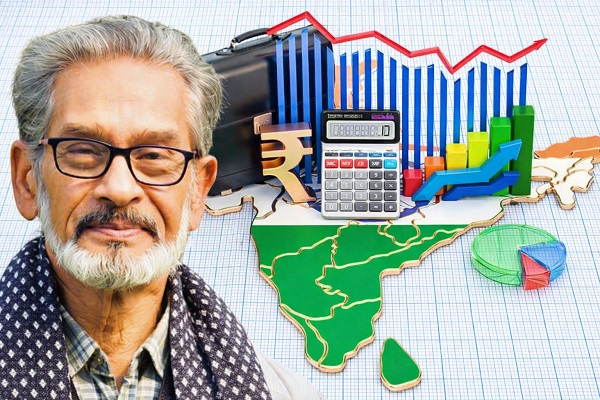
To unpack the numbers and their implications, veteran journalist Rajesh Mahapatra spoke with Dr Pronab Sen, India’s first Chief Statistician and one of the country’s most experienced interpreters of national accounts.
In a wide-ranging conversation, Sen examines what has genuinely improved in the methodology, where scepticism still lingers, and why the structural paradox of growth without proportional job creation may prove more consequential than any statistical revision.
Watch the interview here
Here are the edited excerpts of the interview.
Q: You have seen the new GDP numbers under the 2022-23 base series. What was your first reaction?
Household consumption has risen very sharply in the current year, 2024-25. And that comes as a surprise. Normally, one expects household consumption to grow about 1-1.5 percentage points lower than GDP growth. This time, it is almost the same. And that is a surprise. But it is a pleasant surprise. As a country, we do need to consume more.
The other thing that came as a surprise is that the investment figures continue to be depressed. We are a country which seems to be chugging along at more than 7.5% for several years, and with an investment rate of 30–32%.
Where is this growth coming from? Where is the capacity being created for further growth? Because at 30–32%, you would be expecting a growth rate of 6–6.5% GDP. Anything more than that becomes stretched.
Q: The 2023-24 growth number has been sharply revised down under the new series. Does this validate earlier criticism that India’s GDP may have been overstated?
Now, why this is happening is really the question. Because really, if you look at the methodologies that have been adopted, other than a couple of new sources of data, of which the most important one is the Annual Survey of Unincorporated Sector Enterprises, there is no real difference in the change in data. The change is primarily methodological.
So what is happening? The big methodological change here is moving from single deflation to double deflation. And we will have to tease this out, because this is done at the sectoral level. It is very difficult to look at the numbers and say, this is what is happening. But yes, there would be some new data that would have come in, but whether it would lead to such a dramatic downward revision is really the question. So one would really have to look at what the unincorporated sector surveys are saying.
Q: The survey of unregistered enterprises resumed after a gap of several years. Did the absence of fully-processed survey data affect the estimates for 2024-25 and 2025-26?
Now it is an annual survey, so you do have the survey which was done in 2024-25. But the data has not yet been incorporated, I think. That data is not in the public domain yet. But that data does exist.
Normally, it takes seven or eight months for it to get processed.
But the annual survey in itself does not solve that problem. And the reason for it is that for these annual surveys to be accurate, they need to be based on a fairly up-to-date Economic Census. That is how you choose the companies you will survey and make them representative.
Now, with the annual survey, what you do have is an estimate of the number of enterprises. But the amount of credence you can put on that number is questionable.
So doing the population census and doing the Economic Census are absolutely essential to establish the credibility of the survey data.
The surveys are only as accurate as whether they represent the population fairly or not. If you do not even have any idea of what the population looks like, then getting a good survey done is difficult. In fact, impossible.
Now, the whole charge that was levelled earlier was that because you had no estimates for the unincorporated sector, you were putting in whatever projection you felt like. That was what the critics were saying.
But now that they are using the annual survey, that charge cannot be levelled anymore. You can question the survey, but you cannot level that charge.
But please make the data available. Earlier, we used to get manufacturing broken up between corporate and non-corporate. That has vanished.
At the annual level, we used to get that. This is the annual level.
Remember, you are taking the value added, which is the value of the product less the money value of all inputs going into it. And you take that difference, which is what the company is adding, the value the company is adding. And you divide that by the price of the product. So, you are converting the value added into the number of units of the finished product. That was single deflation.
What they are doing now is using the prices of the output separately and the inputs separately, and then getting two money values and subtracting one from the other.
Now, we have had a period where global commodity prices have gone down sharply, particularly last year.
When that happens, the sector it will mainly affect will be manufacturing. Mining not so much, but manufacturing for sure, because a lot of their inputs are coming from abroad. With the softening of global prices, this is going to reduce the price index that you are using to deflate the inputs. And that is going to push up your gross value added.
If you look at the figures, it suggests that inflation last year for us was only about 1%.
Most people do not believe it. So that is an issue in itself. But that is how it is.
So, it is not just that because there is a large presence of input material whose prices have fallen and therefore the WPI is low. What would happen is that those industries that were using those materials, their estimates of production would go up. But for other industries, it might come down. So, it is not strictly true.
But the criticism still remains. They are trying to address that by using double deflation. But the point is that it does not entirely solve the problem. In a sense, it can make it worse, given that a lot of the softness in pricing was because of imports and global market prices. You are bringing that into the import side and artificially raising your real gross value added.
Q: Corporate earnings have not reflected the kind of double-digit manufacturing growth seen in the data. How do you reconcile this?
Remember, the stock market reflects the view of investors on Indian companies, on corporates. So, they were not wrong.
But it does not reflect the larger story in and of itself. If I have a situation where the MSME sector is growing very strongly at the cost of corporates, that is a good story. But that will not enthuse the foreign investor. He has access only to listed companies.
Corporate earnings are not doing very well. In fact, when one looks at volume growth, the story gets even worse.
We were supposed to have revised the GDP base year in 2017-18. Until that point, the IMF was perfectly comfortable with our GDP estimates. We were always rated fairly highly.
But from 2017-18 onwards, you keep delaying, keep delaying, keep delaying, until 2023-24. And you actually do the revision now in 2026.
Over this extended period of time, the credibility of the estimates becomes questioned.
What the IMF was saying, in effect, is that you have used various ratios and proportions to calculate a lot of the numbers. And we cannot trace where these rates and ratios are coming from. We have no idea what you are up to.
If now you are using recent survey data and you put it out clearly and say this is where it comes from, then that should take care of the problem.
The problem was really this long delay in revision of the base.
Some of that has now been addressed. Because we have the annual survey, and you have an important breakthrough in terms of corporate data. Now, at least for some companies, you can break up manufacturing from services and treat them separately. Those are big steps forward. So there is good news.
A: Real wages are certainly stagnant.
Even if we assume that the new series has got it right, and that the average is around 7%, that is still good growth. But the question is where is this growth coming from?
Investment as a proportion of GDP has stayed roughly the same. You are not seeing any surge in employment. So, both capital and labour are more or less remaining where they were.
So where is the growth coming from? Are we creating growth from thin air?
Maybe this is the play of technology. Or incredible increases in efficiency.
Efficiency can explain a lot. But most of the technologies you are talking about would have to be embedded in physical investments. You have to put these machines into place. That should show up somewhere.
The other possibility is that education and training systems have improved dramatically. We have no evidence of that. In fact, it may have deteriorated.
So, the larger structural question remains.
Q: Final thoughts on the new GDP series?
More From BasisPoint