.png)

Cockroaches May Be Videshi, But The Rot Is Desi
This is the inflection point before a steep decline in the bell curve of the people’s trust in the government. If it cannot even conduct annual exams diligently, how can it make people’s lives better?
Rajesh Ramachandran is a former Editor-in-Chief of The Tribune group of newspapers and Outlook magazine.
June 5, 2026 at 12:25 PM IST
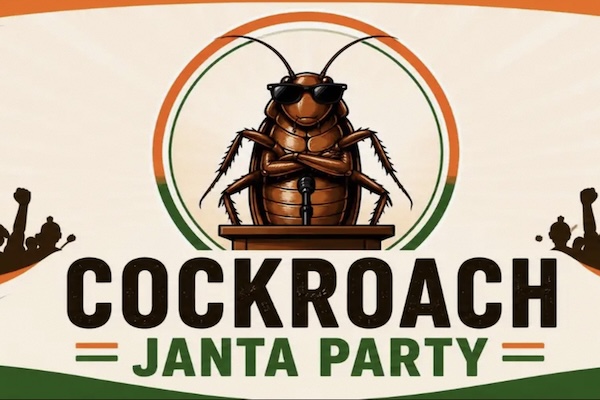
The Cockroach Janata Party leader Abhijeet Dipke is expected to reach India and launch his political movement against the Bharatiya Janata Party-led Union government on Saturday. The debate so far has been on whether CJP is a Western-scripted, regime-change attempt to dislodge Prime Minister Narendra Modi like successful similar youth movements in Sri Lanka, Bangladesh and Nepal. Former Pakistan Prime Minister Imran Khan was the first to be pushed out in the recent round of Western-influenced political upheavals in the subcontinent.
There are tell-tale signs all around: a Magsaysay awardee readily endorsing the new political outfit; a self-explanatory reference to Tories, Quakers, Suffragettes and Queer, which is a tough one to crack for the Indian Gen Jee (as Gen Z is pronounced in Delhi); celebrities from the Opposition fold queueing up in anticipation; the explosive media coverage; algorithms that allow overnight growth exponential on social media and, of course, most importantly the current country of residence of the Chief Cockroach.
The hashtag #Mainbhicockroach reminds one of the older, staler #Mainbhianna that helped Arvind Kejriwal delegitimise former Prime Minister Manmohan Singh, the Congress party and the Nehru-Gandhi family and helped defeat the UPA in 2014. In the process, Kejriwal managed to win the Delhi elections thrice and is now in power in Punjab. The anti-establishment movement that evolved into the Aam Aadmi Party was so strong that there was barely a state or a district without its local unit all across the country.
The AAP drew sincere, committed young people with integrity from across the ideological spectrum, from the RSS to the Naxalites to what appeared like a genuine platform for transformational politics. Apart from a Magsaysay awardee leading the charge and the likes of the Ford Foundation funding him, much of the Cockroach template resembles that of the AAP. Kejriwal’s massive protests began in 2011 and ended up with the UPA getting booted out in 2014. There are three more years to go for the next Lok Sabha polls in 2029.
Even Dipke was an AAP volunteer before he went to the US for his master’s degree. And a master’s degree ought to cost over ₹10 million, which is beyond the paying capacity of a regular Indian student. History this time is supposed to be repeating itself as satire; but it is more of a see-through puppet show.
Yet, the genius of the puppeteers is in the timing and the choice of the agenda. India is reeling under a devastating economic crisis fuelled by the war in West Asia. Routine frustrations of unemployment, inflation and governmental apathy have been aggravated by hostile US tariffs, a falling rupee, crashing markets and fleeing investors. An economy that refuses to self-start without bright ideas, where the Prime Minister talks of austerity that would only further contract consumption, is an ideal incubator for agitational politics.
At that very moment, the NDA government’s biggest failures began getting exposed: the question paper leak in the National Eligibility cum Entrance Exam (NEET) that involves the fate of 2.2 million students; the glitches in the Central Board of Secondary Examination Class XII paper evaluation that have made lives of 1.7 million students miserable; the technical failure in the Common University Entrance Test (CUET) affecting about 3,700 students across 533 centres. These failures are systemic, pan-India and entirely caused by the government’s incompetence.
That was the moment the Cockroach was born. The “objective conditions” were most conducive. It really does not matter who funds a cockroach when the environment is rotten; for only dirt and apathy can breed cockroaches. The story of the National Testing Agency (NTA) that conducted the NEET and the CUET is fast replacing the mythology of the NDA government’s efficiency. The failure to get CBSE answer papers scanned has hollowed out the government’s claims of scaling new heights in technology.
Indian education ––– higher and even basic ––– is facing its fake robot crisis. And this is the inflection point before the steep drop in the bell curve of the people’s trust in the government’s ability to run the country. If it cannot even conduct regular, annual exams diligently, how can it make people’s lives better? This is a question that is gaining traction. The Cockroaches may be videshi, but the rot is desi.
The NTA was established in 2017 as a “premier, specialist, autonomous and self-sustained testing organisation to conduct entrance examinations for admissions/fellowships in higher educational institutions.” But it has failed miserably. Unlike its predecessor, CBSE, which used to conduct the All India Pre-Medical Test, the NTA seems to have roped in substandard vendors who hire godforsaken venues for the tests.
It was glaringly evident in Delhi NCR itself; but, unfortunately, the government managed to look askance. Noida is a bustling city of university campuses, top-class classrooms and prosperous parents. But, under NTA, a parent had to trudge all the way to Habibpur, a village in Greater Noida, to get his ward to appear for the NEET exam last year. The Chaudhary Kesram Inter College did not have doors on its toilets, nor an approach road. There were two bulls that almost caused a stampede when the children walked out of the exam hall.
On an average every NEET aspirant has to pay about ₹1,500 (higher for general category and lower for those availing quotas) and the government ought to be shelling out an equal amount. This was more than enough for CBSE to conduct examinations in centrally located venues in big and small cities all over the country. But why did the NTA’s vendor have to drag students to Habibpur? To cut costs and maximise its profits.
Sarthak Siddhant, a 17-year-old CBSE student, called out the alleged dilution in the tender conditions that resulted in the choice of the vendor, who failed in the On-Screen Marking system. A failure in scanning documents is surely worse than the fake robot fiasco. And that’s exactly the crossroads, where the Indian youth sees itself at.
The paper leak, the re-test, children taking their own lives in frustration are all examples of governmental failures at its worst. This is a political context in which people might look for political alternatives regardless of the desi or phoren origin of the circus stilts that make the Cockroaches walk tall.
More From BasisPoint