Following Keir Starmer’s resignation as the United Kingdom’s prime minister, Andy Burnham, the popular Labour politician who just won a seat in parliament in a special election, appears more likely than ever to succeed him. Whether or not this happens, however, the political drama has focused attention on the UK’s second city, Manchester, where Burnham served as mayor for nearly a decade.
Known internationally for its football clubs and music scene, Greater Manchester has become the UK’s fastest-growing region. Investment has been flowing in, especially to sectors like professional services and technology. Visitors note the buzz of outstanding restaurants, a vibrant art scene, and plenty of construction.
The model that produced this success began coming into focus in 2009, when the Manchester Independent Economic Review panel—of which I was a member and lead author—shared the seven analyses it had commissioned with the UK Treasury and then-Shadow Chancellor of the Exchequer George Osborne. Our report emphasised the importance of long-term investment in skills, especially in children’s early years, and transport.
As Ed Glaeser of Harvard University observed in 2003, long-run urban success depends on the ability to respond to challenges. A strong human capital base is vital to this ability, just as it is to individuals’ ability to seize the opportunities a growing city has to offer. Building this base was therefore our top policy recommendation.
The second priority—transport—similarly aimed to expand opportunity. Reliable and accessible public-transport links help to create a “thick” labour market, in which workers are connected to more potential employers. In a country where authority is exceptionally centralised, the review also made the case for devolving some spending and decision-making powers to a new Combined Authority for the Manchester City region.
A decade later—two years after Burnham became mayor—I chaired the Greater Manchester Independent Prosperity Review, which had been tasked with producing an updated economic assessment. The review again emphasised skills, labour-market transitions, and infrastructure, but added a focus on the innovation ecosystem.
If there is another review in 2029, I would gladly take part. But the mere fact that such assessments are being conducted periodically highlights two features of Manchester’s success: openness to a thorough and pragmatic analysis of the economy’s strengths and weaknesses, and, equally important, strategic intent.
Reviving a deindustrialised and depressed region is a long game. By the time the 2009 review took place, a generation of civic leaders—notably, Chief Executive Howard Bernstein and elected Council Leader Richard Leese—had spent years building a political coalition in favour of devolving some powers to the city. And since 2009, the city’s leaders, including Burnham, have stuck with the same broad set of policies. This stability contrasts sharply with the policy churn seen at the national level.
The strategy for reviving Greater Manchester is not without dissenters. It has been guided by the understanding that economic growth is a prerequisite for anything else political leaders might want to do, including addressing large inequalities among the city’s boroughs. But for some critics of the city’s leadership, the contrast between the shiny new skyscrapers in the city center and the more deprived areas beyond it is offensive.
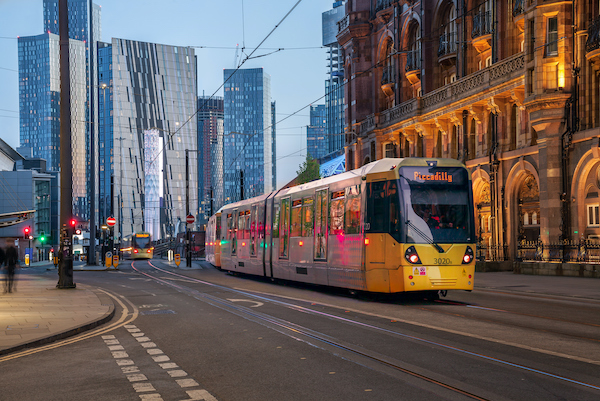
Nonetheless, there has been enough buy-in to sustain a long-term effort to strengthen the foundations of growth. The results speak for themselves. Greater Manchester has the UK’s largest light-rail and tram network—one of only eight in the country—which has been incrementally expanded since its 1992 inauguration. And it has become the first region outside London in almost 40 years to bring all local bus services under local control as part of the Bee Network, which Burnham introduced in 2021.
Burnham is sometimes mocked for his enthusiasm for the Bee Network. But the service could not be more important to Manchester’s future prosperity. Local buses account for three-fifths of all public-transport journeys in the UK. If congestion in most cities is ever to be solved, these networks will have to be expanded.
Beyond improving residents’ everyday lives, Manchester’s leaders have built a platform for growth centered on its universities and innovation ecosystem. This reinvention has been decades in the making, and until recently, the results looked disappointing. But once the virtuous cycle of growth was activated, progress accelerated—and became self-reinforcing.
Can the UK’s likely next prime minister replicate the Manchester model at the national level? Not entirely. Local authorities are better equipped than national leaders to identify their region’s needs, coordinate across functions, and build consensus. And the sheer number of challenges a prime minister must confront dwarfs that faced by any municipal government.
But the core lessons of the Manchester model do apply. Ensuring that people have the skills and infrastructure they need to find jobs, get to work, and build their businesses is vital to growth. And it can be achieved only if the authorities stick with their strategy for the long term. As Ernest Hemingway had one of his characters famously observe, bankruptcy happens “gradually and then suddenly.” The same is true of prosperity.
© Project Syndicate 1995–2026
.png)