.png)

Portugal Were Held by a Failure of Service, Not Their Captain
Portugal’s 1-1 draw exposed a lack of service, not a fading captain. Ronaldo was starved of chances while an elite midfield played safe all game.

Aarav Aher studies International Business: Supply Chain and Brand Management at Northeastern University, Boston, when he's not dribbling a football on pitches or down a corridor.
June 21, 2026 at 8:13 AM IST
Portugal’s opening game of the 2026 FIFA World Cup, a 1-1 draw against the Democratic Republic of the Congo, unleashed a world of criticism on Cristiano Ronaldo. With zero shots on target, the media were quick to pin the result on him, with football legends like Thierry Henry and Zlatan Ibrahimović singling him out.
Both of them, as well as the media and fans alike, pointed to a single contested half-chance, which has been inflated into a verdict on Ronaldo’s entire afternoon. What the critics failed to register is the ninety minutes of him being starved of service. The truth is, Ronaldo isn’t carrying the blame because he failed; he’s absorbing it because his name is the one big enough to make a headline.
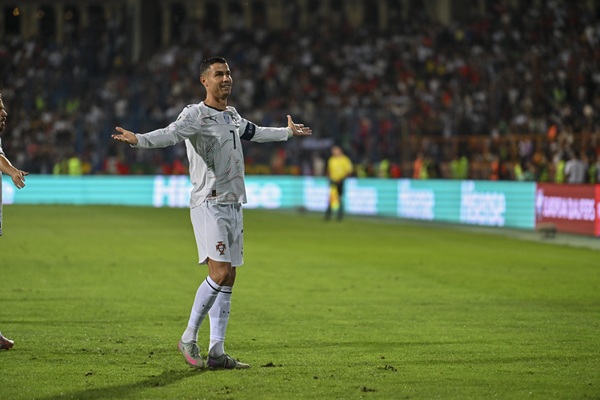
With this game, Cristiano Ronaldo became the oldest outfield player ever to start in a World Cup match. After the historic hat-trick from Lionel Messi just a day earlier, everyone waited for Cristiano Ronaldo’s response. Instead, a rather underwhelming display in Houston, Texas, gave DR Congo a point to celebrate. Portugal’s only goal was scored from an early cross, scored by João Neves, with DR Congo’s Yoane Wissa replying deep into stoppage time in the first half. Disappointment prevailed among the Portuguese supporters, and a single question lay on the lips of everyone: what was Cristiano Ronaldo doing?
The real question was never whether Ronaldo was once great, but whether he still belongs in Portugal’s World Cup hunt and whether he is now in the way. Over the last three years, no Portuguese player, including Gonçalo Ramos, whom people have sought as a replacement for Ronaldo, has scored more for any club or the country than he has. The world prefers to ignore that this may not be the Ronaldo of old, capable of receiving the ball in his own half and charging through the field to score, or the Ronaldo who could shoot at the drop of a hat, from 30 yards out, and bury the ball in the back of the net. But the 41-year-old Ronaldo’s reinvention of his game is nothing short of genius. Going from a fleet-footed winger to an elite poacher, he has adapted his game to stave off the cliff-like drop-off that comes with age.
Where the younger Ronaldo would have manufactured a goal on his own, he is now a pure number nine. Like most elite strikers in the modern game, he lives off the passes and through balls fed to him by creative midfielders and wingers. While Messi remains dynamic and roams to create his own chances, Ronaldo, much like Erling Haaland among the younger players, makes his living from being in the right place at the right time, almost always inside the box. That is where he thrives, and it is exactly where Portugal failed to find him. For the better part of the last two decades, Portugal’s hopes have rested on Cristiano Ronaldo’s shoulders. For the better part of the last two decades, Ronaldo delivered. Qualifying for only three World Cups and three European Championships before Ronaldo’s first cap to qualifying for every major tournament in the last 20 years is nothing short of remarkable. And Ronaldo took Portugal even further. Winning the Euros in 2016, the Nations League in 2019, and again as recently as 2025, with marquee performances through all three tournaments, cemented him as one of the greatest on the international stage. But that glorious World Cup trophy remained elusive, with his best result all the way back in 2006.
Coming into the 2026 World Cup, Ronaldo himself acknowledged this as the fabled ‘Last Dance’. With Portugal being the heavy favourites to go deep, the burden is distributed amongst a star-studded squad. Their current midfield is often regarded as the best in the world. With back-to-back UEFA Champions League-winning midfielders Vitinha and João Neves, and Premier League Player of the Season and FWA Footballer of the Year Bruno Fernandes, it looked like Ronaldo finally had the help he needed. The point was not lost on everyone: a comment on Instagram under Bruno Fernandes’ post after the match went viral, joking that “it was finally Ronaldo’s turn to be carried.” Met with a mix of mockery and agreement, the line nonetheless landed on a real truth.
The rest of the squad is also filled with superstars: Bernardo Silva, Ruben Dias, Diogo Dalot, João Cancelo, Rafael Leão, João Félix, among others. And yet, the blame for Portugal’s failure landed squarely on Cristiano Ronaldo, with the media and legends alike framing it as “Cristiano Ronaldo’s Portugal held to a 1-1 draw.”
But as the spotlight burned brightest on Ronaldo, most people refused to acknowledge how poorly the rest of the team played. Vitinha, hailed as the best midfielder in world football, broke the record for the most completed passes in a World Cup game. Despite completing 121 of 128 attempted passes (Opta), he created zero chances. Bernardo Silva and João Cancelo had no key passes; Bruno Fernandes had just one, played to Nuno Mendes within the first 15 minutes of the game. After their goal, Portugal seemed happy to sit back and pass the ball around the back as if they were winning 5-0. Even after the shock equaliser from Yoane Wissa, the sense of urgency was completely missing. There was no direct play or line-breaking passes from the players everyone expected to show up on the big stage. Portugal’s only shot on target was the goal they scored in the 6th minute. For the remaining 84 minutes plus added time, they registered zero shots on target (Opta).
The scandal isn’t that Ronaldo missed his chances, but rather that those were the only three balls he got. Even with just these three opportunities, he led the team with the most shots in the game, with just 3 (Opta). His only three attempts were half-chances that he missed, and while people may argue that the Ronaldo of 10 years ago would have found the back of the net with them, it is futile, even ridiculous, to compare a 41-year-old Ronaldo to the younger Ronaldo who went on to three-peat the Champions League.
Ronaldo drew particular backlash for the second of those chances, with Thierry Henry questioning his selfishness: “The team needs to score, not you need to score.” Yet the moment was sensationalised far beyond what actually happened. In reality, it was a ball driven into the middle of the box, and Ronaldo simply got there first, peeling off his marker to arrive in front of the defence, exactly where a striker is paid to be. The delivery was actually behind him, forcing him to adjust and reach for it; had the ball arrived cleanly at his feet, there is every chance Ronaldo would have buried it himself. The square pass being held up as the “correct” play was no certainty either: Bruno Fernandes had a defender on each side of him, and there is no guarantee he would have scored. Additionally, DR Congo getting a draw out of this fixture was no minnow rolling over. Sitting deep and attacking with quick counters, they were extremely dangerous in transition. Cédric Bakambu rattled the post, and for long stretches, Congo looked the more likely side to find a winner. The draw was a product of a well-coached opponent earning their place in history, and the obsession with what Ronaldo did or did not do does a disservice to Congo.
Throughout the game, Ronaldo cut a frustrated figure as the ball was passed backward time and time again. Whether the fault lay with the tactics of Roberto Martinez or the unwillingness of the midfield to take risks, it very clearly did not lie with Cristiano Ronaldo. As a striker, there is nothing more he can offer than creating space and being a threat in the box, and he did exactly that. Congo was so worried about him that they kept two of their three centre-backs marking him for much of the game. That should have been a gift: with two defenders occupied by one 41-year-old, his teammates were left with acres of space. They never used it.
Ronaldo even tried to make something happen himself, repeatedly dropping deep to drag defenders out of position and open up room for his teammates. In the game’s most telling moment, he pulled two Congo defenders with him to free Bruno Fernandes in behind. The chance was so obvious that even the referee began sprinting towards the Congo goal, expecting a quick break. Fernandes, instead, turned and passed the ball back to his own defence. The opportunity was there, but Portugal wasted it. Portugal’s centre-back Tomás Araújo had 104 passes, with Ronaldo having only 21(Opta). Every time the ball was with the midfield, it was recycled backwards instead of being fed forwards.
Despite the disappointing result, Ronaldo stood by the team, saying it was “not the start we wanted, but this is far from over. Head up and focus on the next game.” He once again shouldered the burden, just as he has for the last two decades, allowing the younger players he depends on to escape criticism. He showed a far more reasonable and mature mindset than at the 2022 FIFA World Cup and kept his frustration at the lack of goals off the pitch.
None of this makes Ronaldo above criticism. There is a real debate to be had about whether a 41-year-old should anchor Portugal's World Cup hunt, or whether a more mobile striker would suit them better. A more mobile forward might stretch a deep block in ways Ronaldo no longer can. Those are honest questions for Roberto Martinez to weigh. But they are questions about a role, not an indictment of a performance, and they are a world away from the verdict the headlines reached. But certain arguments go further and ask for Ronaldo to be left out of the starting eleven entirely, and they miss the key role he played in Portugal's Nations League victory in 2025. Playing as a poacher, he scored the winner against Germany in the semi-finals, and then the equaliser against Spain in the final. Ronaldo's movement and knowledge of the game remain elite. He may no longer compete with the crème de la crème of Europe, but he is still Portugal's best striker. He has provided Portugal with something that no other striker has: consistency.
With only a single point to show, Portugal has two very important games ahead of them. With Colombia proving an extremely hard defence to break, these must-win games have made the group stage significantly harder. While they are still in a position to qualify comfortably, the situation can become tense if the result against Uzbekistan on Tuesday is unfavourable. Additionally, failing to top their group could mean a face-off against European champions Spain or runners-up England as early as the Round of 16. With these two games coming up, all of the Portuguese players must step up and go all in for their country.
More From BasisPoint