When Hyundai Motor India listed in October 2024, it completed what was then India’s biggest initial public offering. The entire issue, worth about ₹278.6 billion, was an offer for sale, or OFS, by its South Korean parent. The Indian company received none of the proceeds. Investors were buying into a company’s public debut, but their money was going to its owner. That difference deserves greater prominence in India’s primary market vocabulary.
The history of going public has always involved more than raising fresh capital. For decades, the state controlled who could issue shares and at what price. The Capital Issues (Control) Act, 1947, was repealed and the Controller of Capital Issues abolished in 1992, as SEBI acquired statutory powers and controls on issue pricing were removed.
Earlier, under the Foreign Exchange Regulation Act, 1973, many foreign companies were required to reduce their ownership of Indian businesses to 40%. ITC, Pond’s and Colgate-Palmolive diluted foreign equity, while Coca-Cola and IBM chose to leave India.
Reliance Industries’ celebrated 1977 public offer received applications for 7.19 times the shares available. Its annual report describes the transaction as an offer for sale by existing shareholders, undertaken because financial institutions had made listing a condition of expansion financing.
Shareholder sales at a company’s public debut are therefore hardly new. What has changed is their scale, and the freedom of owners to choose when to sell.
PRIME Database figures reported in November 2025 show that, since 2015, about ₹4.73 trillion of IPO proceeds had come through OFS, against ₹2.44 trillion in fresh issues, roughly two-thirds going to sellers.
By mid-November 2025, OFS proceeds that year had reached nearly ₹960 billion, overtaking the previous year’s record of ₹952.85 billion, while fresh capital stood at ₹567.96 billion.
The pattern continued in 2026.
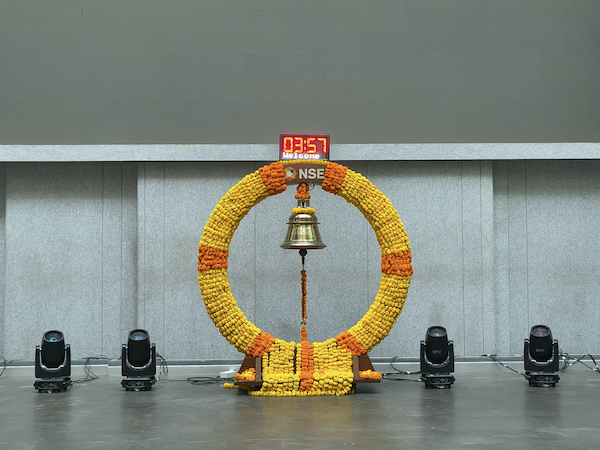
According to Uniqus, 86 companies listed in the January–September period, raising ₹433.3 billion through fresh issues and ₹658.56 billion through OFS. The National Stock Exchange and SBI Funds Management offerings, both entirely OFS, together accounted for about ₹323.56 billion.
These proportions need a clearly defined base. Grant Thornton puts OFS at 61% of mainboard IPO proceeds in 2025–26, down from 65% in 2024–25. Measures that include rights issues and other forms of equity issuance answer a different question and should not be treated as competing estimates of the IPO mix.
Exit Economics
On the same mainboard basis, OFS made up 61% of proceeds in 2025-26, down from 65% in 2024-25. A different analysis puts OFS at 34% of 2025-26 issuance of ₹3.8 trillion, but that base includes rights issues.
Both can be right, so anyone using them should state the denominator.
Even the fresh money often isn’t growth money. Debt repayment took 48% of third-quarter IPO proceeds. Full Year 2025-26 view also lists debt repayment as the largest use, at about 26%.
The estimates differ, but the ranking is the same, and a “fresh issue” is frequently a balance-sheet repair.
Much of a company’s early financing has also moved out of public view. Angel investors, venture capital funds and private equity firms now supply seed and growth capital. Retail investors often meet the company after several rounds of private funding, sometimes as the buyers of early investors’ exits.
Foreign parents offer a particularly clear illustration. Reuters reported in June 2026, citing PRIME Database, that only one of six foreign companies that had listed Indian units since 2024 had raised fresh capital. The others were entirely shareholder sales. Their overseas parents received nearly $5 billion, with Hyundai and LG accounting for more than 80%. LG’s roughly ₹116 billion issue involved the sale of a 15% stake, with no proceeds reaching the Indian unit.
The attraction is valuation. At the time of the Reuters report, Nestlé India traded at nearly 77 times earnings, against 22 times for its Swiss parent. LG Electronics India traded at about 59 times, against 44 times for its South Korean parent. Such gaps give foreign owners a strong incentive to monetise part of their Indian holdings. Economists quoted by Reuters also pointed to pressure on the rupee from the repatriation of proceeds.
The defence of shareholder exits deserves a fair hearing.
SEBI Chairman Tuhin Kanta Pandey has argued that the primary and secondary mix varies across IPOs, that many companies have raised capital earlier and that markets should accommodate different objectives. PRIME Database’s Pranav Haldea points out that private investors increasingly provide growth capital before companies reach public markets. SEBI member Kamlesh Varshney has also stressed that investors need exit routes.
They have a point. Founders and funds are entitled to sell, and a mature company with ample cash may have little reason to issue new shares. Simply renaming an IPO a “share sale” solves nothing, because every IPO involves selling shares. The meaningful distinction is whether the proceeds go to the company or its existing shareholders.
Clearer Labels
Chief Economic Adviser V. Anantha Nageswaran has raised the wider concern directly. In November 2025, he warned that IPOs were increasingly becoming exit vehicles for early investors rather than mechanisms for raising long-term capital, a shift he said “undermines the spirit of public markets”.
There is another source of confusion: “offer for sale” describes two different processes. In an IPO prospectus, it denotes shares sold by existing owners. On a stock exchange, OFS is a separate mechanism for selling shares in companies already listed. SEBI introduced that window on February 1, 2012. A January 2023 revision allowed promoters, promoter group entities and non-promoter shareholders of eligible listed companies to use it.
The government relies heavily on this window. By June 2026, it had raised about ₹254.91 billion through OFS in eight listed public sector companies, the highest amount since 2015. Separate disinvestment targets have been discontinued since the revised estimates for 2023–24; the 2026–27 Budget provides ₹800 billion under the broader head of miscellaneous capital receipts. An investor reading “OFS” in a government stake-sale headline and on an IPO page is encountering different mechanisms under the same acronym.
That supports a more practical proposal than abandoning the term IPO. It can remain the description of a company’s first public offering. For shareholder sales within an IPO, “offer for sale” could give way to the plainer “sale by existing shareholders”. Reuters’s description of these Indian deals as secondary offerings makes the same distinction.
Every advertisement, bid form and broker app screen should prominently show how much of the offer goes to the company and how much goes to selling shareholders, in both amounts and percentages. Prospectuses already distinguish fresh issues from shareholder sales.
That information should be equally clear wherever investors make their subscription decisions. The exchange window should have its own distinct name, making clear that it concerns shares already listed.
Regulation already recognises the difference. A March 2026 SEBI amendment introduced a standardised draft abridged prospectus format that includes the weighted average acquisition cost for promoters and selling shareholders. For IPOs on the small and medium enterprise platforms, SEBI has already capped the OFS component at 20% of the total issue size. The language presented to investors should reflect these distinctions as clearly as the rulebook does.
Companies are entitled to raise capital, and their owners are entitled to cash out. Investors, in turn, deserve to know whose financing needs their money is meeting. The first line of an IPO pitch should make clear how much reaches the business and how much pays for someone else’s exit.
.png)