.png)

Amitabh Tiwari, formerly a corporate and investment banker, now follows his passion for politics and elections, startups and education. He is Founding Partner at VoteVibe.
February 18, 2026 at 3:25 AM IST
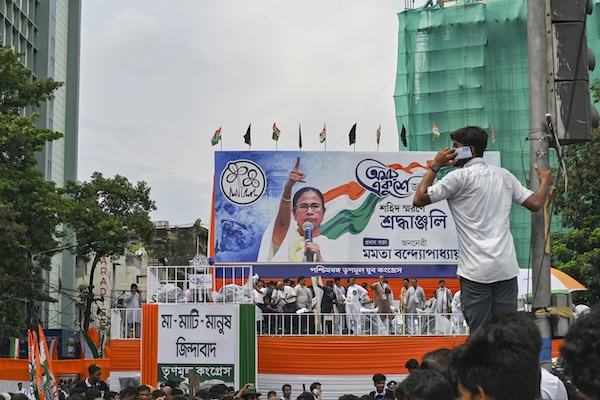
West Bengal promises the most combustible electoral contest of 2026. Mamata Banerjee’s Trinamool Congress faces its toughest election since it swept to power in 2011, challenged by an emboldened Bharatiya Janata Party and weighed down by visible anti-incumbency. The collapse of the Left and the Congress has left the battlefield starkly bipolar, intensifying pressure on both principal contenders.
In earlier elections, Mamata and her party campaigned from a position of command. They set the tone, chose the battles, and forced opponents to react. This time, they are reacting more than leading. The BJP’s organisational presence has deepened. Its messaging is sharper.
Scandal Burden
Over the past few years, a steady accumulation of controversies has chipped away at the TMC’s claim to moral authority. The teachers’ recruitment scam, the Sandeshkhali episode, and the RG Kar Medical College rape-murder case have placed the Chief Minister repeatedly on the defensive in a state she has governed for nearly fifteen years.
The BJP has been quick to seize on these episodes. Its campaign has centred on governance failures, economic stagnation, and the sensitive issue of illegal immigration from Bangladesh. The demand for a Special Intensive Revision of voter lists has further sharpened political divisions, reinforcing fears about demographic change among its core supporters.
Issues that once flared briefly and faded are now being stitched into a larger argument: that state institutions have weakened under prolonged one-party rule, and that complacency has set in at the top
Bipolar Battlefield
The TMC’s rise itself was born of political rupture. Founded in 1998 after Mamata Banerjee broke with the Congress, the party entered state politics, winning 60 seats in 2001 and securing 31% of the vote by largely inheriting its parent party’s base.
After a troubled 2006 experiment with the BJP, when its tally halved to 30 seats, the TMC returned to the Congress fold and engineered one of Indian politics’ most dramatic turnarounds in 2011, ending 34 years of uninterrupted Left Front rule.
From there, dominance followed. In 2016, contesting on its own, the TMC widened its grip on power, winning 211 seats and leaving little doubt about who ran Bengal. The first real jolt came three years later. In the 2019 general election, the BJP broke through, winning 18 Lok Sabha seats and establishing itself as the only credible challenger to Mamata’s dominance.
Survey Signals
Recent VoteVibe surveys capture this drift. Today, fewer than four in ten voters are willing to say they are satisfied with the government’s performance — a warning sign for any long-serving administration. Banerjee still tops the leadership charts, with 35.4% preferring her as Chief Minister, compared with 20.9% for Suvendu Adhikari, but the comfort she once enjoyed has narrowed.
The same unease shows up in voting intentions. The TMC remains ahead, but by less than before. Nearly one in five voters has not made up its mind — an unusually large pool at this stage.
And their concerns are not abstract. Jobs are scarce. Policing is questioned. Women’s safety is debated daily. Corruption is part of routine political conversation. These are the pressures shaping how Bengal is thinking about this election.
Mahila & Muslim
Despite mounting headwinds, the TMC’s greatest structural advantage remains its electoral arithmetic. Muslims constitute roughly 27% of West Bengal’s population and are decisive in close to 100 constituencies. In 2021, the party swept 106 of 112 seats with Muslim populations above 25%.
This consolidation, combined with selective gains in Hindu-majority seats, has functioned as the TMC’s electoral floor.
Yet this demographic shield is now under strain. The SIR process has led to the deletion of nearly 5.8 million names from voter rolls. The TMC alleges that minority voters have been disproportionately affected. The BJP counters that Matua voters have been targeted.
Voter registration has become a political battleground.
Mamata also continues to command strong support among women through schemes such as Lakshmir Bhandar and Kanyashree. The recent ₹500 increase in monthly DBT payments is expected to benefit around 24 million women, reinforcing this base.
The BJP Challenge
The BJP’s path to power remains obstructed by its own limitations. Under new state president Samik Bhattacharya, the party is attempting a tonal recalibration — seeking acceptance among the bhadralok intelligentsia while mobilising Matua, SC and OBC communities.
In Bengal, the TMC has created a coalition of extremes: upper castes and minorities. While VoteVibe suggests the BJP is doing well among SC, OBC and ST voters, the TMC retains an edge among minorities and upper castes.
The Verdict
The overall picture is of a TMC that holds a meaningful, but not unassailable, lead.
Anti-incumbency at the MLA level suggests considerable seat-level fluidity. The BJP has momentum, no doubt, but it remains uneven: strong in some pockets, thin in others, effective at campaigning but less convincing on governance.
What is certain is that 2026 will not resemble the relative clarity of 2021.
Prices are high. Law and order is debated daily. Both parties look tired in different ways. This will go down to the wire — decided seat by seat, margin by margin, probably later than anyone expects.
For Mamata Banerjee, it is no longer about adding another term. It is about holding on.
More From BasisPoint